Prop Firm Evaluation vs Funded Account: What Actually Changes After You Pass
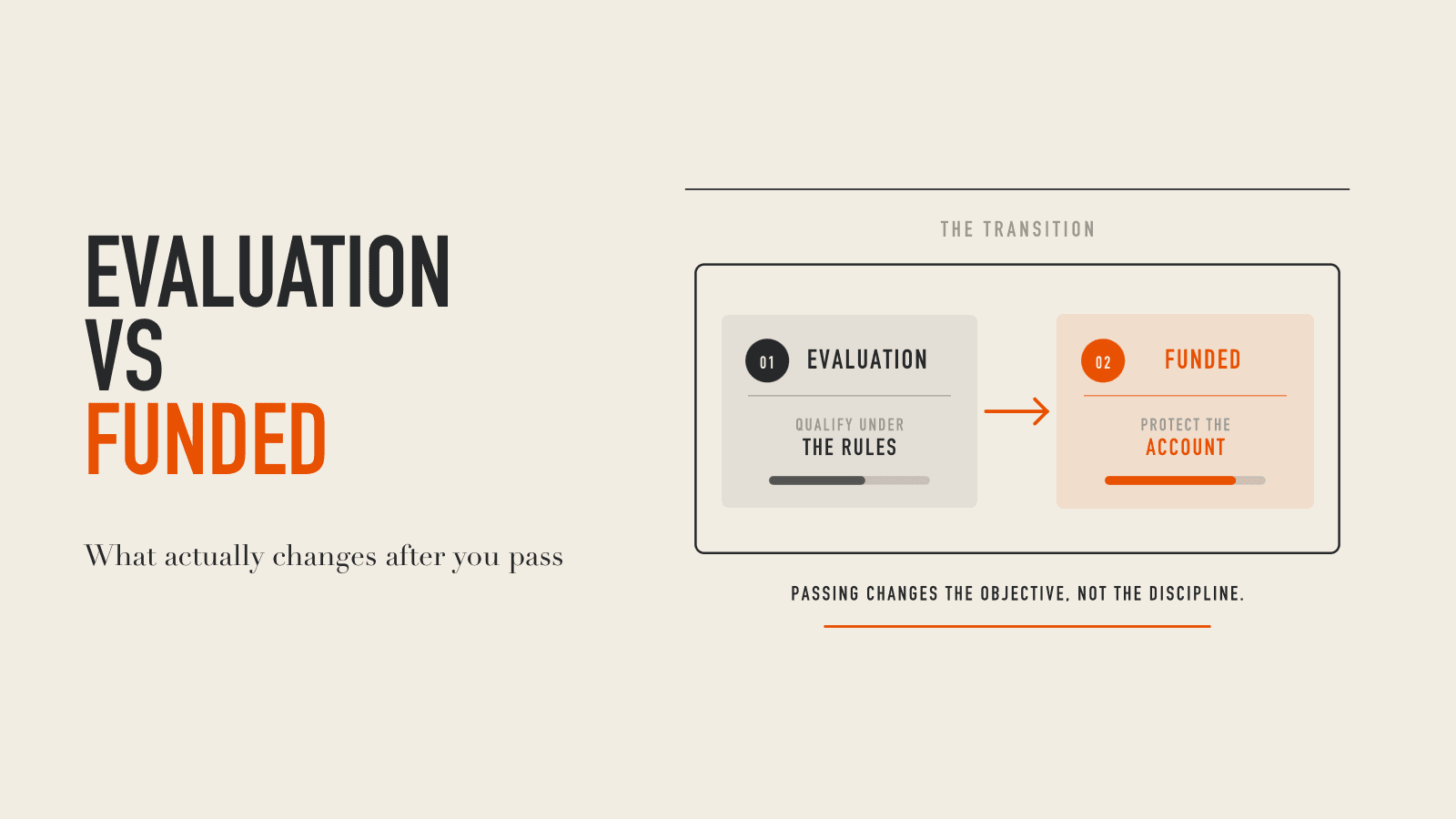
A prop firm evaluation is the qualification stage: you trade under a set of rules to prove you can meet a program's requirements. A funded account is the next stage, where you can generally become eligible for payouts, but you are still trading under rules and can still fail the account. Passing changes the objective. It does not make risk limits disappear.
The distinction matters because “funded” can sound like freedom while “evaluation” sounds like a test. In practice, both demand rule discipline. The exact details vary by firm and program, so the terms for the specific account you are buying or trading are the authority. The useful distinction is simple: an evaluation asks whether you qualify; a funded account asks whether you can keep qualifying behavior while protecting payout eligibility.

What is a prop firm evaluation?
A prop firm evaluation is a performance-based qualification process. You trade a simulated account under a defined rule set. Meet the requirements without breaching a rule, and you move to the program's next stage or funded status, depending on its structure.
The evaluation is not only about finding profitable trades. It tests whether your process can work inside the constraints attached to the account. A trader can have a good directional read and still fail because position size, daily loss, drawdown, trading-day requirements, or a restricted trading practice does not fit the rulebook.
That is why the first thing to check is not the headline account size. It is the actual operating rule set:
- How is maximum loss calculated?
- Is there a daily loss limit, and what does it measure?
- Is drawdown static or trailing?
- Are there minimum trading days or consistency requirements?
- Are there restrictions around news, holding periods, copy trading, or automated strategies?
- What happens after a breach?
For comparisons across providers, use the Proplysis prop firm directory as a starting point, then verify the exact program terms before committing.
What is a funded account?
A funded account is the stage after qualification where the trader may be eligible to receive a share of profits under the program's payout terms. It is still a rule-governed account. The firm may apply ongoing drawdown, daily loss, consistency, activity, payout, or strategy conditions.
The important mental shift is that the job changes from proving you can reach a target to preserving a repeatable process. During an evaluation, traders often focus on getting to the finish line. Once funded, the stronger question is: can I make decisions that protect the account long enough for payouts to matter?
That shift usually means reducing the urge to recover a red day immediately, sizing positions around the loss limit rather than a hoped-for trade, knowing which rules continue after passing, and treating every new funded account as its own rule set.
Trade the evaluation
Work within the program's qualification requirements.
Pass the required stage
Confirm which conditions change and which continue.
Read the funded-stage terms
Check ongoing loss rules, activity requirements, and payout conditions.
Manage the funded account
Use an internal risk plan that stays below hard account limits.
What are the practical differences between an evaluation and a funded account?
| Area | Evaluation | Funded account |
|---|---|---|
| Main objective | Qualify under the program's conditions | Trade within the ongoing rules and work toward payout eligibility |
| Profit target | Often central to passing the stage | May be absent, changed, or secondary to payout conditions depending on the program |
| Risk limits | Must be respected to progress | Usually continue to matter and can still result in account failure |
| Trader mindset | Finish qualification cleanly | Preserve the account and follow a repeatable process |
| What to verify | All qualification conditions | Ongoing rules, payout terms, and any stage-specific changes |
This is a general comparison, not a specific firm's terms. A two-step evaluation, a one-step model, and a direct-funded offering can each define their stages differently. Never assume that a rule carries over unchanged just because its label looks familiar.
Do the rules change after you pass?
Sometimes. But funded does not mean rule-free.
A firm may change the profit target, the drawdown method, payout conditions, or other requirements at the funded stage. It may also keep core risk limits in place. The only safe approach is to read the funded-stage terms separately from the evaluation-stage terms.
There are two mistakes to avoid. The first is assuming that passing removes drawdown pressure. The second is assuming that the evaluation rulebook tells you everything about payouts. Those are separate questions.

Before trading a funded account, write down the loss rules that apply now, how drawdown is calculated, whether there are live progress requirements such as days traded or consistency, the conditions for requesting a payout, and any restrictions that matter to your strategy.
If the answer is only in a long FAQ or program agreement, save it. Do not rely on a screenshot from a Discord group, an old affiliate page, or what applied to a different account type.
Why can a trader pass an evaluation but fail a funded account?
The evaluation rewards controlled progress toward a clear event: passing. A funded account exposes whether that same control holds after the finish line.
The pressure can change quickly. A trader who kept risk small during the evaluation may size up because the account now feels real. Another may take lower-quality setups because they are focused on getting a payout request submitted. Neither behavior is necessarily a strategy problem. It is often a rule-awareness and risk-budget problem.
A funded account should be treated as a business constraint. You have a known set of limits, a strategy with uncertain outcomes, and a need to remain in the game. That calls for a clear buffer zone between ordinary trade risk and the point where a rule becomes dangerous.
For example, if a program has a daily loss rule, do not make the limit your normal daily risk budget. If a drawdown floor exists, do not wait until it is nearly reached before reducing exposure. Exact limits differ by program; the principle does not.
How should your trading plan change once you are funded?
Your setups may not need to change. Your operating rules probably should.
Start by defining a smaller internal stop than the firm's formal limit. This is your own decision point, not a claim about what the firm allows. It gives you room to stop trading, reassess, or reduce size before a single difficult session becomes an account problem.

Plan around account preservation:
- Set a maximum loss for the day that is below the program's hard boundary.
- Decide how many attempts a setup gets before you stop.
- Keep position size consistent enough that one trade cannot undo a week of good decisions.
- Avoid using payout timing as a reason to force trades.
- Review the funded-stage terms whenever you add an account or change programs.
This is also where many traders benefit from separating accounts mentally. One account's rules should not blur into another's. A futures account may express limits differently from a forex or CFD account, and each program can have its own reset timing and reference point. Check the agreement for the account in front of you.
Is a funded account better than an evaluation?
Neither is better in isolation. They are different stages with different jobs.
An evaluation is the route to qualification for many programs. A funded account is where account preservation and payout eligibility become the focus. If you are choosing between firms or programs, compare the full structure rather than only the price of the challenge or the advertised account size.
Consider whether the rules fit your market and holding period, whether the drawdown method makes sense for your style, whether you can meet the program's conditions without forcing trades, whether you understand the funded-stage payout terms, and whether you can monitor the account's standing consistently.
If you are buying a challenge anyway, review current options in the Proplysis deals directory. The right deal is still the one attached to rules you can trade responsibly.
How Proplysis helps you manage the transition
Proplysis gives challenge and funded traders one dashboard for tracking prop-firm rules across their accounts. It watches key risk limits, including daily loss and drawdown, and can warn you before a breach. It also shows your live standing for items such as consistency, trading days, daily loss remaining, and distance to a floor or target when those rules apply to your program.
The point is not to tell you what trade to take or promise that you will pass an evaluation. It is to keep the rule context visible while you trade, so the move from qualification to funded-account management is not a move from one forgotten PDF to another.
Illustrative example, not a specific firm's figures.
FAQ
Is a prop firm evaluation the same as a funded account?
No. An evaluation is a qualification stage, while a funded account is the later stage where ongoing compliance and payout eligibility become relevant. Both can have rules, and the exact terms depend on the program.
Do prop firm rules still apply after you pass the evaluation?
Funded accounts commonly operate under program rules, but the precise rule set can change by stage. Read the funded-account agreement rather than assuming the evaluation terms carry over exactly.
Can you receive payouts during a prop firm evaluation?
Payout eligibility is program-specific and should be checked in the firm's terms. In a typical evaluation structure, the immediate purpose is qualification rather than payout access.
What should I check before trading a funded account?
Confirm the current loss limits, drawdown calculation, payout conditions, minimum activity requirements, and strategy restrictions. Save the funded-stage terms somewhere you can review before and during trading.
Does Proplysis guarantee that I will pass a prop firm challenge?
No. Proplysis helps traders track relevant account rules and standing. It does not execute trades, guarantee funding, or guarantee payouts.
Prop firms on Proplysis
Buy your evaluation through our link
These are the firms we list, in alphabetical order. Buying through our link is what keeps Proplysis free to use - it costs you nothing extra.















Some links are affiliate links. Purchasing through them is how Proplysis stays free.