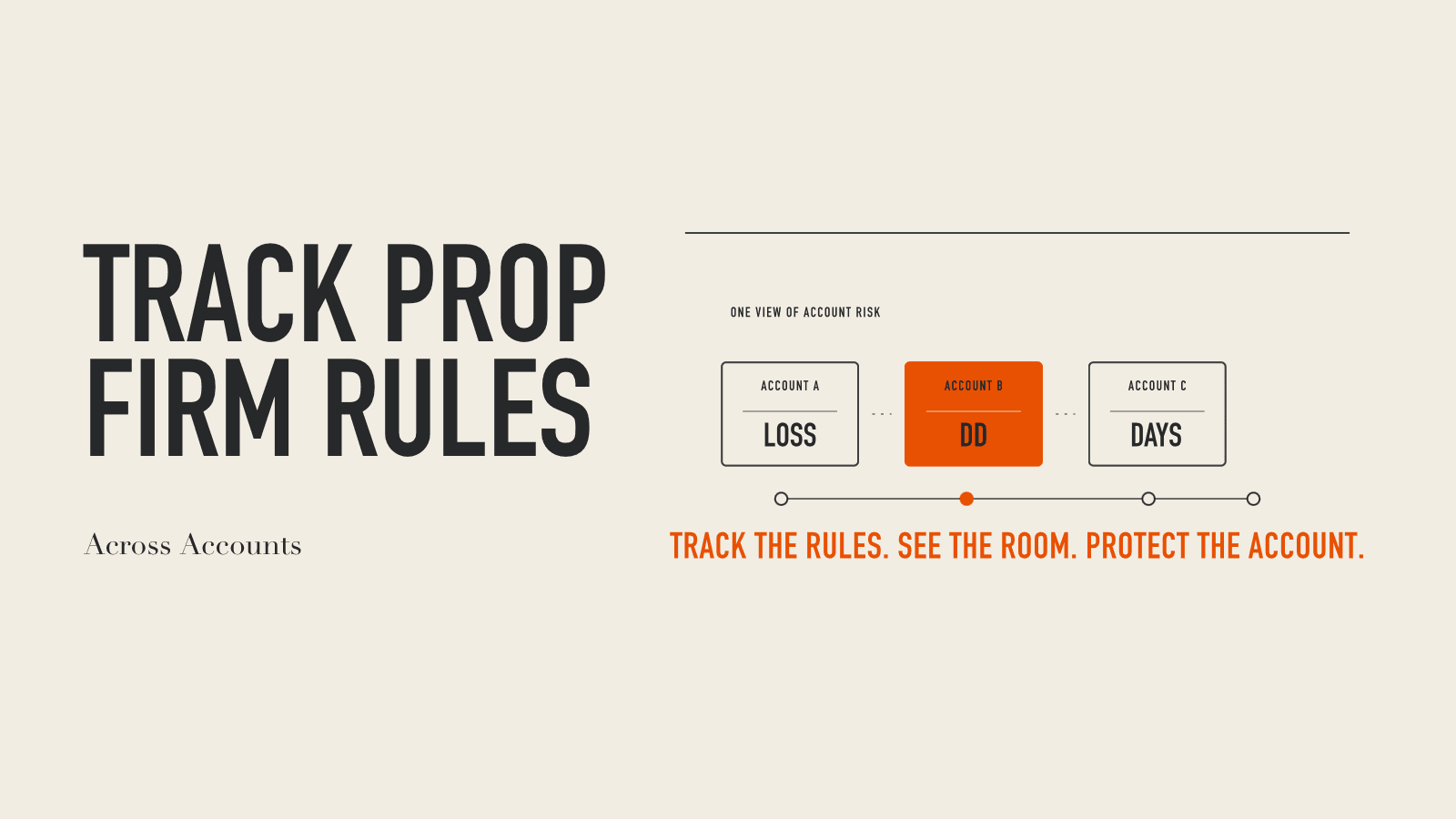
How to Track Prop Firm Rules Across Accounts
To track prop firm rules across accounts, keep every account's daily loss, drawdown, consistency, trading-day, and payout requirements in one place, then check the risk left before the next trade. The important part is not collecting rule PDFs. It is seeing the rules that apply to each live account alongside its current performance.
Several accounts turn a simple rule set into an operational problem. Each account can be at a different stage, use a different drawdown method, reset at a different time, or have a separate consistency condition. A trade that feels normal in one account can put another too close to a breach.

Why do prop firm rules get harder to manage as you add accounts?
One account is manageable with a rulebook, a spreadsheet, and discipline. Multiple accounts introduce different account sizes and stages, daily-loss and drawdown calculations, reset times, minimum trading days, consistency conditions, trading restrictions, balances, open risk, and realized P&L.
The dangerous part is that rule names can sound identical while the calculation behind them is not. A daily loss limit may consider balance, equity, realized P&L, floating P&L, or some combination. A drawdown may trail a high-water mark, remain static, or change at a later account stage.
That is why a generic note such as “daily loss: watch it” is not enough. Record what the limit measures, when it resets, and how much usable room remains now.
What prop firm rules should you track for every account?
Daily loss limit
The daily loss limit is often the most urgent number because it can be breached in a single volatile session. For each account, record what counts toward the limit, whether open P&L matters, the reset time and time zone, and the remaining room before the limit.
Do not rely on your platform clock. A rule can reset according to the firm's server time, which may not match your local time or the market session you trade.
Illustrative example, not a specific firm's figures.
Maximum drawdown

Maximum drawdown tells you how far an account can decline before it fails. The crucial question is not only the threshold. It is how that threshold moves. Write down whether the drawdown is static or trailing, whether it is based on balance or equity, and which reference point moves the floor.
A trailing drawdown can create a false sense of safety after a strong day. You may see more balance, but the floor behind the account may have moved up too. The distance between current equity and failure matters more than the headline drawdown number.
Illustrative example, not a specific firm's figures.
Consistency, trading days, and restrictions
Some programs assess how profit or activity is distributed, not only whether an account reaches a target. Others require qualifying trading days or place restrictions around scheduled news, overnight holding, weekend exposure, permitted instruments, or strategies. Keep a short account-level note for the restrictions most likely to affect your next decision.
You do not need to predict every outcome. You need a visible prompt to check the exact program rule before assuming a profitable account is ready for payout.
Where each rule came from
A rule card is only as reliable as its source. For every limit you write down, record where you read it and the date you last checked it. Firms revise program terms, and a number copied from a forum post, a screenshot, or a comparison site can survive in your notes long after the firm has changed it. A dated source line makes it obvious which accounts are due for a review before your next session, and it keeps a disagreement between two accounts from turning into guesswork.
This matters most when an account changes stage. Evaluation, funded, and later phases can carry different drawdown behavior, different treatment of daily loss, and payout conditions that were not relevant earlier. Treat every stage change as a prompt to re-read the program page rather than an assumption that the previous card still applies.
How do you build a useful rule card for each account?
Create one rule card per account, then update the fields that change as you trade. The card should include the firm and exact program, account stage, current balance and equity, daily-loss status, drawdown status, consistency status, trading-day progress, key restrictions, and a clear next action.

The next-action line matters. A tracker should reduce decision time, not turn a trading session into paperwork. If an account is close to a limit, the card should make that obvious enough that you do not need to calculate it under pressure.
- Trade normally when the account is compatible with the planned risk.
- Reduce size when its remaining room is tighter than the group.
- Pause the account when a limit or rule needs review.
What should you check before placing a trade across accounts?
- Confirm which accounts are eligible for the setup.
- Check remaining daily-loss room for each eligible account.
- Check distance to drawdown, especially where open positions matter.
- Review whether the proposed position size fits the tightest eligible account.
- Confirm there is no program-specific restriction relevant to the session.
- Decide whether to trade all accounts, a smaller subset, or none.
This avoids sizing a trade according to the strongest account and applying it to every account. If one account has materially less room than the others, skip it, reduce size across the group, or stand aside. The mistake is making the choice without seeing the account-specific risk first.

Why should you group accounts by rule compatibility?
Do not treat every account as one pool just because they are all yours. Group accounts by similar daily-risk conditions, drawdown behavior, trading stage, session restrictions, and execution constraints. This makes position sizing cleaner and lets a tighter group sit out without forcing a rushed calculation for every account.
Illustrative example, not a specific firm's figures.
How Proplysis helps you track prop firm rules across accounts
A spreadsheet can hold rule notes, but it depends on manual updates. Checking several firm portals during a live session has the same problem: you are stitching together information while the market is moving.
Proplysis gives you one dashboard for supported platforms that automatically brings multiple prop firms and accounts into one place. You can group, filter, and compare accounts instead of working through them one by one.
For each connected account, Proplysis helps you monitor daily loss, drawdown, consistency, trading days, payout-related conditions, and other account requirements. It calculates the remaining room to a rule limit while also showing the underlying performance metrics, so you can see both the risk position and the reason behind it.
Use the Proplysis analytics dashboard to review more than 30 analytical charts and graphs across your connected accounts. The aim is not to replace judgment. It is to make the current account state visible before a small oversight becomes a rule breach.
How does Proplysis warn you before a rule becomes a breach?
When an account approaches a rule threshold, Proplysis can surface an in-dashboard warning and send notifications through email, push alerts, and Telegram. That gives you a chance to reduce exposure, remove an account from a group trade, or stop for the session and review the exact condition.
Connect supported accounts
Account data is brought into one dashboard automatically for supported platforms.
Review account-level rule status
See daily loss, drawdown, consistency, trading days, payout-related conditions, and underlying metrics.
See remaining room
Use the calculated distance to a rule limit to assess whether an account can take the next trade.
Receive a warning early
Near-limit warnings can appear in the dashboard and through email, push alerts, or Telegram.
Should you still use the firm's rulebook?
Yes. Proplysis is a decision-support tool, not the authority that defines a firm's program rules. The firm's official website, rule page, and program documentation remain the final reference for questions about eligibility, breaches, and payouts.
Use Proplysis to keep the current account state visible and to flag risk across accounts. Then verify any unclear rule, updated term, or payout condition directly with the firm before acting on it. When a dashboard chart needs clarification, check the Proplysis charts FAQ.
If you are purchasing a challenge, you can also review current options on the Proplysis deals page. Confirm the exact program terms directly with the firm before buying.
FAQ
How do I track daily loss limits across multiple prop firm accounts?
Record each account's reset time, calculation basis, current daily P&L, and remaining room separately. Review that information before a group trade because one account may be much closer to its limit than the others.
Can I use the same position size on every prop firm account?
Only if the accounts have compatible risk room and program restrictions. A position size that fits one account may be too aggressive for another with less distance to its daily-loss or drawdown limit.
What is the best way to track trailing drawdown?
Track current equity or balance, the active drawdown floor, and the distance between them. Also record what causes the floor to move, because the behavior of a trailing drawdown matters more than its label.
Why should I track prop firm rules after passing an evaluation?
Rules can change by stage, and payout eligibility may introduce conditions that were not relevant during evaluation. Treat a funded account as a new rule card, not simply a continuation of the old one.
How often should I review the rules I have written down?
Review a card whenever the account changes stage, whenever the firm announces a program change, and on a fixed schedule you keep for every account. A monthly pass is enough for most traders, provided stage changes are handled as they happen. The aim is to catch a stale number before it drives a sizing decision, not to re-read every rulebook each week.
Prop firms on Proplysis
Buy your evaluation through our link
These are the firms we list, in alphabetical order. Buying through our link is what keeps Proplysis free to use - it costs you nothing extra.















Some links are affiliate links. Purchasing through them is how Proplysis stays free.