July 18, 2026
Is Prop Firm Drawdown Measured on Balance or Equity?
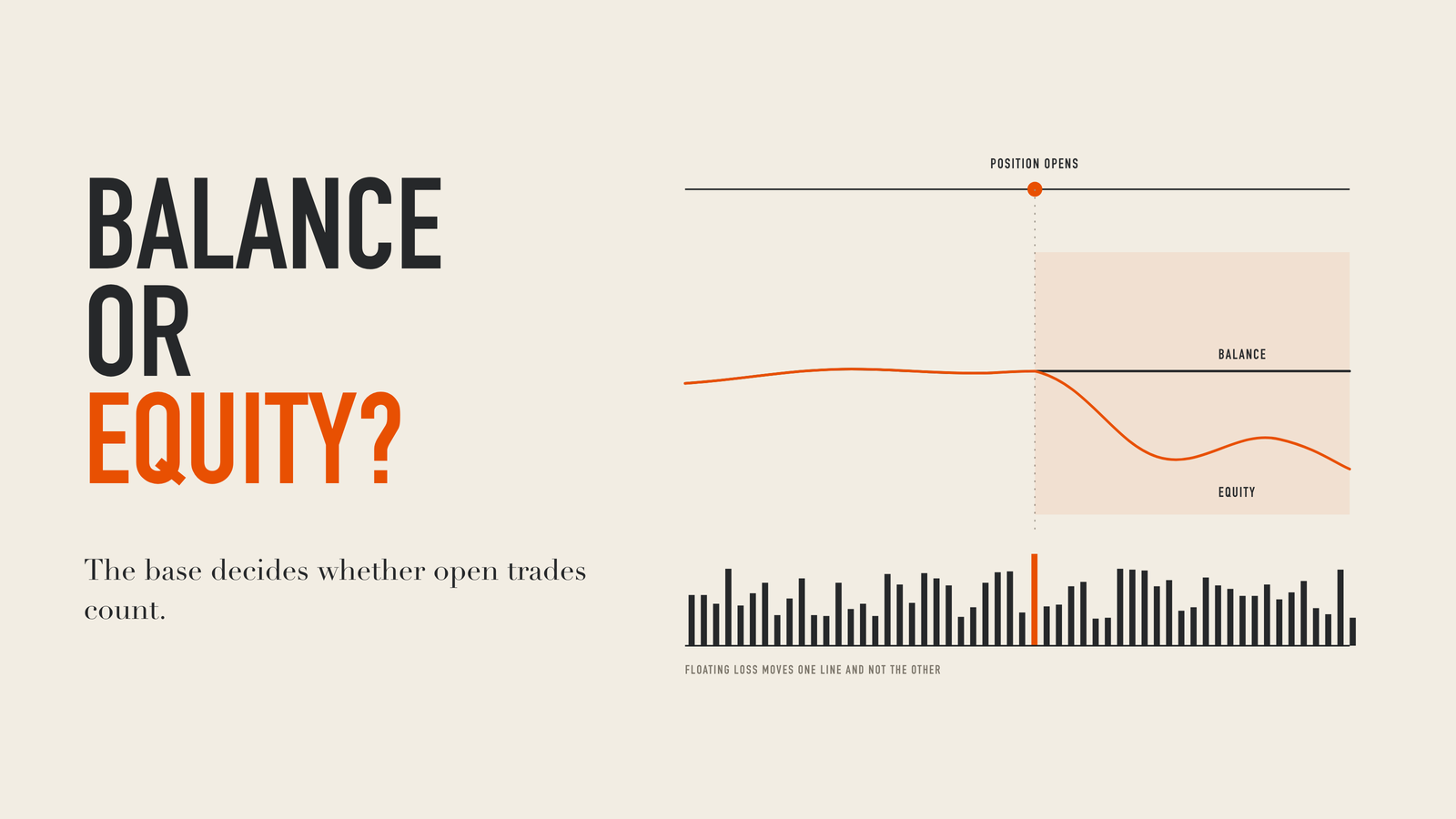
It depends on the program, and the difference matters. A drawdown floor measured on balance only counts closed trades, so an open losing position cannot breach it by itself. One measured on equity counts everything, including floating losses on positions still open. A growing number of programs use the higher of the two, which turns out to be the strictest option of all. Always confirm which base your specific account uses before you assume your open position is safe.
This is also one of the places where firms' own documentation contradicts itself most often, sometimes stating one base for the daily loss limit and a different one for the overall drawdown floor on the same account. Naming the base every time you talk about a limit, not just the percentage, is the only way to avoid confusing two different rules that happen to share a number.
What do "balance" and "equity" actually mean on a trading account?
Balance is the account's value from closed trades alone: every position you have already exited, net of costs. It does not move while a trade is open. Equity is balance plus the unrealized profit or loss of every position still open, so it moves tick by tick with the market. The two are identical the instant you have no open positions and can diverge sharply the moment you do.
| Base | Counts open positions? | Moved by a floating loss? |
|---|---|---|
| Balance | No | No, only once the trade closes |
| Equity | Yes | Yes, immediately, tick by tick |
| Higher of balance or equity | Yes, whichever is greater | Only once the higher figure gives ground |
Why does "higher of both" end up stricter than either alone?
It sounds generous on paper, since the firm is measuring from whichever number is better for you at any given moment. In practice it means the floor tracks your peak equity as well as your peak balance, so an unrealized gain that later evaporates counts as ground given up even though you never booked a loss on a closed trade.
How do balance and equity actually diverge over a stretch of trading?
The two lines below are illustrative, not any specific account. Balance moves only at the end of a trading day when positions close; equity moves throughout the day as the market does.
Illustrative example on a $100,000 account, plotted as change from the start of the week so the divergence is visible. Not a specific firm's figures.
On Tuesday and Thursday, balance stayed flat while equity dipped, because both days involved a position still open at the day's low. An account measured on balance alone would show no stress on those days. An account measured on equity, or on the higher of the two, would show real pressure against the floor on both.
The chart below breaks the same idea down per day: the closed profit or loss versus the floating profit or loss sitting in whatever was still open. This is the gap that a balance-only rule ignores and an equity-based rule does not.
Does the base change how a static or trailing floor moves?
The base and the floor type are two separate decisions a program makes, and they combine rather than cancel out. A static floor sits at a fixed level, usually tied to the initial balance, and never moves regardless of profit. A trailing floor rises as the account's high-water mark rises. Either type can be measured on balance, on equity, or on the higher of the two, so the same "10% trailing drawdown" wording can behave four meaningfully different ways depending on which base it references. Our guide to static versus trailing drawdown covers how the floor itself moves; this article covers what it is measured against.
A trailing floor measured on equity is the most sensitive combination that exists: the floor rises with every tick of unrealized gain, and a floating loss counts against it immediately, before you have closed a single trade to lock anything in.
Do futures and forex programs use the same base convention?
Not automatically, though the same three-way choice, balance, equity, or the higher of both, exists in both markets. Futures accounts more commonly track equity in real time because intraday marks are a core part of how the exchange values a position anyway. Forex and CFD accounts vary more by broker and platform, and it is common to see one program measure its daily loss on balance while measuring its overall drawdown on equity within the same account. Never assume the two rules on one account share a base just because they share a percentage.
Where the same firm's own wording gets inconsistent
The clearest evidence that "balance or equity" is not a settled convention comes from looking at the daily loss limit's stated base across live programs. These four rows are real, named examples for the daily loss limit specifically, not the overall drawdown floor, shown here because they demonstrate exactly how much the base varies even for a single, narrowly defined rule.
| Program (evaluation) | Daily loss limit measured on | Reference point |
|---|---|---|
| FTMO Challenge: 2-Step and 1-Step | Equity | Initial balance |
| FundedNext Stellar 2-Step | Balance | Start-of-day balance |
| FundingPips 2 Step Standard | Higher of balance or equity | Start-of-day |
| Maven Trading 2-Step Challenge | Higher of balance or equity | Start-of-day |
Four live programs, three different bases, on what is nominally the same rule. If the daily loss limit alone varies this much across firms, assuming the overall drawdown floor uses the same base as the daily rule on your own account is a guess, not a fact. Read your specific program's rulebook for the drawdown floor separately from the daily loss limit, even when both documents live on the same page.
What actually happens when the floor is measured on equity and you hold overnight?
An open position does not pause overnight just because you stopped watching it. On an equity-based floor, a gap against you at the next session's open counts the instant equity is recalculated, with no opportunity to react before it happens. This is the scenario the base question is really protecting against: it is not about whether you will eventually close at a loss, it is about whether the account can breach while you are away from the screen.
Confirm the base
Balance only, equity, or the higher of the two, stated in the program's rules.
Confirm the reference point
A fixed initial balance, or a moving high-water mark.
Track the live figure
Balance updates on close; equity updates continuously with the market.
Compare against the floor
The relevant figure is checked against the floor at every valuation.
A breach ends the account
Unlike a daily loss limit, a max drawdown breach is typically not a soft reset.
Why is it worth reading the base before the percentage?
Most comparisons between programs start and stop at the headline number: a 10% drawdown looks tighter than a 12% one, so the smaller figure gets treated as the safer account. That comparison only holds if both programs measure the 10% and the 12% against the same base and the same reference point. A 10% floor measured on equity against a trailing high-water mark can be far more restrictive in practice than a 12% floor measured on balance against a fixed initial deposit, because the equity-based floor reacts to every open position in real time while the balance-based one waits for a trade to close. Reading the base first turns a misleading percentage comparison into an honest one.
This also explains why two traders on nominally identical accounts can describe completely different experiences with the same rule. One trader who closes positions quickly rarely notices whether the floor is measured on balance or equity, because the two figures stay close together for that trading style. A trader who holds positions longer, especially overnight or through a news event, feels the difference immediately, since an equity-based or higher-of-both floor is watching every tick of that open position the entire time it stays open. The rule reads the same on paper; it plays out differently depending on how you actually trade.
How Proplysis helps
Proplysis's compliance engine tracks max drawdown per account against your program's real floor and reference point, and it watches the intraday low as well as the value at each sync, so a dip-and-recover trough is not missed. It warns you as your account approaches the floor, before a breach, rather than only reporting the outcome afterward.
Illustrative example of the alert view. Not a specific account.
Frequently asked questions
Is prop firm drawdown measured on balance or equity?
It depends entirely on the program. Some measure the drawdown floor on balance only, counting closed trades. Some measure it on equity, counting open positions in real time. A growing number use the higher of the two. Confirm your specific program's stated base rather than assuming.
Why is "higher of balance or equity" the strictest option?
Because the reference point can rise with an unrealized gain and then stay there even after that gain disappears. Giving back a floating profit you never locked in still counts as ground lost against the floor, which does not happen under a balance-only rule.
Can an open position breach my max drawdown before I close it?
Yes, if the floor is measured on equity or on the higher of balance and equity. Both include floating losses continuously. A balance-only floor cannot be breached by an open position alone, since it only updates when a trade closes.
Does the daily loss limit use the same base as the overall drawdown floor?
Not necessarily, and this is a common source of confusion. A single account can measure its daily loss limit on balance while measuring its overall drawdown on equity, or the reverse. Check each rule's stated base separately rather than assuming they match.
Does the balance-or-equity question differ between futures and forex accounts?
The same three-way choice exists in both markets. Futures accounts more commonly track equity in real time given how exchange marking works. Forex and CFD accounts vary more by broker, so check the specific platform rather than assuming a market-wide default.
How does a trailing floor interact with the balance-or-equity base?
They are separate settings that combine. A trailing floor measured on equity is the most reactive combination, since the floor itself rises with unrealized gains and falls immediately with floating losses. See our guide to static versus trailing drawdown for how the floor's movement works on its own.
Prop firms on Proplysis
Buy your evaluation through our link
These are the firms we list, in alphabetical order. Buying through our link is what keeps Proplysis free to use - it costs you nothing extra.












Some links are affiliate links. Purchasing through them is how Proplysis stays free.