July 17, 2026
Static vs. Trailing Drawdown: What Prop Traders Need to Know
Static vs. trailing drawdown is really a question about your account's loss floor. A static drawdown floor stays fixed at the level defined by the program. A trailing drawdown floor can move upward as your account reaches qualifying highs, following the method in that program's rules. The difference determines how much room you retain after a profitable trade. It also changes how you should read a balance that looks comfortably profitable.
Do not confuse the rule with a performance statistic. A trader can calculate drawdown as the distance from a past peak to the current balance. A prop firm, however, normally enforces a specific balance or equity floor. The floor is the number that matters when you size a trade: touch it, and the program's stated consequence applies.
What is the difference between static and trailing drawdown?
A static rule begins with a floor and leaves it in place. If an illustrative $50,000 account has a $2,000 maximum-loss allowance, its static floor is $48,000. If the account grows to $53,000, the floor is still $48,000. The account has more room above the floor because profits increased, not because the rule changed.
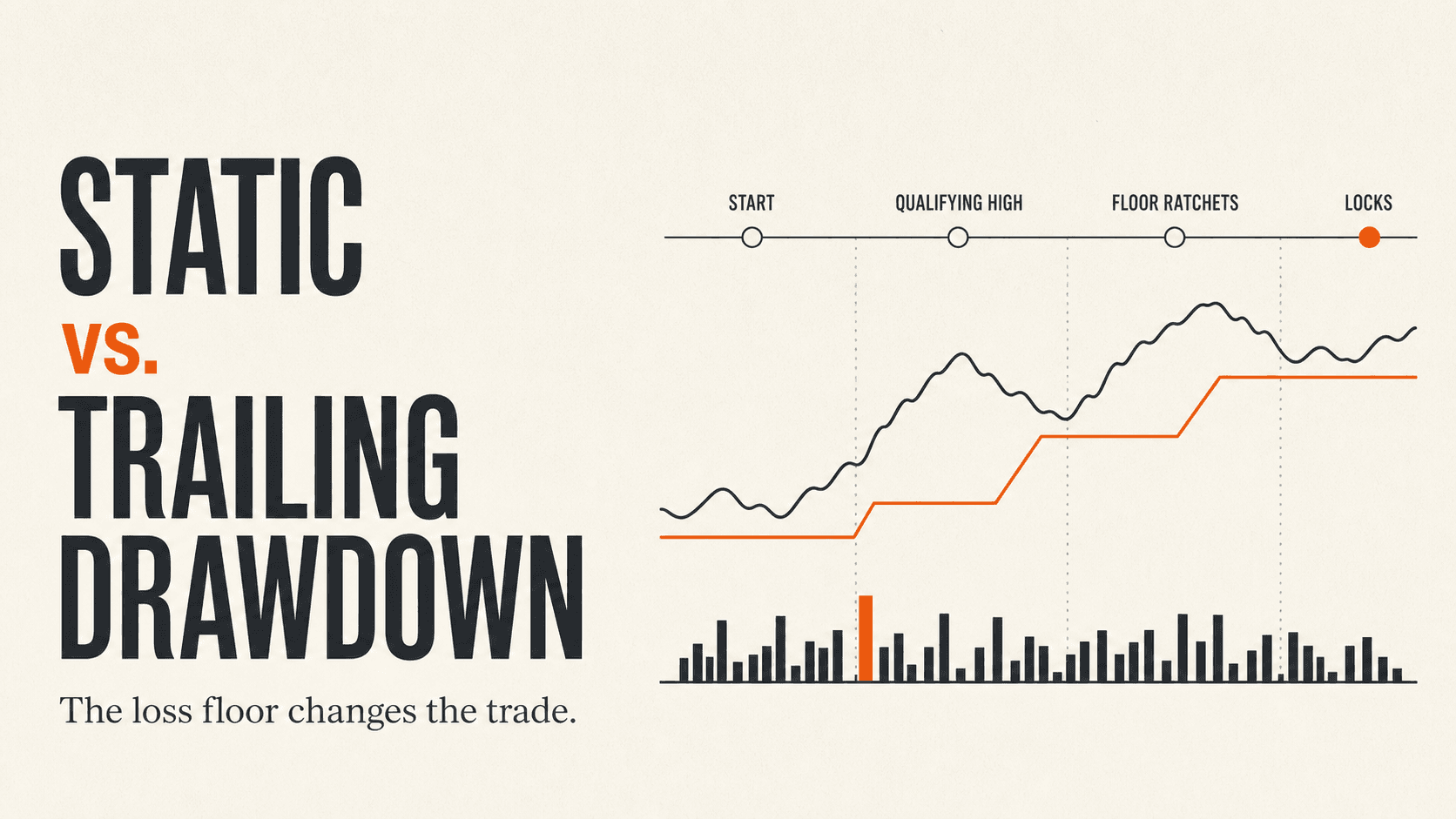
A trailing rule begins with a floor too, but the floor can ratchet higher when the program's qualifying high increases. The firm must define what qualifies: an intraday equity high, a realized balance, an end-of-day close, or something else. It may also define a point where trailing stops and the floor locks. Those details are not interchangeable.
The opening floor is set
The program starts the floor at the level defined by its stated reference and loss allowance. At this point a static rule and a trailing rule look identical.
A qualifying high is recorded
The program decides what counts: an intraday equity high, a realized balance, an end-of-day close, or another named measure. The word "trailing" alone does not tell you which.
The floor ratchets upward
The floor follows the qualifying high. Trailing mechanisms are commonly described as ratcheting up and not moving back down, but that behavior has to be confirmed in the program's own terms.
The floor may lock
Some programs stop trailing at a named level and fix the floor there. Others keep trailing, and some change the calculation after a payout. The rulebook decides, and these details are not interchangeable.
How do you calculate a static drawdown floor?
For a simple static rule, the calculation is straightforward:
Static floor = starting balance minus the stated loss allowance.
Using the illustrative $50,000 account and $2,000 allowance, the floor is $48,000. If balance rises to $51,200, the cushion is $3,200. If balance falls to $49,000, the cushion is $1,000. The floor remains $48,000 at every point.
This is why a static rule can become easier to manage after a sustained run of profits. The risk line is fixed while the balance is higher. It does not mean risk disappears. It means you can calculate the room above the known floor without guessing which prior high the firm will use.
| Account balance | Static floor | Room above the floor |
|---|---|---|
| $50,000 (start) | $48,000 | $2,000 |
| $51,200 | $48,000 | $3,200 |
| $49,000 | $48,000 | $1,000 |
| $52,000 | $48,000 | $4,000 |
How does a trailing drawdown floor move?
With a trailing rule, the account's qualifying high can lift the floor. The mechanism is set by the program. An intraday trailing rule may respond to an equity high while positions are open. An end-of-day trailing rule may use only a qualifying closing balance. A realized-profit rule may wait until profit is closed. The name "trailing" alone does not tell you which method applies.
In the illustrative end-of-day example below, the account starts at $50,000 with a $2,000 allowance. After a $50,800 qualifying close, the floor rises to $48,800. It does not move back down after a lower close. After a later $51,400 qualifying close, it rises again to $49,400. The available room stays close to the stated allowance while the floor is still trailing.
That is the pressure point traders miss. A profitable account can have less flexibility than it appears if the floor has followed it upward. Whether a rule trails forever, locks at a named level, or changes after a payout is program-specific. Read that language before treating open profit as extra risk capacity.
Illustrative $50,000 account with a $2,000 allowance. This example uses qualifying end-of-day highs; actual program mechanics vary.
Does trailing drawdown always use intraday highs?
No. You have to check the actual calculation basis. “Intraday” can mean the firm observes equity including unrealized profit and loss during the session. “End of day” can mean the floor changes after a qualifying close but is monitored through the next session. A rule can also use realized balance, a platform-specific measure, or a separate payout calculation.
A current official example from Topstep distinguishes a static floor from an end-of-day trailing maximum-loss limit, and its standard trailing explanation says the limit rises with end-of-day balance and does not move down. That is one firm's program documentation, not a universal formula. Read the program-specific static versus EOD trailing example and compare it with your own firm's current rulebook.
What does an intraday trailing floor look like?
An intraday rule can tighten the floor during an open trade if the program measures a qualifying equity high in real time. In the illustrative comparison below, one session runs to an open equity high and then closes lower: under an intraday basis that open high lifts the floor, while under an end-of-day basis only the close counts, so the same session leaves different room above the floor. This is why a closed-trade balance alone may not explain the risk line you see later. It is also why you must verify whether a program uses open equity, realized balance, or end-of-day values.
Illustrative $50,000 account with a $2,000 allowance and an opening floor of $48,000. The session runs to a $51,200 open equity high and closes at $50,500. On an intraday basis the open high lifts the floor to $49,200; on an end-of-day basis only the $50,500 close counts and the floor moves to $48,500. Not every program calculates trailing drawdown either way.
Which rule gives you more room after profit?
Under the illustrative examples here, static drawdown creates more cushion after profit because its floor stays put. A trailing floor can keep the available room near the original allowance while it ratchets. That is not a claim that static is always the better program. A trailing rule may have a lock level, a different allowance, a different calculation basis, or other terms that materially change the decision.
The useful comparison is not the label. It is the specific floor you would trade against tomorrow. Ask for the current floor, the event that moves it, whether open equity counts, and whether the floor can lock. Then compare that result with your normal stop size and your worst plausible loss.
Illustrative comparison only. The trailing example assumes the floor continues to trail and has not locked.
What should you verify in a prop firm's drawdown rule?
Read the program rules as if you are checking a contract, not a marketing page. The same firm can use different mechanics across account types, sizes, evaluation stages, funded stages, and promotions. A rule that was correct when you bought an account may also be revised later, so keep a dated copy of the terms that apply to you. Hola Prime Forex is a working example: its 1-Step and 2-Step Prime Challenges use a static floor, while its Direct Account uses an end-of-day trailing one.
First, identify the actual threshold: is it a balance floor, equity floor, daily loss limit, or another risk control? Next, confirm the calculation basis. Then confirm when the value updates and whether unrealized profit and loss count. Finally, look for a lock, a buffer requirement, a payout effect, or a reset rule. Those details decide whether a number on the dashboard is usable trading room or only a headline.
How should you manage static drawdown?
With a static floor, calculate the current cushion before each session: current balance or equity minus the fixed floor, using the measure the program enforces. Keep your planned loss smaller than that cushion by a margin that reflects volatility, slippage, and the possibility that the firm uses intraday equity rather than closed-trade balance.
Profits increase the cushion in a static example, but that is not a reason to increase size automatically. A trader who sees more room may still be one uncontrolled position away from the floor. Treat additional cushion as protection first, then decide whether a different risk limit is justified by the trading plan.
How should you manage trailing drawdown?
With a trailing floor, record the current floor and the next event that can move it. If the rule is end-of-day, distinguish today's intraday cushion from tomorrow's possible floor. If it is intraday, assume an open trade can change the risk picture before you close it. If the rule locks, identify the lock level and the condition that triggers it.
Do not build a plan around a presumed rolling window, a presumed reset, or a rule from another trader's account. If the firm has not stated that exact mechanic for your program, it is unknown. The safest position size is the one that remains survivable under the current stated floor, not the friendliest interpretation of a vague label.
FAQ
Is static drawdown based on the highest account balance?
Not in the usual meaning of a static loss floor. A static floor is fixed by the program's stated reference and allowance. Do not infer the formula from the word “static”; confirm the written rule and whether deposits, payouts, or account changes alter that reference.
Can a trailing drawdown floor move down after a losing day?
It depends on the program's calculation. Many trailing mechanisms are described as ratcheting upward and not moving down, but you should not assume that behavior without the program's current terms. The update basis and any lock rule are essential.
Does a trailing drawdown include unrealized losses?
Some programs enforce their floor on real-time equity, which can include unrealized profit and loss; others use end-of-day or realized measures for part of the calculation. This is one of the first details to verify because it changes whether an open position can cause a breach.
Is a larger drawdown allowance always better?
Not by itself. Compare the allowance with its calculation method, daily-loss rules, payout rules, position limits, and the account's terms. A larger headline allowance can still be restrictive if the floor trails aggressively or another rule constrains the same trading behavior.
What number should I track before taking a trade?
Track the current enforceable floor and your cushion above it, using the same balance or equity measure named in the rulebook. If you cannot state how the floor is calculated for your exact program, pause and verify before sizing the trade.
Bottom line
Static vs. trailing drawdown is not a contest between two labels. It is the difference between a floor that stays fixed and a floor that can follow qualifying performance upward. Get the current terms for your exact program, calculate the live cushion, and size from the floor rather than from a headline account balance.
Prop firms on Proplysis
Buy your evaluation through our link
These are the firms we list, in alphabetical order. Buying through our link is what keeps Proplysis free to use - it costs you nothing extra.















Some links are affiliate links. Purchasing through them is how Proplysis stays free.