July 18, 2026
When Does the Daily Loss Limit Reset?
The daily loss limit resets at the start of the firm's trading day, not yours. Which moment that is depends on what you trade: a futures account usually rolls with the exchange session, and a forex or CFD account usually rolls at the broker's server midnight. Neither is likely to be midnight where you live, and assuming otherwise is how traders breach a limit on what they think is a fresh day.
The clock is only half the rule. The other half is the reference point the limit is measured from once it resets, and that varies too. Get the clock right and the reference wrong and the account still fails. This guide covers both, plus the costs that quietly count against you.
Futures or forex? The rule is built differently
Before anything else, establish which world your account lives in, because the daily loss limit is expressed in different units and reset by different clocks in each. This single split explains most of the confusion traders run into when they compare notes across firms.
Futures accounts generally state the limit as a fixed dollar amount tied to the account size, and the trading day follows the exchange. For CME products the session closes at 5:00pm New York time and reopens an hour later, so "the day" runs from evening to evening rather than midnight to midnight.
Forex and CFD accounts generally state the limit as a percentage of balance or equity, and the day rolls at the broker's server midnight. Retail forex servers commonly run at GMT+2 or GMT+3, which puts that midnight in the late New York afternoon rather than anywhere near your own.
| Futures accounts | Forex / CFD accounts | |
|---|---|---|
| Limit usually expressed as | A fixed dollar amount per account size | A percentage of balance or equity |
| Day usually rolls at | The exchange session close (5:00pm New York for CME products) | The broker's server midnight (often GMT+2 or GMT+3) |
| Typical reference point | Account size, or the trailing drawdown floor | Initial balance, or start-of-day balance |
| Open positions counted? | Commonly yes, on equity | Varies: balance, equity, or the higher of the two |
| Where to confirm it | The firm's rules page plus the exchange calendar | The firm's rules page plus the platform's server clock |
There is a coincidence worth noticing here. A CME session closing at 5:00pm New York and a forex server midnight at GMT+3 land at almost the same instant. Two completely different conventions, arrived at independently, converge on roughly the same moment. That is why so much prop-firm advice sounds interchangeable across markets even when the underlying rules are not.
Whose midnight is it?
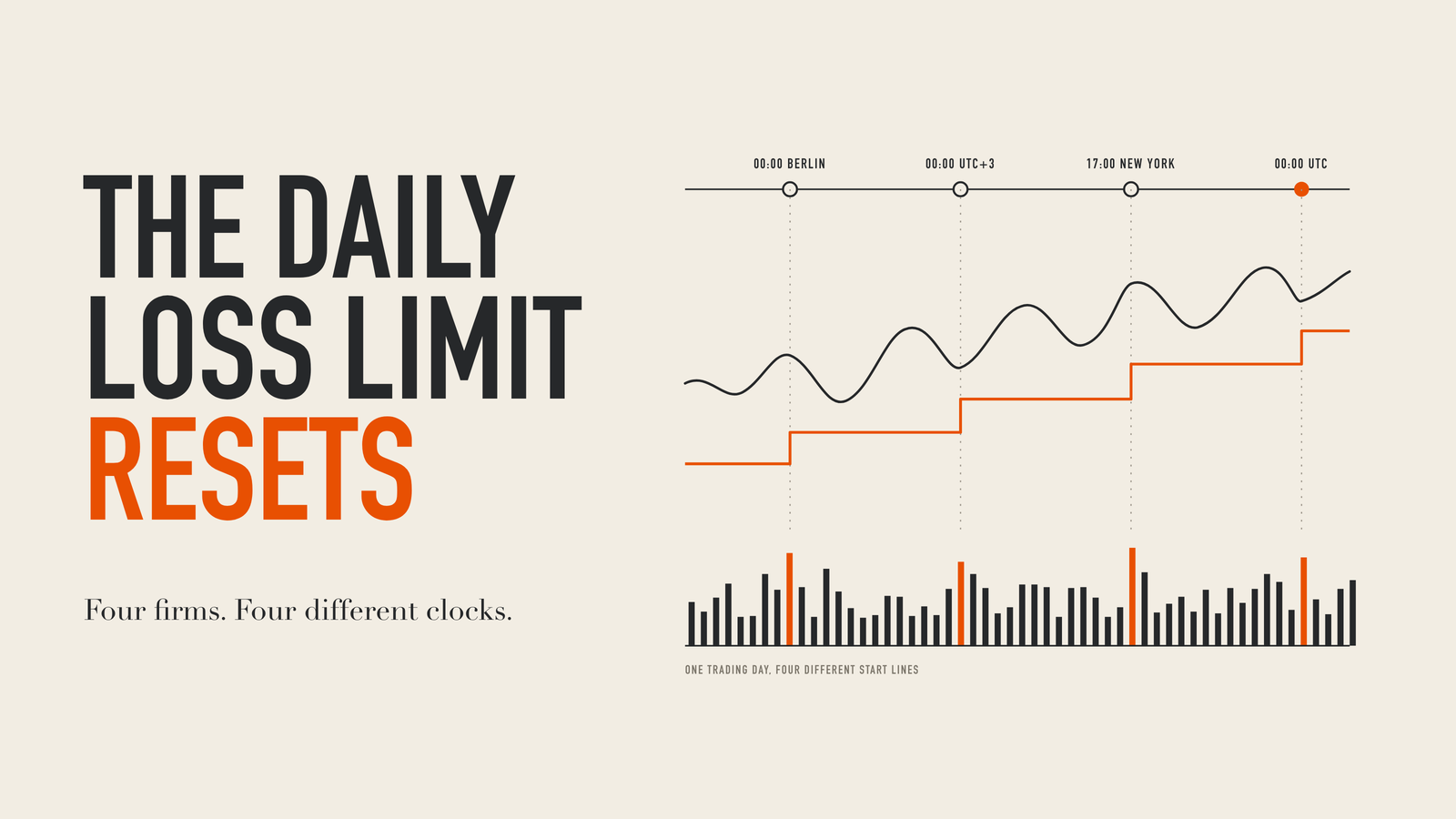
"The limit resets at midnight" tells you a time without telling you a clock, which is not enough information to trade on. Programs that all say 00:00 can still reset hours apart, because each one means midnight somewhere different.
Below are reset clocks taken from real programs in the Proplysis firm database. They are examples, chosen to show how far apart "midnight" can land, not a recommendation or a ranking.
| Example program | Stated daily reset | Limit measured against |
|---|---|---|
| FTMO Challenge: 2-Step (evaluation) | 00:00 Europe/Berlin | Initial balance |
| FundingPips 2 Step Standard (evaluation) | 00:00 platform time (UTC+3) | Start of day, higher of balance or equity |
| Maven Trading 2-Step Challenge (evaluation) | 00:00 UTC | Start of day, higher of balance or equity |
| FundedNext Stellar 2-Step (evaluation) | 17:00 America/New_York | Start-of-day balance |
Three of those four say midnight, and the three land across a roughly three-hour spread. The fourth states 17:00 New York outright, which is the same broker server-midnight convention written in a clearer way: a server running at GMT+3 has its midnight at 5:00pm New York, so the two descriptions point at one moment.
What is the limit measured against?
Once the day rolls over, the firm needs a reference point to measure the day's loss from. Two choices are common, and they behave very differently over a run of days.
A fixed reference, usually the initial balance or the account size. The floor sits in one place for the life of the account. Profit does not move it, so a good week gradually buys you more room before the daily limit becomes relevant.
A start-of-day reference, recalculated each morning from wherever the account stands. The floor moves every day, in both directions. Profit raises it, which is the part almost nobody expects.
A percentage on its own therefore tells you less than it appears to. A 5% limit against a fixed initial balance and a 5% limit against start-of-day are the same number describing two different rules. The figures below are examples from live programs, offered to show the spread rather than to compare firms, since each one measures from a different reference point.
Examples only, from live forex/CFD programs. Each measures from a different reference point, so these are not directly comparable.
Balance, equity, or the higher of the two?
A third variable decides whether your open positions count. A limit measured on balance looks only at closed trades. A limit measured on equity includes the floating profit and loss of anything still open, so an unrealised drawdown can breach the limit before you close a single position. Some programs use the higher of the two figures as the reference, which is stricter than it first sounds.
What counts toward the daily loss?
Traders picture the daily loss as the sum of their losing trades. Most rulebooks define it more broadly: it is the movement of the account against the day's reference point, whatever caused it. Costs count. A session that finishes flat on trade outcomes but paid commission and financing charges is a session the account moved down.
Commission is the obvious one, charged per lot or per contract as you trade. Financing is the one that catches people, because it arrives overnight rather than at the moment you trade, and because many venues triple it on one day of the week to cover the weekend. Hold size through that rollover and three days of financing land against a single day's limit.
$5 / lot
Example: FundingPips 2 Step Standard, forex and metals
$7 / lot
Example: FundingPips Zero, standard accounts
3x swap
Example: FundedNext Stellar 1-Step, forex on Wednesdays
Those three are examples from live programs, not universal rates. The point is structural: your real daily allowance is the stated limit minus the costs you will incur getting there, and on a high-volume day that gap is not small.
What actually happens at the reset
On a start-of-day program the reset does one thing: it takes your current balance and redraws the floor beneath it. That produces the result most traders do not see coming, which is that a profitable day raises tomorrow's floor.
Illustrative example on a $100,000 account with a 5% start-of-day daily loss limit. Not any specific firm's figures.
Follow the two lines. The trader makes $3,000 on day one, so at the reset the floor moves up from $95,000 to $97,850, because 5% is now measured from $103,000. On day two the account falls to $98,000. That is still $2,000 above where the whole thing started, and it is $150 from a daily breach.
On a fixed-reference program those same two days look entirely different. The floor stays at $95,000 and $98,000 is not close to anything. Same trading, same headline percentage, opposite outcome. If you learn one thing about your own program, learn which of these two it uses.
The anatomy of one trading day
The clock rolls
At the program's reset moment: an exchange session close for futures, a server midnight for forex and CFDs.
A reference is captured
Either your start-of-day figure is recorded, or a fixed initial balance or account size is reused.
The floor is drawn
The limit, as a percentage or a dollar amount, is applied to that reference to produce today's hard number.
You are measured against it all day
On balance, equity, or the higher of the two. Equity-based programs count open positions in real time, so a floating loss can breach the limit.
A breach ends the day, or the account
Some programs treat a daily breach as a soft stop and let you resume tomorrow. Others treat it as a failed account. Check which yours is before you find out.
Does the reset time move with daylight saving?
If the reset is pinned to a city, yes. A program resetting at midnight in Berlin or at 5:00pm in New York follows that city's daylight saving changes, so the moment shifts by an hour twice a year relative to UTC. If it is pinned to a fixed offset such as UTC+3, it does not shift, and twice a year it drifts an hour away from any city clock you were using as a proxy.
This is not a technicality. We store these reset clocks as named timezones rather than fixed offsets precisely because a fixed offset turned out to be an hour wrong for roughly five months of the year on one firm's programs. An hour of error at a day boundary moves whole trades from one trading day into the next, and with them, which day's loss they count toward.
If your firm's documentation states a fixed offset with no mention of a seasonal change, treat that as unconfirmed rather than settled, and ask support directly.
Illustrative example. Your real distance depends on your reference point and whether open positions count.
Frequently asked questions
Does the daily loss limit reset at midnight?
Rarely at your midnight. Forex and CFD accounts typically reset at the broker's server midnight, which often sits at GMT+2 or GMT+3 and therefore lands in the New York afternoon. Futures accounts typically follow the exchange session instead, which for CME products closes at 5:00pm New York time. Your own local midnight is the reference only by coincidence.
Is the daily loss limit different for futures and forex?
Usually, in two ways. Futures programs tend to state the limit as a fixed dollar amount tied to the account size, while forex and CFD programs tend to state it as a percentage of balance or equity. They also use different day boundaries: an exchange session close for futures, a server midnight for forex. The concept is the same; the units and the clock are not.
Does a profitable day give me more room tomorrow?
On a start-of-day program it does the opposite: profit raises the floor, because the limit is recalculated from your new, higher balance. On a program measured against a fixed initial balance or account size, profit leaves the floor where it is, which effectively does give you more room.
Do open positions count toward the daily loss limit?
They do when the limit is measured on equity, or on the higher of balance and equity, because both include floating profit and loss. They do not when it is measured on balance alone, which counts only closed trades. This is worth confirming before you hold anything through a reset.
Do commissions and swap count toward the daily loss?
In most rulebooks, yes. The limit tracks the account's movement against its reference point rather than trade outcomes alone, so per-lot commission and overnight financing both count. Watch the weekly triple-swap day in particular, when three days of financing are charged at once.
Is the daily loss limit the same as maximum drawdown?
No. The daily loss limit resets each day. Maximum drawdown does not, and it is measured across the life of the account. Both can end an account and they are calculated from different reference points. Our guide to static versus trailing drawdown covers how the longer-term floor behaves.
Where do I find my own program's reset time?
Check the rulebook attached to your specific program rather than the firm's general marketing pages, since the value can differ between programs at the same firm. If the documentation names a time without a timezone, treat it as unanswered and ask support two questions: which timezone, and whether it shifts with daylight saving.
The practical version
Four questions define your daily loss limit. Is the account futures or forex, which sets the likely units and clock? What time does the day roll over, in which timezone? Is the limit measured from a fixed reference or from start of day? And does it look at balance, equity, or the higher of the two? Two programs advertising the same headline number can behave completely differently once you have those four answers.
Proplysis tracks these values per program across every account you connect, and warns you as you approach the floor rather than after you cross it.
Prop firms on Proplysis
Buy your evaluation through our link
These are the firms we list, in alphabetical order. Buying through our link is what keeps Proplysis free to use - it costs you nothing extra.












Some links are affiliate links. Purchasing through them is how Proplysis stays free.