FTMO Best Day Rule Explained: What It Is and How to Stay Compliant
You hit a great trading day, banked a solid profit, and feel like you're ahead of schedule. Then you check your consistency stat and realize your best day is eating up most of your total profit. Now you can't withdraw until you spread that profit out across more days. That's the Best Day Rule in action.
It doesn't fail your account. It doesn't cost you money. But it can hold your payout hostage until you fix the imbalance, and if you don't understand the math, you can accidentally make it worse while trying to fix it.
This article covers exactly how the rule works on the FTMO Challenge: 1-Step program, when it applies, and how to trade around it without taking unnecessary risk.
What the Best Day Rule Actually Says
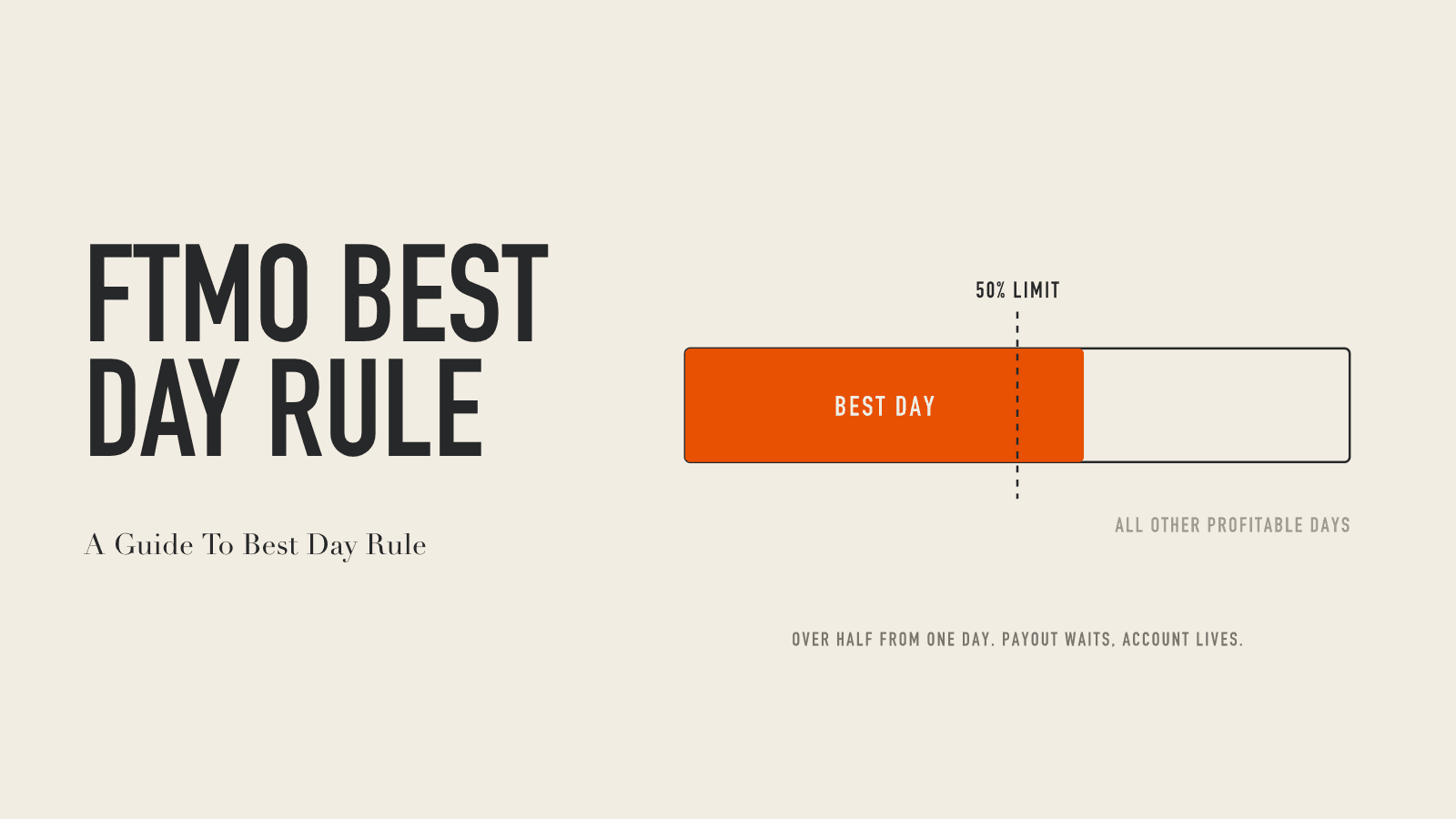
On the FTMO Challenge: 1-Step (both the eval and funded stages), the consistency rule is defined as: your best single trading day's profit must not exceed 50% of the sum of all profitable days' profits.
In plain terms: take every day where you made money, add those profits together, then check whether any single day accounts for more than half of that total. If it does, you're over the limit.
The key word in the rule is soft. Breaching the 50% threshold does not fail your account and does not cost you the challenge. It blocks your payout until you bring the ratio back into compliance by accumulating more profit on other days.
A Concrete Example
Say you've had three profitable days: $600, $200, and $200. Total profitable-day profit: $1,000. Your best day ($600) is 60% of that total. You're over the 50% threshold.
To fix it, you need to add more profitable days until your best day drops to 50% or below. If you add another $200 day, your total becomes $1,200 and your best day is now 50% exactly. That's the boundary. One more profitable day and you're clearly inside the limit.
Notice what doesn't help: adding losing days. Only profitable days count toward the denominator. A losing day adds nothing to the sum of profitable-day profits, so it doesn't move the ratio in your favor.
Working Out How Much More You Need
There's a shortcut for the "how far off am I" question. If your best day is B and the total of all your profitable days is T, you're compliant when B is at or below half of T. Rearranged, T needs to reach at least twice your best day, so the extra profit you still need from future profitable days is simply 2B minus T.
Run it on the earlier numbers. Best day $600, total $1,000. Twice the best day is $1,200, so you need $200 more in profitable-day gains. That matches the worked example above, and the same arithmetic holds at any account size.
The catch is that the target moves if you beat your own record. Add a $700 day to that $1,000 total and your best day becomes $700 against a total of $1,700. You now need $2,400 minus $1,700, or another $700. You closed a bigger day and finished further from the gate than the $200 you needed before you started.
Calculate your current ratio
Divide your best day's profit by the sum of all profitable days' profits. If the result is above 50%, you need more profitable days.
Identify the gap
Work out how much additional profitable-day profit you need so the best day drops to 50% or below. Only profitable days count toward the denominator.
Trade smaller, consistent sessions
Multiple modest profitable days dilute the ratio faster than chasing one large day. A new large day just resets the best-day number higher.
Recheck before stopping
Once you've hit your profit target, verify the consistency condition is also met before requesting a payout or stopping trading.
Which Programs Carry This Rule
Based on verified data, the Best Day Rule (at the 50% threshold) applies to the FTMO Challenge: 1-Step at both the eval and funded stages. The rule is identical across both stages: best day profit must not exceed 50% of total profitable-day profits.
The FTMO Challenge: 2-Step program data provided does not include a consistency rule field, so no claim is made about whether or how consistency applies there. Check the FTMO Challenge: 2-Step terms directly if that's your program.
| Stage | Consistency rule | Threshold | Breach type |
|---|---|---|---|
| FTMO Challenge: 1-Step / eval | Best day ≤ % of total profitable-day profits | 50% | Soft (payout gate, not account breach) |
| FTMO Challenge: 1-Step / funded | Best day ≤ % of total profitable-day profits | 50% | Soft (payout gate, not account breach) |
How the Math Can Trap You
The ratio gets worse in two ways most traders don't anticipate.
Closing out early on good days. If you're up big and you stop trading to protect the gain, you've just locked in a large best-day number. Future days need to catch up to it. There's nothing wrong with protecting profits, but understand the tradeoff.
Losing days after a big win. Suppose your best day is $800 and your only other profitable day is $400. Total: $1,200. Best day is 67%. You then have a $300 losing day. That losing day does nothing to your denominator. You still need more profitable days, not fewer losing ones.
Trying to fix it with one big day. If your best day is already $800, you can't fix the ratio by having another $800 day. That just ties the record. You need multiple smaller profitable days to dilute the percentage, or one very large day that exceeds the current best (which then becomes the new best, and the problem restarts at a higher level).
What Happens If You're Over the Limit at Payout Time
On the FTMO Challenge: 1-Step, exceeding the 50% threshold is not a breach. Your account stays active. You simply cannot request a payout until the condition is met. You keep trading, accumulate more profitable days, and once the ratio drops to 50% or below, the gate opens.
There's no penalty beyond the delay. But if you're running close to your profit target and planning to stop trading, check the consistency stat before you do. Stopping with a payout-blocked account means you'll have to come back and trade more days anyway.
What the Rule Doesn't Restrict
It's worth being precise about what the 50% threshold does not touch, because traders tend to over-correct. It says nothing about how many trades you place, how large your positions are, how long you hold, or how many losing days you have. It is a ratio between one number and a sum, and both are built only from days that finished in profit. A day that ends flat or down is not in the calculation at all.
That makes cutting a strong day short a real tradeoff rather than a free fix. Ending early does pull your best-day figure down, and it pulls the total down with it, so the ratio does improve. But you paid for that improvement with profit you chose not to take, and one ordinary profitable day later gets you to the same place without giving anything up.
Tracking It Without Doing the Math Manually
The ratio changes every time you close a profitable day. Doing this in a spreadsheet is fine but easy to lose track of, especially across multiple accounts or programs.
Proplysis pulls your trade data from connected accounts and shows rule standing in one place, including consistency metrics where the data exists. If you're running the FTMO Challenge: 1-Step alongside other programs, you can see where each account stands without switching between platforms. Connect via cTrader, TradeLocker, DXtrade, or other supported platforms, or import via CSV if your broker isn't on the direct-sync list.
See the prop-firm income calculator if you want to model how payout splits translate to actual income across different account sizes. For a full overview of FTMO's programs and current pricing, the FTMO firm profile has the details.
Practical Approach to Staying Compliant
You don't need to cap your best days artificially. The rule rewards consistency over time, not small days specifically. A few habits help:
- Check your best-day ratio at the end of each profitable day, not just when you're near the profit target.
- If one day is already dominant, plan for multiple smaller profitable sessions rather than trying to offset it with one more large day.
- Losing days don't help the ratio. Focus on adding profitable days, even small ones.
- Don't stop trading just because you've hit your profit target number. If the consistency condition isn't met, you're not done yet.
FAQ
Does the Best Day Rule apply during the FTMO Challenge: 1-Step eval or only on the funded account?
It applies at both stages. The FTMO Challenge: 1-Step carries the 50% Best Day Rule during the eval and again on the funded account. The rule definition is the same at both stages.
Can I fail my account by breaching the 50% threshold?
No. On the FTMO Challenge: 1-Step, the Best Day Rule is explicitly a soft rule. Exceeding 50% does not breach your account. It blocks payout until you bring the ratio back into compliance.
Do losing days help bring the ratio down?
No. The denominator is the sum of profitable days' profits only. Losing days don't appear in that calculation. Only additional profitable days move the ratio.
What if I stop trading once I hit the profit target but the consistency condition isn't met?
You'll need to resume trading and add more profitable days before a payout is possible. The profit target and the consistency condition are separate gates; both need to be satisfied.
Does the Best Day Rule apply to the FTMO Challenge: 2-Step?
The verified data provided for this article does not include a consistency rule for the FTMO Challenge: 2-Step. Check FTMO's official terms for that program directly rather than assuming it matches the 1-Step.
If you're buying an FTMO challenge anyway, buying through Proplysis's FTMO link gives you access to the free dashboard at no extra cost.
Prop firms on Proplysis
Buy your evaluation through our link
These are the firms we list, in alphabetical order. Buying through our link is what keeps Proplysis free to use - it costs you nothing extra.















Some links are affiliate links. Purchasing through them is how Proplysis stays free.