July 17, 2026
How Do Prop Firm Payouts Work? A Trader's Plain-English Guide
How do prop firm payouts work? In plain terms: you make eligible trading profits, meet the firm's current payout conditions, submit a request, and the firm reviews it before sending your share through its available payment method. The important part is that a positive account balance is not automatically the same thing as money you can withdraw.
A prop firm gives a trader access to a trading program under its own rules, rather than simply acting as a broker for the trader's personal capital. For a broader definition of proprietary trading, see Investopedia's overview of proprietary trading. In the retail prop-firm world, payout terms are set by each program's rulebook, so read the specific terms that apply to your account before you count a trade as withdrawable income.
Illustrative example - this is not a specific firm's eligibility formula or figures.
What has to happen before you can request a payout?
Most payout processes have the same basic shape, even though the details vary widely by firm and program. First, you need a program that permits payouts. Some traders reach this stage after completing an evaluation or challenge; others trade under a different account structure. The label is less important than the written terms attached to that account.
Next, your profit must be eligible. A firm may assess more than the headline balance. It may look at whether the account remains within its risk limits, whether required trading activity has occurred, whether trades are still open, whether recent deposits or credits affect the calculation, and whether there are any compliance issues under its agreement.
Then you request the payout in the firm's portal or through its stated process. The request is generally reviewed before payment is issued. A request can be accepted, adjusted, delayed, or rejected according to the account's terms and the firm's review process.
The clean mental model is this: your trading performance creates a potential payout; the rulebook determines whether that potential has become payable. Keep those two things separate when you plan your trading week.
Illustrative example - profit splits vary by firm and program.
Is all of the profit yours?
Usually, no. A payout is commonly based on a profit split: one portion goes to the trader and one portion remains with the firm. The split may change by program, account stage, payout history, promotions, or other terms. Do not assume a percentage from a firm's homepage applies to the account you actually hold.
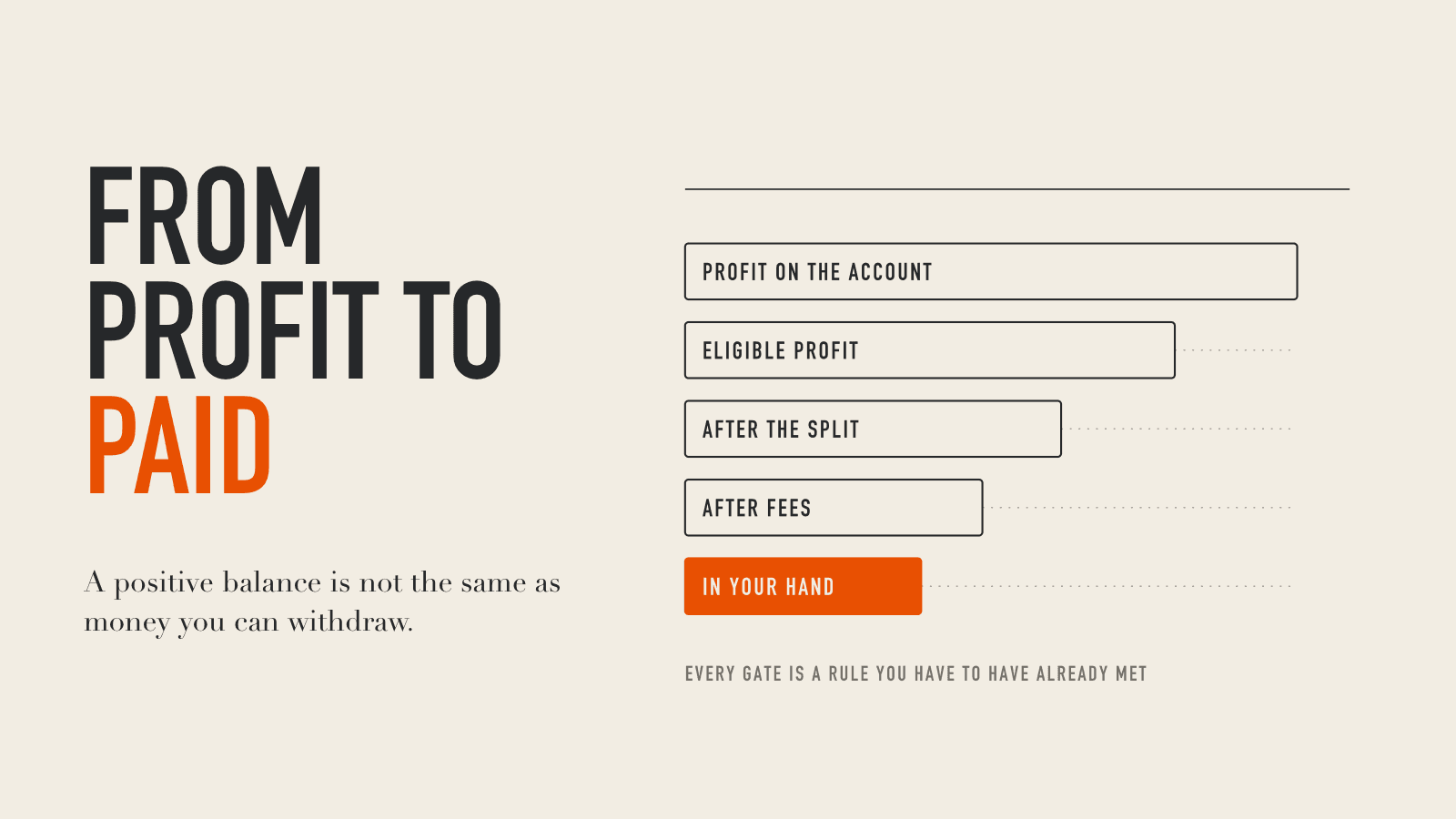
The figure that matters is not just the advertised split. It is the final amount that can be withdrawn after the firm applies the account's written terms. Those terms may address fees, refunds, platform costs, data charges, payment-provider charges, taxes, prior payouts, adjustments, or a reserve that must remain in the account.
Here is a simple illustrative example. Suppose an account has generated a hypothetical $2,000 of eligible profit and the applicable trader share is 80%. The trader portion would be $1,600 before any other applicable charges or adjustments. That is arithmetic, not a prediction of what any firm will pay.
- Gross profit: what your trading record shows.
- Eligible profit: the amount the program treats as available under its rules.
- Trader share: the eligible profit multiplied by the applicable split.
- Net payout: the amount actually sent after applicable adjustments and payment costs.
Keep this calculation separate from the portal's balance. It makes a difference between a payout that was calculated incorrectly and a payout that was correctly reduced by a disclosed cost.
Why can a profitable account still be ineligible for a payout?
Because payout eligibility is usually a compliance question as well as a profit question. A trader can be profitable and still have an account that needs further review. The most common reason is simple: the account must remain within the program's risk framework. A payout does not erase prior trading activity or make a breached rule disappear.
Other issues can come from the timing of the request. A firm may have a request window, a minimum account age, a minimum number of trading days, a waiting period after a previous payout, or a rule about closed positions. Those are program-specific conditions, not universal prop-firm rules.
The same applies to trading-behavior reviews. Firms may have terms covering prohibited strategies, account-sharing, identity verification, automation, market conditions, or activity they consider inconsistent with their agreement. The only safe source is the current agreement for your program. If the wording is vague, get clarification in writing before you place a trade designed around an assumed exception.

What does a payout review look for?
A review is the part many traders underestimate. The exact review process is not public or identical across firms, but the practical question is usually whether the request matches a valid account, eligible profits, and the program's terms.
Expect the firm to confirm basic account information and payment details. It may also check trading records, open positions, prior payouts, the requested amount, and any conditions that apply to your program. If the firm needs documents or a payment-profile update, respond with the exact information requested and keep a copy of what you provide.
Do not treat a payout request as a final scorecard on your trading. It is an operational process. The best way to make it boring is to keep your records boring: use accurate account details, preserve your trade history, avoid guessing at rules, and make requests only after checking the current terms.
Illustrative example - not a specific firm's figures or drawdown calculation.
Do you need to leave money in the account after a payout?
Sometimes. This depends entirely on the program's drawdown, balance, and payout rules. The practical risk is that withdrawing profit can leave less room between your account balance and an enforceable loss limit. If the program's loss calculations continue after payout, a withdrawal may change how much room you have for normal trading losses.
If the program has a buffer or reserve concept, you need to understand whether it is a requirement, a recommendation, or both. Do the math with the actual rule language in front of you. Do not assume that profit above the starting balance is safe to withdraw. That may be true in one program and wrong in another.
For a concrete version of all of this at one firm, our breakdown of the Bulenox payout rules walks through how a published reserve, a per-request cap and a consistency gate interact across six programs at the same brand.
Before requesting money, ask:
- What balance or equity figure does the firm use after a payout?
- Are loss limits static, trailing, or calculated in another way?
- Does the firm require a minimum balance, buffer, or retained profit?
- Are there any changes to account status after a payout?
- Will the next trading day begin with different risk room?
A payout can be good news and still require a smaller position size afterward. Plan for that before you submit the request, not after the account is back live.
Illustrative example - stages and timing vary by firm and program.
How long do prop firm payouts take?
There is no reliable universal timeline. The request date, review process, payment method, bank or payment-provider processing, weekends, holidays, identity checks, and the firm's own operations can all affect delivery.
The most useful date is the date and time recorded in the payout request itself. Save the request confirmation, the stated status, the amount requested, and the payment reference once available. If the stated processing period passes, contact support with those details instead of sending a vague message.
A delay is not automatically a denial. But neither should you assume a request is approved until the firm confirms it. Treat pending money as pending money.
What fees or taxes can affect a prop firm payout?
Fees and taxes are where a neat headline number can become a smaller bank deposit. A firm may charge or pass through certain costs under its terms. Payment providers and banks can also charge transfer, conversion, or receiving fees. These costs may be visible before you submit a request, shown in the transaction history, or appear only when the money reaches your payment method.
Tax treatment is personal and jurisdiction-dependent. A prop-firm payout is not automatically tax-free because it is called a payout. Keep a record of the gross amount, all deductions, payment date, currency, and any statement or invoice. If you trade seriously, bring those records to a qualified tax professional in your jurisdiction.
The right question is not whether you will pay tax. It is what records you need so you can report the income correctly. That is a far more useful place to start.
How can you avoid payout surprises?
Build a payout checklist before your first profitable month, not after it. Read the current program terms and save a dated copy. Confirm how the firm defines eligible profit, whether payouts have a schedule or window, what balance remains after a withdrawal, and what payment methods it supports. Verify your profile and payment information early.
Keep a separate journal of requests, approvals, amounts received, and deductions. Most importantly, do not trade up to a limit just because you plan to withdraw soon. A payout request is not a force field around the account. Your risk rules still matter until the firm confirms the request and your account's post-payout conditions are clear.
If the rulebook gives you a choice between a fast withdrawal and preserving more trading room, calculate both outcomes. The best payout is one that does not make your next week of trading needlessly fragile.
FAQ
How much profit can you withdraw from a prop firm?
It depends on the specific program's payout rules. The withdrawable amount may differ from the account's displayed profit because the firm can define eligible profit, limits, reserves, profit splits, and request conditions differently. Check the current terms for your exact program before submitting a request.
Do prop firms pay you the same day?
Some programs may process requests quickly, but there is no universal same-day payout rule. Review time, payment method, verification, weekends, and provider processing can all affect when funds arrive. Wait for the firm's confirmation before treating the payment as complete.
Can a prop firm deny a payout after you made profit?
A firm can review whether the request meets its program terms. Profit alone may not settle questions about eligibility, risk limits, account status, payment details, or compliance with the agreement. That is why reading the terms before trading is part of payout planning, not paperwork.
What happens to my account after a prop firm payout?
That depends on the program's post-payout rules. The account balance, available risk room, account status, or future eligibility may be affected differently across programs. Confirm the exact post-payout calculation before you resume normal position sizing.
Should I withdraw every available dollar?
Not automatically. A withdrawal can reduce the room available for future losses if the program's rules continue to apply to the account after payment. Compare the cash you would receive with the risk room you would retain, then choose deliberately.
Prop firms on Proplysis
Buy your evaluation through our link
These are the firms we list, in alphabetical order. Buying through our link is what keeps Proplysis free to use - it costs you nothing extra.















Some links are affiliate links. Purchasing through them is how Proplysis stays free.