July 18, 2026
Do Prop Firms Allow Copy Trading?
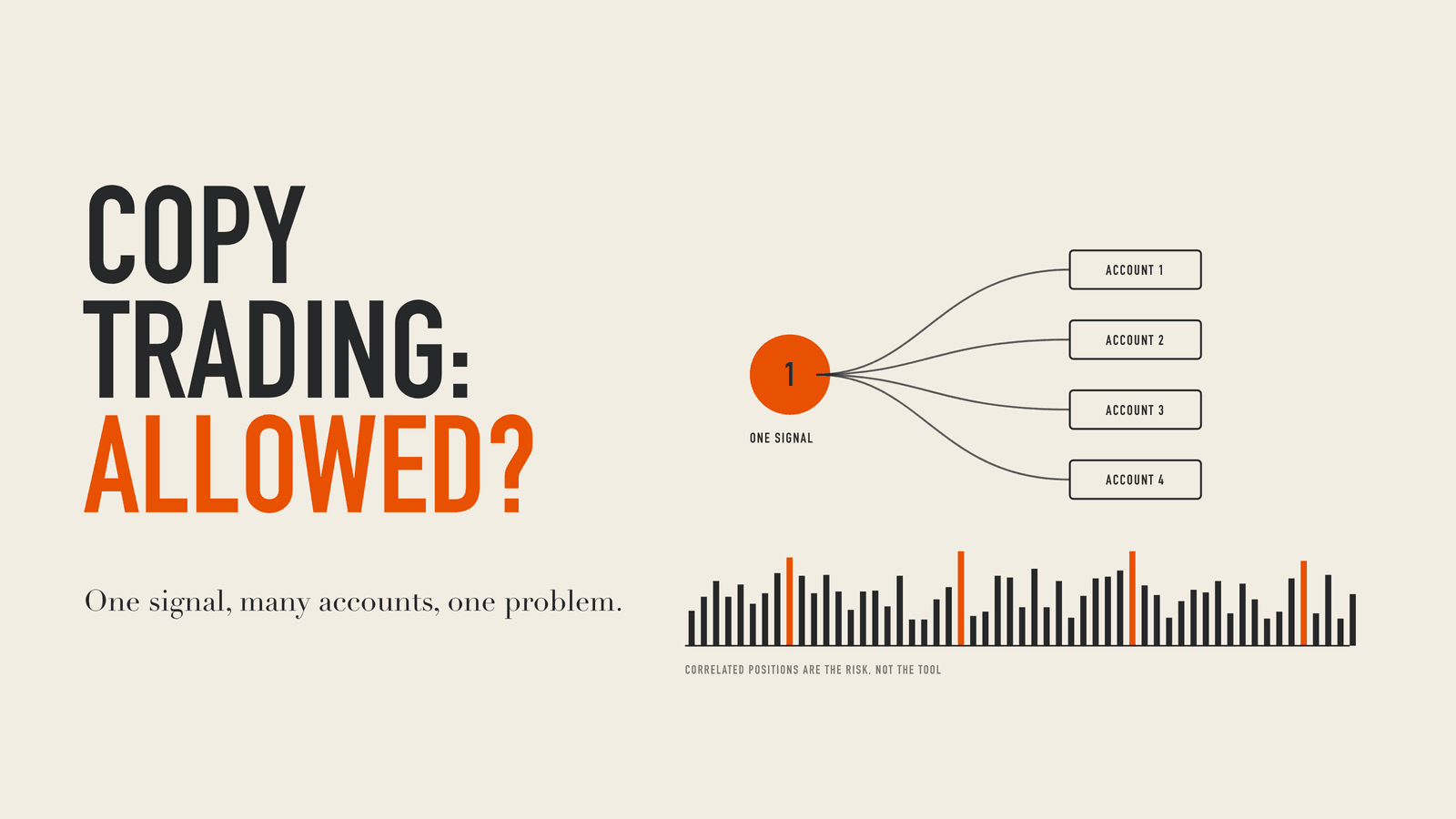
Some prop firm programs allow copy trading and some don't, and among the verified examples in this article restriction is the more common answer, not permission. The rule sits at the program level, so the honest way to answer "do prop firms allow copy trading" is to look up your specific program rather than assume a blanket industry answer either way.
Copy trading also gets confused with running an Expert Advisor, and the two are governed by separate rules that do not always move together. A program that bans one does not automatically ban the other. This guide covers what copy trading means in a prop firm context, which example programs allow it, and where it overlaps with, and diverges from, the rules around automated trading.
What does "copy trading" mean on a prop firm account?
In this context, copy trading means a third party's trades are replicated onto your account, automatically and without your individual decision on each entry, whether through a signal service, a MAM or PAMM style arrangement, or software that mirrors another account's orders. It is distinct from you manually watching someone else's analysis and placing your own trades based on it, which is simply discretionary trading informed by a source, not copy trading in the rule sense.
| Example program | Copy trading |
|---|---|
| FTMO Challenge: 2-Step | Allowed |
| FTMO Challenge: 1-Step | Allowed |
| FundedNext Stellar 2-Step / 1-Step / Lite | Not allowed |
| FundingPips 2 Step Standard (evaluation) | Not allowed |
| FundingPips Zero (funded) | Not allowed |
| Maven Trading 2-Step Challenge (evaluation) | Not allowed |
| Earn2Trade Trader Career Path® / The Gauntlet Mini™ (futures) | Not allowed |
Which prop firm programs allow copy trading?
Among the example programs verified for this article, FTMO's Challenge programs, both 2-Step and 1-Step, are the ones that permit copy trading. Every other program listed here, across both forex/CFD and futures, does not. That is not a statement about FTMO's other programs or about any firm not named here, and it is not a ranking. It is simply what the named programs state.
Count among the 7 example programs named in this article, not a market-wide statistic.
Allowed
FTMO Challenge: 2-Step, copy trading
Allowed
FTMO Challenge: 1-Step, copy trading
Is copy trading the same as using an Expert Advisor?
No, and it is worth separating them because the two rules do not always match on the same program. An Expert Advisor, or EA, is automated logic you run on your own account: you supply the strategy, the software executes it. Copy trading replicates someone else's trades onto your account regardless of whose logic produced them. A program can allow one while banning the other.
Maven Trading's 2-Step Challenge is a direct example: it does not allow copy trading, and it separately does not allow EAs either, so on that specific program the two restrictions happen to align. FTMO's Challenge programs sit at the opposite end: both copy trading and EAs are allowed. That agreement in both directions on these two programs is not a rule that copy trading and EA permission always travel together, it is a fact about these two specific programs.
Why do so many programs restrict copy trading?
The verified facts behind this article do not include a stated reason from any firm, so this section stays general rather than attributing a motive to any named program. The structural concern most often discussed in the industry is that copy trading can produce identical, or near-identical, trading patterns across multiple accounts from a single source, which cuts against the idea that each funded account reflects one trader's independent decision-making. Whether that is the reason behind any specific program's rule is not something this article can confirm.
Entry and exit timing across accounts
Trades opened and closed at matching or near-matching moments, across accounts that should be independent.
Position sizing patterns
Proportional lot sizes that scale with account size rather than an individual trader's own risk decisions.
Source signals
Whether trades trace back to a third-party signal provider, MAM/PAMM structure, or mirrored account.
None of this is a claim about how any named program in this article enforces its rule. It describes the general shape of the concept, not a specific firm's detection process.
Does the rule differ between futures and forex programs?
Among the verified examples, no clean split by market shows up. FundingPips's 2 Step Standard and Zero programs, both forex/CFD, restrict copy trading. Earn2Trade's Trader Career Path® and The Gauntlet Mini™ programs, both futures, also restrict it. FTMO's Challenge programs, forex/CFD, allow it. The pattern in these examples tracks the program, not the asset class, and it would be inventing a distinction to claim otherwise from this data.
| Example program | Asset class | Copy trading | Expert Advisors |
|---|---|---|---|
| FTMO Challenge: 2-Step | Forex / CFD | Allowed | Allowed |
| Maven Trading 2-Step Challenge | Forex / CFD | Not allowed | Not allowed |
| Earn2Trade Trader Career Path® / The Gauntlet Mini™ | Futures | Not allowed | Not allowed |
Three programs is not a survey. Treat the rows above as worked examples of how the field gets written, not as a shortlist, and read your own program's terms before you connect anything. Where a firm has published no copy trading rule at all, that silence is not permission.
Does the rule change once you're funded rather than in evaluation?
It can, though the clearest example available here is within a single program rather than between an evaluation and its funded continuation. FundingPips's 2 Step Standard, an evaluation program, and FundingPips Zero, a funded program, both restrict copy trading, so in this case the answer stays consistent across the two. That consistency is specific to these two named FundingPips programs and should not be read as a general rule that evaluation and funded stages always agree. Always check the funded-stage rulebook separately rather than assuming it mirrors the evaluation you passed.
What should you do before connecting a copy trading tool?
Read the specific program's rule first, not a summary of it from a forum or a signal seller's marketing page. Signal providers and copier software have an obvious incentive to describe their product as compliant everywhere, and that description is not the same thing as your program's own rulebook. If the rulebook does not clearly define copy trading, treat the gap as unanswered rather than as permission, and ask support directly before you connect anything to a live account.
It also helps to separate the account-level question from the strategy-level question. Whether copy trading is allowed at all is one answer from the rulebook. Whether a specific tool crosses into other restricted territory, an EA it runs internally, a prohibited martingale-style sizing method, a scalping restriction on very short holds, is a separate check against the rest of the program's rules. A tool can clear the copy trading question and still fail on one of these others, so checking one rule is not the same as clearing the account.
Copy trading
Whether trades may be replicated from a third-party source onto your account.
Expert Advisors
Whether automated logic you supply may execute trades on your account.
Prohibited strategies
Whether the sizing or entry method itself, such as martingale-style scaling, is restricted.
How Proplysis helps with copy trading rules
Copy trading permission is not something the compliance engine monitors or flags for you. Proplysis does not watch your trade pattern for copy trading signatures. What it does is display the rule for your program directly on your dashboard, allowed or not allowed, next to the account it applies to, so you are checking one screen instead of re-reading a program rulebook to answer a question you already answered once.
| Program | Copy trading |
|---|---|
| Account A | Allowed |
| Account B | Not allowed |
Frequently asked questions
Do most prop firms allow copy trading?
Among the example programs verified for this article, no. FTMO's 2-Step and 1-Step Challenges allow it; FundedNext's Stellar programs, FundingPips's 2 Step Standard and Zero, Maven Trading's 2-Step Challenge, and Earn2Trade's futures programs do not. Restriction is the more common answer in this sample, though it is not universal.
Is copy trading the same rule as using an Expert Advisor?
No, they are separate rules. An EA is your own automated logic running on your account; copy trading replicates a third party's trades onto it. A program can permit one and restrict the other, so check both rules individually rather than assuming they match.
Can I use a signal provider without technically "copy trading"?
That depends on how your program defines the term, which this article cannot state for any program not named here. Manually reading a signal and placing your own trade is generally discretionary trading, not copy trading in the rule sense, but an automated mirror of that signal onto your account is the behavior the rule is usually aimed at. Confirm the specific wording in your own rulebook.
Does copy trading permission change once I'm funded?
It can differ by program, and a funded account is not guaranteed to carry the same rule as the evaluation that unlocked it, particularly if the funded stage is a differently named program at the same firm. Reread the funded-stage rulebook rather than assuming it matches.
Is copy trading treated differently for futures accounts than forex accounts?
Not in a clean, market-wide way among the verified examples here. Both a forex/CFD program and a futures program in this article restrict copy trading, and a separate forex/CFD program allows it, so the pattern tracks the individual program rather than the asset class.
Where do I check my own program's copy trading rule?
In the rulebook attached to your specific program, since the answer can differ between programs at the same firm, as shown above. If the rulebook does not define what counts as copy trading versus a signal service or a shared strategy, ask support directly before connecting any third-party mirroring tool to a live evaluation or funded account.
Does having multiple accounts change how copy trading is viewed?
The rulebooks referenced in this article do not describe a separate rule for running the same strategy across multiple accounts, so this article cannot state one either way. What is worth noting generically is that copy trading and multi-account rules are usually two different sections of a rulebook, and clearing one does not tell you anything about the other. Check both sections for your own program before running the same strategy across more than one account, especially if the accounts sit at more than one firm.
Prop firms on Proplysis
Buy your evaluation through our link
These are the firms we list, in alphabetical order. Buying through our link is what keeps Proplysis free to use - it costs you nothing extra.














Some links are affiliate links. Purchasing through them is how Proplysis stays free.