July 18, 2026
Prop Firm Inactivity Rule: How Many Days Before Your Account Fails
Most prop firm programs fail an account after a set number of consecutive days with no trading activity, commonly somewhere between two and eight weeks depending on the firm and program. There is no single industry number: one program's window can be four times another's, and the rule usually applies separately to each account you hold, not to you as a trader across a firm.
The rule exists for a boring operational reason: firms carry evaluation and funded accounts on their own infrastructure, and an account nobody is using still ties up a slot, a data feed connection, and in some cases capital the firm has allocated to it. Inactivity is a reference rule, not something monitored minute to minute, but it is one of the few rules that can end an account through pure absence rather than through a trading decision.
What actually counts as inactivity?
The rule counts consecutive calendar days without an open position or a new trade, not business days and not a rolling average. A single trade, even a tiny one, generally resets the counter to zero. That makes the rule forgiving in one sense: you don't need volume, you need presence. It also makes it easy to trip by accident, since a two-week holiday with no trades placed can consume most or all of a stricter program's window before you've done anything wrong.
Why do firms enforce an inactivity rule at all?
From the firm's side, a challenge or funded account that never trades isn't neutral, it's a cost. Each account holds a place on the firm's platform, a live data feed, and in the case of a funded account, capital the firm has set aside against a trader who might never use it. An evaluation slot sitting idle is also a slot that could have gone to a trader actually working through the challenge, so the rule doubles as a way of clearing out accounts nobody intends to keep trading.
That framing matters for how you should think about the rule. It isn't a penalty for taking a break, and it isn't designed to catch traders who are actively working an account but pause for a reasonable stretch. It's aimed at accounts that have effectively been abandoned, and the number of days a firm chooses reflects how quickly it wants to reclaim that slot or capital rather than any judgment about how a trader should manage their time.
How long can an account actually sit idle?
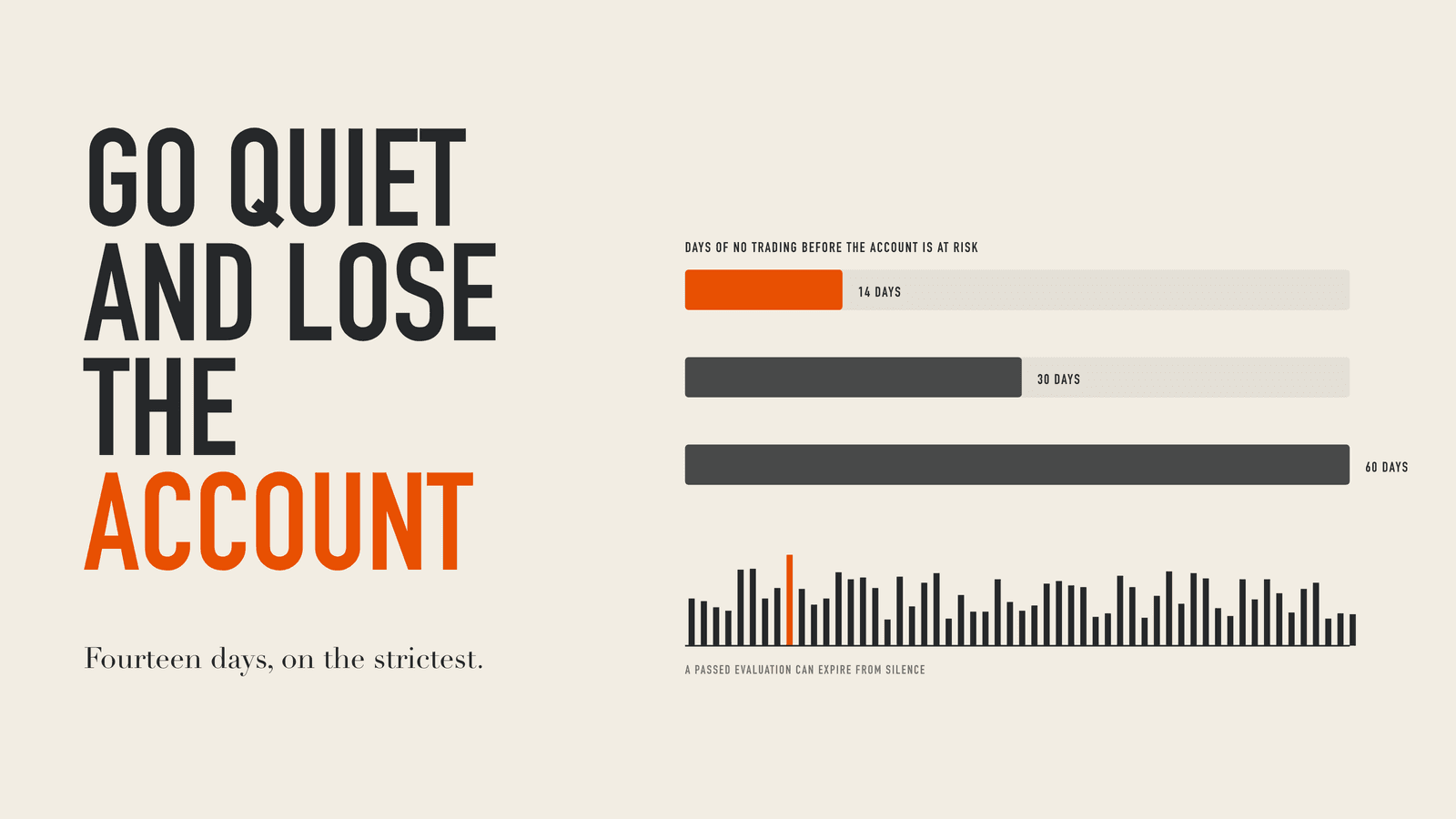
The window varies more than most traders expect, and the spread runs from two weeks to two months across the examples below. This is worth checking on your own program specifically, because assuming your window matches a firm you traded with previously is a common way this rule catches people out.
Examples only. Values are days. Confirm against your own program's rulebook.
Top One Futures's 14-day window is the strictest of this set, four times tighter than FundedNext Stellar's 60-day window on the same list. Neither number is right or wrong; they are two different operating decisions by two different firms, and the only one that matters to you is the one written into the program you actually trade. Two futures firms outside that table sit tighter still: Bulenox allows five days on both Option 1 and Option 2, and Hola Prime Futures allows seven across all of its programs.
Does the inactivity window differ for futures and forex accounts?
Not clearly, based on the programs available for comparison. Top One Futures Elite Access, a futures program, sits at the strict end at 14 days, while FundedNext Futures Bolt, also futures, sits in the middle of this set at 30 days, the same window as the forex-side FundingPips and Maven programs. Inactivity looks like a per-firm operational choice rather than a rule that splits along the futures/forex line the way the daily loss limit does.
| Program | Market | Max inactivity |
|---|---|---|
| Top One Futures Elite Access | Futures | 14 days |
| FundingPips 2 Step Standard | Forex / CFD | 30 days |
| Maven Trading 2-Step | Forex / CFD | 30 days |
| FundedNext Futures Bolt | Futures | 30 days |
| FundedNext Stellar 2-Step | Forex / CFD | 60 days |
A related rule you should also check while you're in the rulebook: some daily loss limits reset on a calendar clock that keeps moving whether you trade or not. Our guide on when the daily loss limit resets covers how that timing works, since a long idle stretch followed by a big first trade back can interact with a fresh daily reset in ways worth understanding beforehand.
What happens when the window is reached?
The mechanics are consistent even where the exact number of days differs: the firm's system tracks the last trade date on the account, and once the gap since that date reaches the program's stated maximum, the account is closed for inactivity. This is generally treated as an account failure rather than a soft warning, though some firms send a notice before the deadline, and none of that changes the fact that it is the trader's responsibility to know the number for their own program.
Whether a failed evaluation or a closed funded account can be reopened afterward is a separate question from the inactivity rule itself, and the answer depends entirely on the individual program's policy. Some firms treat an inactivity failure the same as any other failure, closed for good; others offer a reactivation path, sometimes for a fee. Neither assumption is safe to make without checking, so treat this as one more question worth asking support directly rather than guessing based on how a different program handled it.
The last trade is logged
The firm's system records the date of the most recent open or closed position on the account.
The clock runs
Every consecutive day without a new trade counts against the program's stated maximum.
A notice may go out
Some programs email a warning as the deadline approaches, though this isn't universal and shouldn't be relied on.
The window is reached
Once consecutive inactive days hit the program's maximum, the account is failed for inactivity.
Does inactivity apply differently to a funded account than to an evaluation?
The underlying mechanic, consecutive idle days against a stated maximum, is the same at both stages, but the stakes differ. An inactive evaluation costs the fee already paid and the time spent. An inactive funded account can end an income stream a trader has already qualified for, which is why the rule matters more once you're past the evaluation than it feels like it should while you're still in it.
Evaluation
Idle account costs the fee and the time invested
Funded
Idle account can end a qualified income stream
Can a single small trade keep an account alive indefinitely?
Mechanically, in many cases yes, since the rule tracks presence rather than volume or size. That is exactly why some traders place a minimal trade purely to reset the counter during a planned break, without any intention of building a position. Whether a program's terms permit or discourage that specific tactic is worth checking directly, since some rulebooks address minimum-activity workarounds explicitly and some don't mention them at all.
There's also a practical downside worth weighing against the convenience. A token trade still exposes the account to real market risk for however long it's open, even if the size is small, and if it happens to land during unusual volatility it can move an account further than a trader intended just to satisfy a bookkeeping deadline. Setting a calendar reminder well before the window closes, rather than trading defensively at the last minute, avoids putting a real position on for a purely administrative reason.
How Proplysis helps
Proplysis doesn't track your countdown to an inactivity failure or send a warning as the window closes. What it does is show the maximum inactivity window for your specific program, per program, right on the dashboard, so you know the actual number before you plan a trip or a break instead of guessing or relying on memory from a different firm.
| Program | Max inactivity |
|---|---|
| Your program | Shown per program, as stated in the rulebook |
Frequently asked questions
How many days of inactivity fails a prop firm account?
It depends entirely on the program. Among the examples here it ranges from 14 days on Top One Futures Elite Access up to 60 days on FundedNext Stellar 2-Step, with FundingPips 2 Step Standard, Maven Trading 2-Step, and FundedNext Futures Bolt all sitting at 30 days. Check your own program's rulebook for its specific number.
Does one trade a month keep an account active?
If your program's window is 30 days or longer, a single trade placed roughly once a month can keep resetting the counter before it reaches the maximum, since the rule generally counts consecutive idle days rather than trading volume. On a stricter 14-day program, once a month is not frequent enough.
Is the inactivity rule different for futures accounts than for forex accounts?
Not in a way the available examples show clearly. Top One Futures Elite Access, a futures program, has the strictest window in this set at 14 days, while FundedNext Futures Bolt, also futures, sits at 30 days, the same as several forex-side programs. It reads as a per-firm choice rather than a rule that splits along asset class.
Does inactivity on one account affect my other accounts at the same firm?
Based on how the rule is generally structured, it applies per account rather than per trader, since the count tracks trade activity on that specific account. If you hold multiple accounts at one firm, confirm directly whether the firm treats them independently or links their inactivity status.
Does a firm warn me before failing my account for inactivity?
Some do, some don't, and it isn't something to plan around. Treat the stated maximum in your program's rulebook as the deadline itself rather than expecting a reminder email to arrive beforehand.
Is inactivity treated the same on an evaluation as on a funded account?
The mechanic, consecutive idle days against a stated maximum, is generally the same at both stages. What changes is the cost of getting it wrong: an inactive evaluation forfeits the fee and the time spent, while an inactive funded account can end an income stream you've already qualified for.
Prop firms on Proplysis
Buy your evaluation through our link
These are the firms we list, in alphabetical order. Buying through our link is what keeps Proplysis free to use - it costs you nothing extra.















Some links are affiliate links. Purchasing through them is how Proplysis stays free.