July 18, 2026
Prop Firm Max Loss Explained
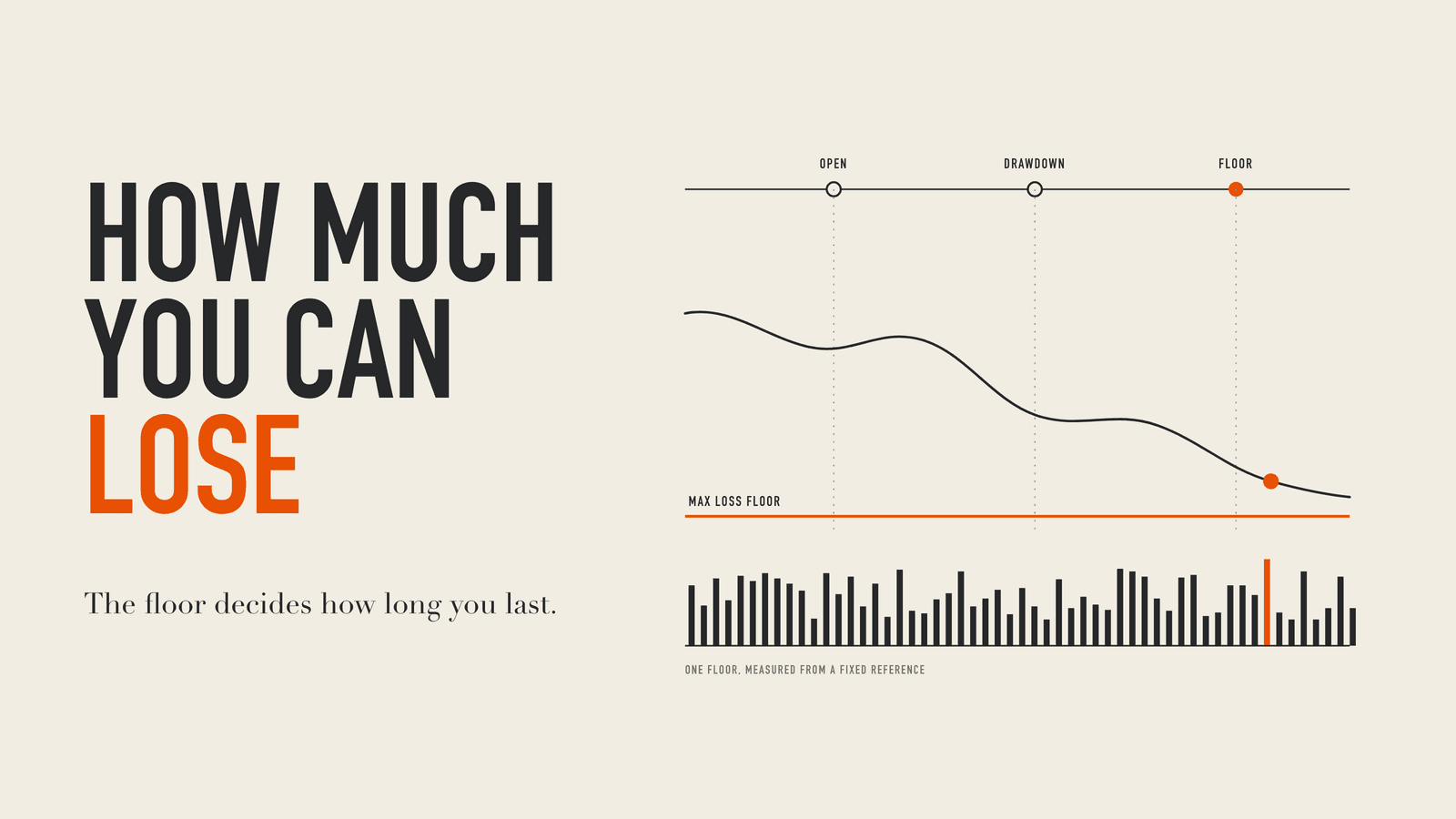
Max loss, also called max drawdown, is the total amount an account is allowed to lose from its starting point before the whole account fails, permanently, not just for the day. It is usually a percentage of balance on forex and CFD programs and a flat dollar figure on futures programs, and unlike the daily loss limit, it does not reset each day. It tracks the account across its entire life, from the first trade to whenever it either passes, gets funded, or breaches.
Two details decide how strict that number actually is in practice: whether the allowed floor is fixed in one place or trails the account's peak balance upward, and whether open, floating losses count against it in real time. Neither shows up in the headline percentage, and both matter more than the number itself.
How is max loss different from the daily loss limit?
The daily loss limit resets at the start of every trading day and only measures that day's movement. Max loss never resets; it is measured from the account's starting point, or from its peak balance, for as long as the account exists. An account can breach the daily loss limit on a single bad day and be finished for that reason alone, entirely separate from how far it sits from its overall max loss floor. Our guide to when the daily loss limit resets covers that day-by-day rule in full; this one is about the limit that never resets.
Static or trailing: does the floor move?
A static max loss sits at one fixed level, calculated once from the starting balance or account size, and it stays there for the account's life. A trailing max loss instead tracks the account's highest balance reached so far and recalculates the floor upward as new highs are made, though it typically stops trailing once the account reaches a certain profit level on many programs. The two produce very different amounts of real breathing room even when the headline percentage is identical.
Illustrative example on a $100,000 account with a 10% trailing max loss floor. Not any specific program's figures.
Follow the floor line, not just the balance line. It sits still at $90,000 while the balance climbs, then jumps to $97,380 the moment the account sets a new high at $108,200, because 10% is now measured from that new peak instead of the starting balance. By week seven the account has given back most of its gains and is trading only about $2,120 above a floor that used to sit $10,000 lower. Nothing about the headline "10% max loss" changes; the room underneath it does.
A trailing floor that stops trailing once the account clears a set profit level is worth understanding on its own, since it changes the shape of the risk over the life of the account. Early on, every new high moves the floor up right behind it, which is the strictest phase. Once the account passes whatever profit checkpoint the program defines, the floor typically locks in place at wherever it last sat, and from that point forward it behaves like a static limit even though it started life as a trailing one. Two accounts on the same program can therefore be under genuinely different versions of the same rule depending on how much profit each has banked.
How is max loss calculated: percentage or dollars?
Forex and CFD evaluation programs generally express max loss as a percentage of balance or equity. The examples below are named, real programs, shown to illustrate the range rather than to rank one against another.
| Example program | Max loss |
|---|---|
| FundingPips 2 Step Pro | 6% |
| Maven Trading 3-Step Challenge | 3% |
| Maven Trading 2-Step Challenge | 8% |
| FundedNext Stellar Lite | 8% |
| FTMO Challenge: 2-Step | 10% |
| FTMO Challenge: 1-Step | 10% |
| FundedNext Stellar 2-Step | 10% |
| FundingPips 2 Step Standard | 10% |
| FundingPips 2 Step Flex | 12% |
Examples only, from live forex/CFD programs. Percentages alone don't reveal whether the floor is static or trailing.
A 3% max loss and a 12% max loss look like opposite ends of a spectrum, but that number alone does not say whether the floor is static or trailing, or whether it is measured on balance, equity, or the higher of the two. The percentage is one input, not the whole rule.
Futures vs forex: how does max loss differ?
Futures evaluation programs generally state max loss as a fixed dollar amount tied to the account size instead of a percentage. Programs like Elite Trader Funding, Bulenox, and FundedNext Futures follow this convention: the limit is a real dollar figure, it is simply modeled differently in the underlying rule data than a percentage would be. A blank percentage field on a futures program is a modeling convention, not evidence the account has no max loss rule.
Beyond units, futures accounts also more commonly use a trailing floor tied to the exchange session, since futures margin and settlement already run on a session-based clock rather than a calendar day, which makes a trailing structure a more natural fit than it is for a percentage-of-balance forex account.
What actually happens the moment you breach it?
The floor is recalculated continuously
On a trailing program, the floor moves up every time the account sets a new peak balance.
The account is measured against it
On balance, equity, or the higher of the two, depending on the program.
Crossing the floor ends the account
Unlike a daily loss breach, which some programs treat as a soft stop, a max loss breach is typically final: the account fails.
No recovery window
There is generally no next-day reset for max loss, since it was never a per-day figure to begin with.
That third step is the practical difference from a daily breach. Some programs let an account that breaches its daily loss limit resume trading the next day under a fresh limit. A max loss breach does not offer that; it is the account's absolute floor, and crossing it is generally the end of the account rather than a pause.
That is also why max loss deserves more attention than the daily loss limit gets in most onboarding conversations. A trader can recover from a bad day; a trader cannot recover from breaching the account's absolute floor. Treat the max loss number as the one figure that defines the account's entire remaining lifespan, not just today's.
Does an open, floating loss count, or only closed trades?
It depends on what the max loss is measured against. A limit measured on balance counts only closed trades, so a losing position that is still open does not touch it until closed. A limit measured on equity, or on the higher of balance and equity, includes floating profit and loss in real time, which means an open position can push the account through the floor before a single trade is closed.
Does max loss apply the same way once you're funded?
Generally yes, though the number itself commonly gets stricter rather than looser. A funded account still carries a max loss floor, and it is common for that floor to sit tighter than the evaluation phase that led to it, on the reasoning that real capital is now at stake rather than a challenge fee. A trailing floor that stopped moving once the evaluation cleared a profit checkpoint typically starts trailing again from the account's new starting point once it is funded, so treat the funded stage as its own version of the rule rather than a carryover of whatever the evaluation looked like.
3% to 12%
Range across the forex/CFD examples above
$ amount
Futures programs typically express max loss in dollars
Equity-based
Can breach mid-trade, before any position is closed
How Proplysis helps
Max loss has a real detector in the compliance engine, and it watches an intraday low watermark rather than only the balance at the moment of sync, so a dip-and-recover trough toward the floor gets caught, not just where the account happens to sit when it last checked in. Proplysis warns you as your connected accounts approach the floor, across every account you connect, rather than leaving you to track a trailing number by hand.
Illustrative example of the dashboard view. Not any specific account's data.
Frequently asked questions
What is the max loss rule at a prop firm?
It's the total amount an account is allowed to lose from its starting point, or from its peak balance on a trailing program, before the account fails outright. Unlike the daily loss limit, it never resets and is measured across the account's entire life.
Is max loss the same as the daily loss limit?
No. The daily loss limit resets every trading day and only measures that single day's movement. Max loss is measured across the whole account, never resets, and either rule alone can fail the account regardless of how the other one looks. See our guide on when the daily loss limit resets for the day-by-day version.
What's the difference between static and trailing max loss?
A static max loss floor stays fixed at one level for the account's life. A trailing max loss floor rises as the account sets new peak balances, which usually means less real breathing room over time than the headline percentage suggests, since the floor is following the balance upward.
Does an open position count toward max loss before it's closed?
It does if the limit is measured on equity, or on the higher of balance and equity, since both include floating profit and loss in real time. It does not if the limit is measured on balance alone, which counts only closed trades.
Is max loss a dollar amount or a percentage?
Both conventions exist. Forex and CFD evaluation programs generally express it as a percentage of balance. Futures evaluation programs generally express the same rule as a fixed dollar amount tied to the account size, which is a modeling difference, not a sign the rule is absent.
What happens once an account breaches its max loss floor?
Generally the account fails outright, with no next-day reset, since max loss was never a per-day figure. This is different from a daily loss breach, which some programs treat as a soft stop that allows trading to resume the following day.
Prop firms on Proplysis
Buy your evaluation through our link
These are the firms we list, in alphabetical order. Buying through our link is what keeps Proplysis free to use - it costs you nothing extra.















Some links are affiliate links. Purchasing through them is how Proplysis stays free.