July 18, 2026
Prop Firm Minimum Trading Days: What Does the Rule Mean?
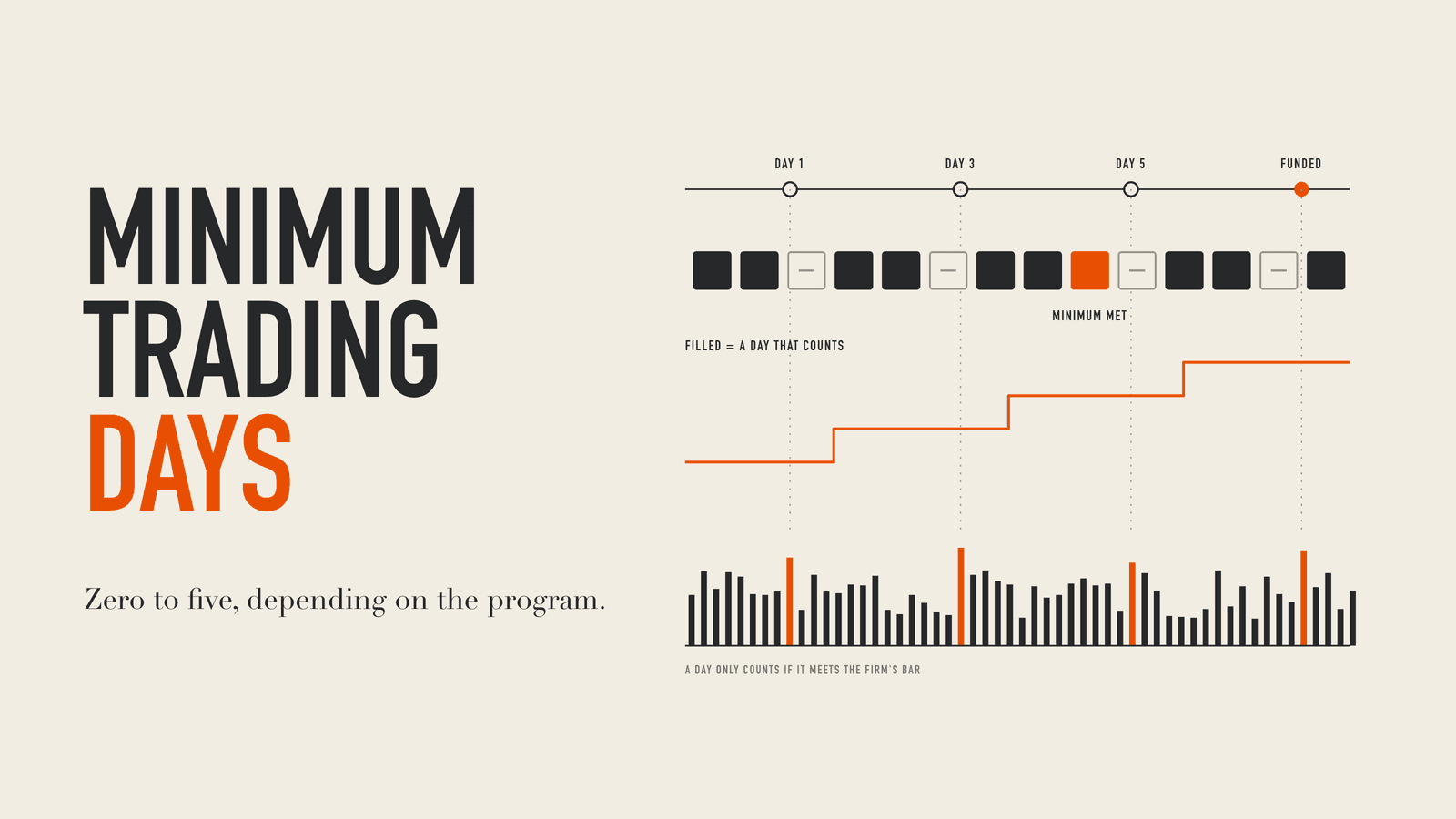
Minimum trading days is the smallest number of separate days on which you must place at least one trade before the account is allowed to pass an evaluation or, on some programs, before it is allowed to pay out. It exists to stop a single lucky session from qualifying an account, and it is measured in calendar trading days, not hours or trade count. Hitting the profit target on day one does not finish the evaluation if the program requires four days; it just means the rest of the requirement is now the only thing left standing between you and a pass.
The number varies a lot between programs, and it can also change between the evaluation stage and the funded stage of the same firm. Some programs set it to zero everywhere. Others require several days in evaluation and none once funded. This guide covers what actually counts as a qualifying day, why the requirement exists at all, and where it differs between futures and forex accounts.
What actually counts as a "trading day" here?
A qualifying day generally needs one thing: at least one trade opened on that calendar day, under the program's own definition of when a day starts and ends. It does not usually require a minimum number of trades, a minimum hold time, or a profitable outcome. A single one-lot trade that lasts thirty seconds and loses money typically still counts as a day traded, in the same way a ten-trade winning session does.
Where programs differ is in the edge cases. Some require the position to still be open when the day rolls over, or to have been held for some minimum duration, specifically to stop a trader from gaming the count with instantaneous trades that carry no real market exposure. That detail is defined per program, so treat "just open one trade" as the general shape of the rule and confirm the specifics in your own account's rulebook rather than assuming every firm applies it identically.
| Example program | Minimum trading days (evaluation) |
|---|---|
| FTMO Challenge: 1-Step | 0 |
| FTMO Challenge: 2-Step | 4 |
| FundedNext Stellar 2-Step | 2 |
| FundedNext Stellar Lite | 2 |
| FundingPips 2 Step Standard | 3 |
| FundingPips 2 Step Pro | 1 |
| FundingPips 2 Step Flex | 0 |
| Maven Trading 2-Step Challenge | 0 |
Four of those eight examples set the requirement at zero, which surprises traders who assume every evaluation forces a slow, drawn-out pace. The spread runs from zero to four days across otherwise similar two-step programs, which is a wide range for a rule that looks like a footnote until it is the only thing standing between a trader and a pass.
Why do firms require a minimum number of days at all?
The rule exists to filter out a specific kind of pass: an account that clears the profit target on oversized risk taken once, rather than through a process that survives repeated exposure to the market. A firm handing out funded capital wants some evidence the result wasn't a single coin flip that happened to land right. Multiple separate days force at least a little repetition into the sample before the firm has to trust the number.
That last point catches traders more often than the headline profit target does. A trader who reaches the target early has every incentive to stop trading and wait out the remaining days, since further trading can only hurt the account from that point forward. Continuing to trade "to be safe" is usually the wrong instinct once the target is already met and only the day count remains.
Does the minimum apply once you're funded, or only during evaluation?
This is where the rule genuinely diverges between programs, more than it diverges between futures and forex. Some firms carry a minimum trading days requirement into the funded stage, usually tied to when a payout can be requested rather than to passing anything. Others drop the requirement entirely once an account is funded, on the reasoning that a funded trader has no further incentive to prove a process; the account is already live. Bulenox runs a sharper version of the first pattern: neither Option 1 nor Option 2 asks for a single qualifying day during the evaluation, and both then require ten trading days on the funded account before a payout can be requested. Its other two routes replace the day count with different gates entirely, which our breakdown of the Bulenox payout rules sets out program by program.
| Example program | Evaluation | Funded |
|---|---|---|
| Elite Trader Funding 1 Step | 5 days | 0 days |
| Elite Trader Funding Fast Track | 3 days | 0 days |
| Upcomers Futures Thunderbolt Legacy | 5 days | 5 days |
Read the grid horizontally, not against each other. Elite Trader Funding's 1 Step and Fast Track programs both drop the requirement to zero once funded, while Upcomers Futures's Thunderbolt Legacy program keeps the same five-day requirement on both sides. All three are real, named programs; none is being held up as more generous than another, since the two stages aren't actually comparable products.
Futures vs forex: does the rule differ by market?
Unlike the daily loss limit or the profit target, minimum trading days does not really split along a futures-versus-forex line. Both markets count the same thing: a calendar day on which you opened at least one trade. There is no dollar-versus-percentage convention to translate here, because a day count is a day count regardless of what you're trading.
The meaningful split for this rule is stage, not market: evaluation versus funded, as shown above, rather than futures versus forex. Where futures programs do differ from forex programs is on unrelated rules measured in dollars instead of percentages, like the profit target and the max loss limit, which is a separate topic from how many days you have to show up.
What happens if a losing day still counts toward the requirement?
Generally, yes, a losing day still counts. The rule tracks whether you traded that day, not whether the day went well. This has a practical upside: a trader who is behind on the day count late in an evaluation window does not need to force a profitable session on the final days, only a trade that satisfies the definition of a qualifying day under their program's own terms.
A trade is opened
Under the program's day boundary, one trade opened is usually enough to start counting.
Some programs check duration or timing
A minority of programs require the position to be held for some minimum time, or to still be open at day-roll, to prevent a day being claimed with no real exposure.
The count runs across the whole evaluation window
Days do not need to be consecutive on most programs; they accumulate toward the total across the window the firm allows.
Passing requires both conditions met
The profit target and the day count are independent requirements. Meeting one early does not waive the other.
That last step is the one worth repeating: profit target and minimum trading days are two separate gates, and clearing one does not touch the other. An account can sit above target and below the day requirement for as long as it takes to close out the remaining days, or it can clear the day requirement early and still be nowhere near the target. Both have to be true at the same time for the evaluation to pass.
0 days
Common minimum on 1-step and no-minimum programs
2 to 4 days
Common minimum on 2-step forex/CFD evaluations
Stage-dependent
Futures programs often drop the requirement once funded
Why do some programs set the minimum to zero?
A zero-day minimum is a deliberate design choice on faster, single-phase programs, not an oversight. Programs built around speed, like a one-step challenge, tend to lean on a stricter profit target and drawdown limit to do the filtering work instead of a day count. The trade- off is explicit: fewer gates, but each remaining gate is usually tighter to compensate.
Examples only, from live forex/CFD programs.
Notice that a zero-day program and a four-day program can sit at the same firm, or at directly competing firms, without either being the "real" version of the rule. Neither number is inherently safer or riskier on its own; it is one input among several, and it should be read alongside the profit target and max loss for the same program rather than in isolation.
Does hitting the target and then losing money still leave the day count intact?
Yes. The day count generally does not reverse. Once a calendar day has satisfied the program's definition of a qualifying day, it stays satisfied even if the account gives back profit on a later day, so long as the account itself has not failed on a separate rule like the daily loss limit or the max loss limit. The day count and the account's health are tracked independently.
How Proplysis helps
Proplysis shows your live standing against the minimum trading days requirement on your program, counted from your connected account's actual trade history. It is not an alert; it is a running number: how many qualifying days you have logged against how many your program requires, updated as your accounts sync, so you can see at a glance whether the day count or the profit target is the one still open on a given evaluation.
Minimum trading days completed
Illustrative example of the live standing view. Not any specific account's data.
Frequently asked questions
What counts as a minimum trading day at a prop firm?
Generally, any calendar day on which the account opens at least one trade under the program's own day boundary. Most programs do not require a minimum trade count, a minimum hold time, or a profitable result for the day to count, though a minority add a duration or open-at-rollover condition. Confirm the specific definition in your own program's rulebook.
Do losing days still count toward minimum trading days?
Yes, on programs that only require a trade to have been placed that day. The rule tracks activity, not outcome, so a small losing trade on a day you were otherwise not planning to trade can still satisfy the requirement.
Can I pass an evaluation before the minimum trading days are met?
No. The profit target and the minimum trading days are independent requirements, and both must be satisfied for the evaluation to pass. Reaching the target early only means the target portion is done; the account still has to reach the required day count before it can pass.
Does the minimum trading days rule apply to funded accounts too?
It depends on the program. Some firms carry a minimum trading days requirement into the funded stage, typically tied to payout eligibility rather than passing anything. Others drop it entirely once the account is funded. Check the specific program's terms rather than assuming the evaluation number carries over.
Is the minimum trading days rule different for futures and forex accounts?
Not in the way it's counted: both markets count a calendar day with at least one trade opened. Where futures and forex programs genuinely diverge is on other rules measured in dollars versus percentages, like the profit target and the max loss limit, not on how days are tallied for this rule specifically.
Why do some prop firm programs have no minimum trading days at all?
Usually a deliberate trade-off on faster, single-phase programs: fewer gates overall, with the profit target and drawdown limit doing more of the filtering work instead of a day count. A zero-day minimum is a design choice, not a sign the program is less serious about verifying a real process.
Prop firms on Proplysis
Buy your evaluation through our link
These are the firms we list, in alphabetical order. Buying through our link is what keeps Proplysis free to use - it costs you nothing extra.















Some links are affiliate links. Purchasing through them is how Proplysis stays free.