July 18, 2026
What Does "Profit Target" Mean at a Prop Firm?
A profit target is the gain an evaluation account has to reach, measured against its starting balance, before the firm will pass it or advance it to the next phase. It is usually a percentage on forex and CFD programs and a flat dollar figure on futures programs, and once an account clears it, along with any other requirements like minimum trading days, the evaluation is done. Funded and instant accounts generally have no profit target at all; that absence is by design, since the account has already proven what the evaluation was checking for.
The number itself gets most of the attention, but two things around it matter just as much: what the target is measured against, and what actually happens the moment you cross it. This guide covers both, plus where futures and forex programs express the same rule in different units.
Why does a profit target exist at all?
The evaluation exists to answer one question for the firm: can this trader turn a starting balance into a meaningfully larger one without breaking the account's other rules along the way. A firm cannot simply hand out funded capital because someone asked; it needs some evidence of skill under its own risk limits, and a percentage or dollar gain is the simplest number to check against.
That's also why the target is paired with a max loss limit and, on most two-step programs, a minimum trading days requirement. A profit target on its own would reward a trader who got lucky on oversized risk. Combined with the other rules, it rewards a gain achieved within a bounded amount of risk and, usually, across more than a single session.
How is the profit target measured: balance or equity?
Firms generally check the profit target against the account's closed-trade balance rather than its live equity, meaning open, unrealized profit typically does not count until the position is closed. This detail is set per program rather than universal, so an account that looks like it has reached the target intraday, based on a floating gain, may not actually register as having passed until that gain is locked in by closing the trade.
Which prop firms set which profit target?
The table below is read from the Proplysis rule database each time this page loads, so it shows the phase-one target we hold for each active program today rather than a list frozen on the day this article was written. Each row is one firm, its most clearly disclosed program, because the target is set per program and firms vary it across their own lineup. The table covers forex programs, where the target is a percentage; futures programs are not listed because they express the target as a dollar figure per account size instead, which the warning further down explains.
| Firm | Program | Profit target |
|---|---|---|
| E8 Markets | E8 One 10% drawdown | 15% |
| FTMO | FTMO Challenge: 1-Step | 10% |
| FundedNext | Stellar 1-Step | 10% |
| FundingPips | 1 Step | 10% |
| FundingTraders | 1-Step Pro | 10% |
| Ment Funding Forex | Forex 1-Step | 10% |
| Top One Trader | Nova Challenge | 5% |
| Upcomers | Ash | 2% |
All 8 firms. Live from the Proplysis firm database.
Read the phase count with the number. Maven Trading's Standard 3-Step sets a 3% target per phase, which looks small next to FTMO's 10% first-phase target until you notice it is three separate hurdles instead of one. The table shows each program's phase-one figure; later phases have their own targets, so a single-digit number tells you very little without knowing how many phases it applies to and what the other rules on that same program look like.
Why do later phases usually have a smaller target?
Look again at FTMO's 2-Step and FundingPips's 2 Step Standard: both drop from a 10% first-phase target to a 5% second-phase target. Maven Trading's Standard 2-Step does something similar, from 8% down to 5%. The logic is that phase one already carried most of the burden of proof; a trader who cleared a 10% target once, under the same drawdown limit, has already shown the core skill the firm is checking for. Phase two exists to confirm that result wasn't a one-off, not to raise the bar further, so a smaller number is enough to do the confirming.
Not every program follows that pattern. FundingPips's 2 Step Pro holds the same 6% target on both phases. A flat target across phases is a different design choice, not an error: it treats each phase as an independent test rather than a first pass and a confirmation, which changes how much total gain the account has to produce across the full evaluation.
How does a two-step target actually get crossed?
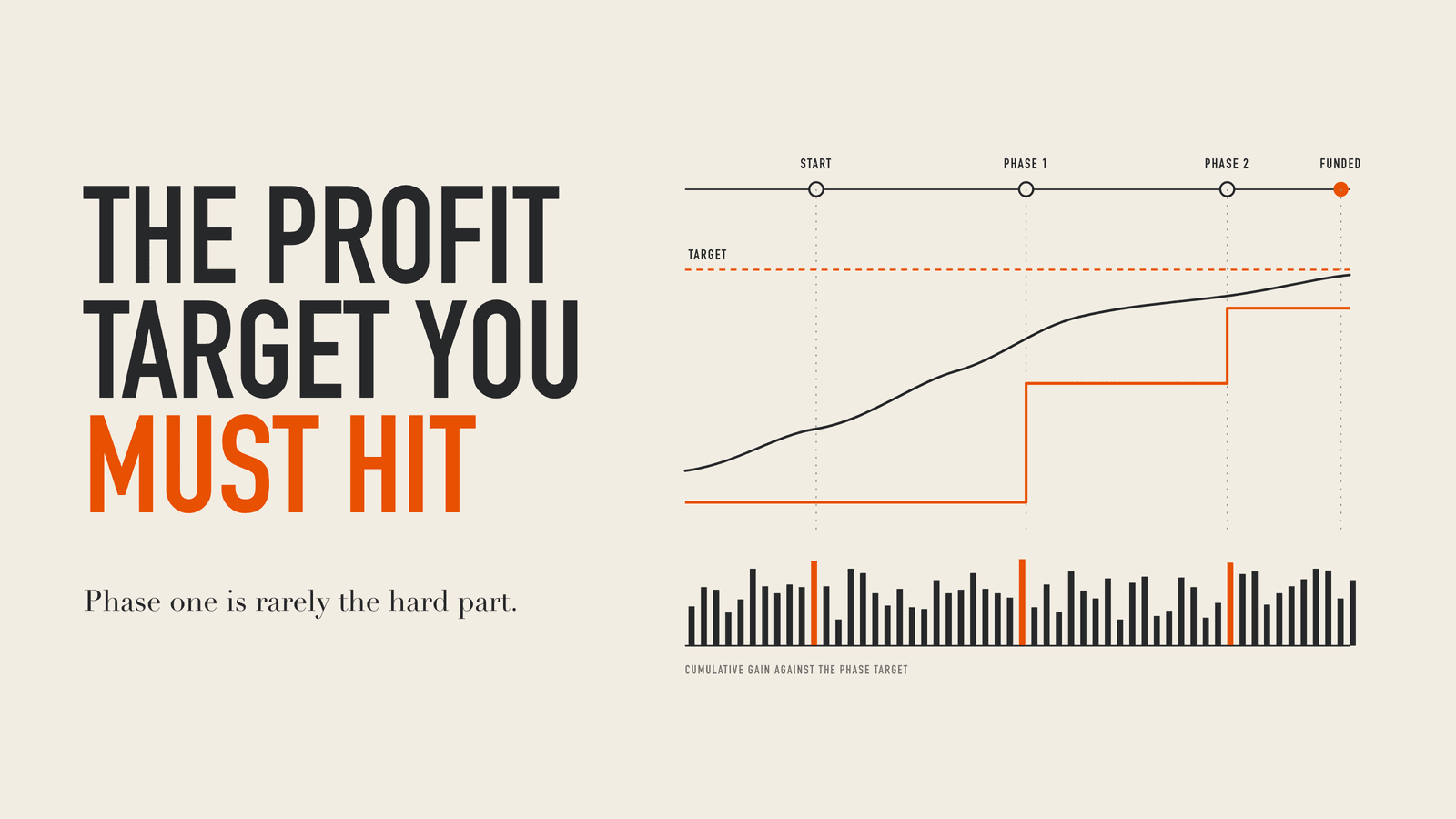
Picture an account climbing toward its phase-one target across a normal, uneven run of trading days: some green, some red, generally trending up until the balance clears the line.
Illustrative example on a $100,000 account with a 10% phase-one profit target. Not any specific program's actual trading.
The dip around day twelve is normal and does not undo the days before it; the target is checked against wherever the balance sits, not against a straight-line pace. What matters is the final crossing on day eighteen, where the balance clears the flat target line and, on most programs, the phase is done from that point.
What happens the moment you clear the target?
The firm's system registers the crossing
Usually checked against closed balance at the end of a trading day, though some programs check continuously.
Other requirements are checked too
Minimum trading days and the max loss limit still have to be satisfied; clearing the target alone does not pass the phase.
Phase 2 opens, or the account is funded
On a multi-step program, a new phase starts with its own target. On the final phase, the account moves toward funding.
Further trading is optional, not required
Once the phase is genuinely done, additional trades can only reduce the balance below where it already qualified.
That last step is worth sitting with. Traders often keep trading after clearing a target out of habit or nerves, which is the opposite of what the moment calls for once the day count and max loss requirements are also satisfied. There is no bonus for exceeding the target by more; there is only downside risk from continuing to trade an account that has already done its job.
Futures vs forex: dollars or percentage?
Forex and CFD evaluation programs generally state the profit target as a percentage of the starting balance, which is why every row in the table above is a percent figure. Futures evaluation programs generally state the same rule as a flat dollar amount tied to the account size instead. Programs like Elite Trader Funding, Bulenox, and FundedNext Futures follow this convention: the target is a real dollar number, it is just modeled differently in the underlying rule data than a percentage figure would be.
The practical effect is the same either way: a fixed line the balance has to cross. The difference is entirely in units and where the number lives in the paperwork, not in what the trader has to do.
6% to 10%
Common phase-one range across forex/CFD examples above
$ amount
Futures programs typically express the target in dollars
No target
Common on funded and instant-funding programs
Do funded or instant-funding accounts have a profit target?
Generally not. Once an account is funded, or is an instant-funding program that skipped an evaluation entirely, there is usually no profit target left to clear. The absence is deliberate rather than an oversight: the evaluation existed specifically to check whether the trader could hit a target under the firm's risk rules, and a funded account has already cleared that bar or was never asked to in the first place. The max loss limit and, on some programs, a minimum trading days requirement generally do carry through to the funded stage even without a profit target attached.
How Proplysis helps
Profit target has a real detector in the compliance engine, which fires an alert the moment an evaluation phase actually clears rather than leaving you to check the balance by hand against the rulebook. Proplysis shows your live distance to the target on the dashboard as you trade, and notifies you the moment the phase is cleared or the evaluation passes, across every connected account rather than one at a time.
Distance to profit target
Illustrative example of the live standing view. Not any specific account's data.
Frequently asked questions
What does profit target mean at a prop firm?
It's the gain, from the starting balance, an evaluation account has to reach before the firm passes it or advances it to the next phase. It's usually a percentage on forex/CFD programs and a dollar figure on futures programs, and it is paired with other requirements like a max loss limit and, on many programs, a minimum trading days count.
Is the profit target measured on balance or equity?
Generally on closed-trade balance rather than live floating equity, meaning an open position's unrealized profit typically has to be closed out before it counts toward the target. This is set per program, so confirm it in your own rulebook rather than assuming.
Do futures accounts have a profit target if no percentage is listed?
Yes. Futures evaluation programs commonly express the target as a flat dollar amount tied to the account size rather than a percentage, so a blank percentage field is a modeling convention, not evidence the program has no target. Check the dollar figure in the program's own terms.
Do I need to keep trading after I hit the profit target?
Only if another requirement, like minimum trading days, is still open on your program. Once every requirement for the phase is satisfied, further trading only adds downside risk to an account that has already qualified.
Why do funded accounts have no profit target?
Because the evaluation already checked what the target was designed to check. A funded account still generally carries a max loss limit and, on some programs, day-count rules, but the profit target itself is usually specific to the evaluation or challenge stage.
Is profit target the same thing as max loss?
No. Profit target is the gain required to pass or advance; max loss is the total amount the account is allowed to lose before it fails outright. They're independent rules measured from the same starting balance, and clearing one has no effect on the other. An account can clear its profit target and still fail later on max loss if it gives back too much afterward, so treat the two as separate finish lines rather than one combined score.
Prop firms on Proplysis
Buy your evaluation through our link
These are the firms we list, in alphabetical order. Buying through our link is what keeps Proplysis free to use - it costs you nothing extra.















Some links are affiliate links. Purchasing through them is how Proplysis stays free.