July 18, 2026
Prop Firm Scalping Rules: What's Actually Restricted
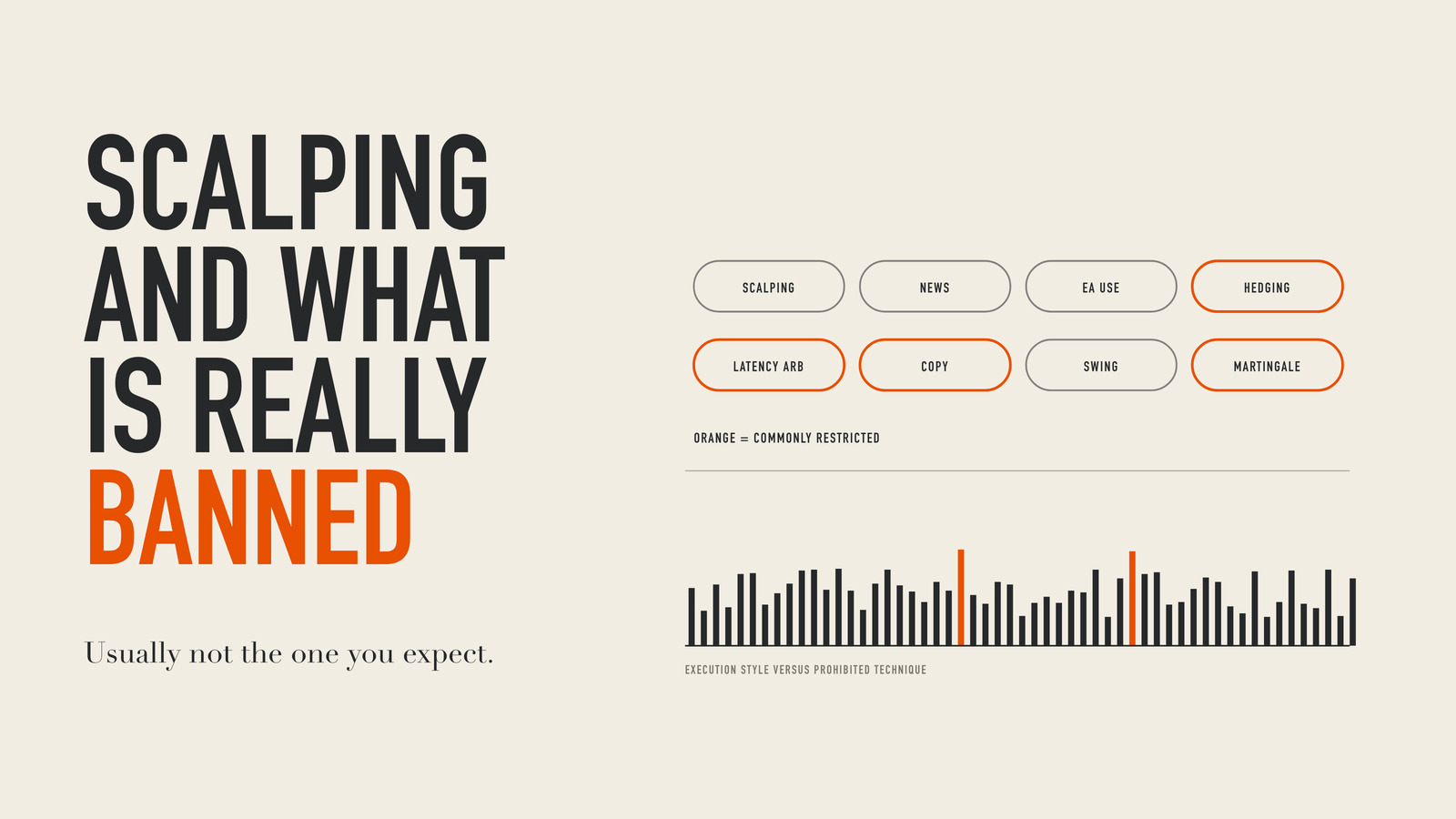
Scalping is allowed on most prop firm evaluations and funded accounts. The strategy that actually gets restricted, and can end an account, is hedging: opening opposing positions to guarantee an outcome regardless of which way the market moves. Traders search "prop firm scalping rules" expecting a ban and usually find none, then run into the real restriction under a different name.
The two get confused because both involve fast, frequent, or unusual-looking trade activity, and both show up in the same "prohibited strategies" section of a rulebook. They are not the same rule, they are not enforced the same way, and mixing them up is how a trader avoids the thing that was never a problem while walking straight into the thing that is.
Is scalping actually allowed at most prop firms?
Scalping means holding trades for seconds to a few minutes and opening a high number of positions in a session. Retail brokers sometimes restrict it because it stresses their execution pipeline. Prop firms generally don't share that problem: the firm's revenue comes from evaluation fees and the funded trader's profit split, not from spread or rebate income tied to holding time, so there is usually nothing in the business model that makes fast trading a threat.
| Program | Scalping |
|---|---|
| FTMO Challenge: 2-Step | Allowed |
| FTMO Challenge: 1-Step | Allowed |
| FundedNext Stellar 2-Step | Allowed |
| FundingPips 2 Step Standard | Allowed |
| Maven Trading 2-Step | Allowed |
| Funded Futures Family Prime | Allowed |
| FundedNext Futures Bolt | Allowed |
Every program in that list allows it. That is not a coincidence specific to these examples; it reflects how the strategy is generally treated across the industry. If your own program's rulebook is silent on scalping, that silence usually means it isn't singled out, though the only way to know for certain is to check your own program's terms directly.
So why does everyone think scalping is against the rules?
Two things get blended together in trader forums. First, some retail brokers do restrict scalping, and traders who came from retail carry that assumption into prop firm evaluations where it usually doesn't apply. Second, "prohibited strategies" sections list scalping alongside hedging, latency arbitrage, and account-sharing in the same paragraph, which reads like all of them are banned even when only some are.
What is actually restricted: hedging
Hedging is opening opposing positions so the account's outcome is locked in regardless of market direction. On a single account that might mean a long and a short on the same instrument at the same time. Across accounts, it can mean splitting opposite positions between two accounts, sometimes at the same firm and sometimes at two different firms, so that one side wins no matter what happens.
Firms restrict it because it can be used to guarantee passing an evaluation, or to guarantee a payout on a funded account, without the trading skill the challenge fee is meant to test for. That is a different kind of risk to the firm than fast trading ever was, which is why the two get treated so differently even though they sit in the same rulebook section.
Opposing positions appear
A long and a short on the same instrument, split across one account or several, at the same time.
The positions are matched
The pattern is checked against the size, timing, and instrument of the opposing side.
The account is flagged or failed
Depending on the program, a confirmed match is treated as a rule breach, which can end the evaluation or funded account.
Scalping vs hedging, by program
Put the two side by side on the same set of example programs and the pattern holds consistently: scalping allowed, hedging not.
| Program | Scalping | Hedging |
|---|---|---|
| FTMO Challenge: 2-Step | Allowed | Not allowed |
| FTMO Challenge: 1-Step | Allowed | Not allowed |
| FundedNext Stellar 2-Step | Allowed | Not allowed |
| FundingPips 2 Step Standard | Allowed | Not allowed |
| Maven Trading 2-Step | Allowed | Not allowed |
| Funded Futures Family Prime | Allowed | Not allowed |
None of these programs is being singled out here; the pattern is simply what the data shows across this set. If a program you trade isn't listed, treat its hedging stance as unconfirmed rather than assuming it matches the pattern above.
What forms does hedging take that firms actually flag?
The word covers a few distinct setups, and rulebooks don't always spell out which ones they mean, which is part of why traders get caught by it unintentionally rather than deliberately.
Same account
Opposite positions on one instrument to lock in a fixed result
Linked accounts
Opposing trades split across two accounts at the same firm
Cross-firm
Opposing trades split across accounts at different firms
The cross-firm version is the hardest for any single firm to see on its own, since each firm only has visibility into its own account. It is also the version most often used to guarantee a payout regardless of direction, which is precisely the outcome the rule exists to prevent.
What about EAs and copy trading? Are those restricted too?
These sit in the same family as scalping and hedging, reference rules rather than live monitoring, but they split by program in a way that scalping doesn't. Expert Advisors are allowed on the FTMO Challenge, FundedNext Stellar, and FundingPips programs, and not allowed on Maven Trading or Funded Futures Family. Copy trading is allowed on the FTMO Challenge, and not allowed on FundedNext Stellar, FundingPips, Maven Trading, or Funded Futures Family.
| Example program | Expert Advisors | Copy trading |
|---|---|---|
| FTMO Challenge: 2-Step | Allowed | Allowed |
| FundedNext Stellar 2-Step | Allowed | Not allowed |
| FundingPips 2 Step Standard | Allowed | Not allowed |
| Maven Trading 2-Step Challenge | Not allowed | Not allowed |
| Funded Futures Family Prime | Not allowed | Not allowed |
Notice there's no clean pattern by firm size or by market here the way there is with scalping. Each program sets its own EA and copy-trading stance, so this is one of the rules worth reading fresh for every account you open rather than assuming it carries over from a firm you've traded with before.
Does the scalping and hedging distinction change between futures and forex?
Not meaningfully, based on the examples available. Scalping is allowed on both the forex-side programs above and on futures programs like Funded Futures Family Prime and FundedNext Futures Bolt. Hedging is restricted on Funded Futures Family Prime, a futures program, the same as it is on the forex-side examples. Nothing in this set suggests the restriction changes shape by asset class the way, say, the daily loss limit does.
That's a different mechanic entirely from a rule like the daily loss limit, which is measured in dollars or percent against a specific reference point and resets on a fixed clock. See our guide on when the daily loss limit resets for how that timing actually works, since it has nothing to do with strategy at all.
What if my program's rulebook doesn't mention scalping or hedging at all?
Silence isn't the same as permission, and it isn't the same as a ban either. A rulebook that doesn't mention scalping specifically usually means the firm hasn't singled it out, which in practice tends to mean it's fine, since firms that do restrict a strategy generally say so explicitly rather than leaving it implied. Hedging is different: even a rulebook that's thin on detail will often carry a general prohibited-strategies clause broad enough to cover it, so the absence of the word "hedging" specifically shouldn't be read as the absence of the restriction.
The safest habit, regardless of what a rulebook does or doesn't spell out, is to ask the firm's support directly before you build a strategy around an assumption. This matters more for a funded account than for an evaluation, since the cost of guessing wrong is an income stream rather than a one-time fee, and a five-minute support ticket is cheap insurance against either outcome. It's a small habit compared with the cost of an account failure over a rule that was written down the whole time, just not where you happened to look for it.
How Proplysis helps
Scalping, EAs, and copy trading are reference rules on Proplysis: we don't monitor them because there's nothing ongoing to monitor, the value is either allowed or not for your program and stays that way. What we do is put that value in front of you per program, so you're reading it on your dashboard instead of hunting for it in a PDF mid-session. Hedging is the one exception in this article: it's a rule our compliance engine can actually watch for on connected accounts and raise an alert on, rather than just display as a static value.
Monitored
Hedging — the compliance engine watches connected accounts and can alert
Reference
Scalping, Expert Advisors and copy trading — shown per program, not monitored
Frequently asked questions
Is scalping allowed on the FTMO Challenge?
Yes, on both the 2-Step and 1-Step FTMO Challenge programs. Scalping is not restricted on either. Hedging is the rule to watch on these programs, not scalping.
Is hedging allowed on prop firm accounts?
Generally no, based on the example programs covered here: the FTMO Challenge (2-Step and 1-Step), FundedNext Stellar 2-Step, FundingPips 2 Step Standard, Maven Trading 2-Step, and Funded Futures Family Prime all restrict it. Programs not listed here should be treated as unconfirmed rather than assumed to match.
Can I use an Expert Advisor while scalping?
It depends entirely on the program's EA rule, not on scalping. EAs are allowed on the FTMO Challenge, FundedNext Stellar, and FundingPips programs listed above, and not allowed on Maven Trading or Funded Futures Family. Check the EA rule for your specific program separately from the scalping rule.
Does scalping count as a prohibited strategy?
Not on the programs covered here. It's often listed near a firm's prohibited-strategies clause, which is where the confusion comes from, but the examples above all allow it outright. Hedging is the strategy in that same clause that is actually restricted.
Is scalping treated differently on futures accounts than on forex accounts?
Not based on the programs available for comparison. Funded Futures Family Prime and FundedNext Futures Bolt, both futures programs, allow scalping the same as the forex-side programs above. This isn't a rule that splits cleanly along the futures/forex line the way the daily loss limit does.
What happens if hedging is detected on my account?
Outcomes vary by program and by how confirmed the pattern is, so check your own program's rulebook for its specific consequence rather than assuming one universal outcome. What's consistent across the programs covered here is that hedging is restricted at all, unlike scalping.
Prop firms on Proplysis
Buy your evaluation through our link
These are the firms we list, in alphabetical order. Buying through our link is what keeps Proplysis free to use - it costs you nothing extra.












Some links are affiliate links. Purchasing through them is how Proplysis stays free.