July 18, 2026
Prop Firm 1-Step vs 2-Step: What Actually Changes?
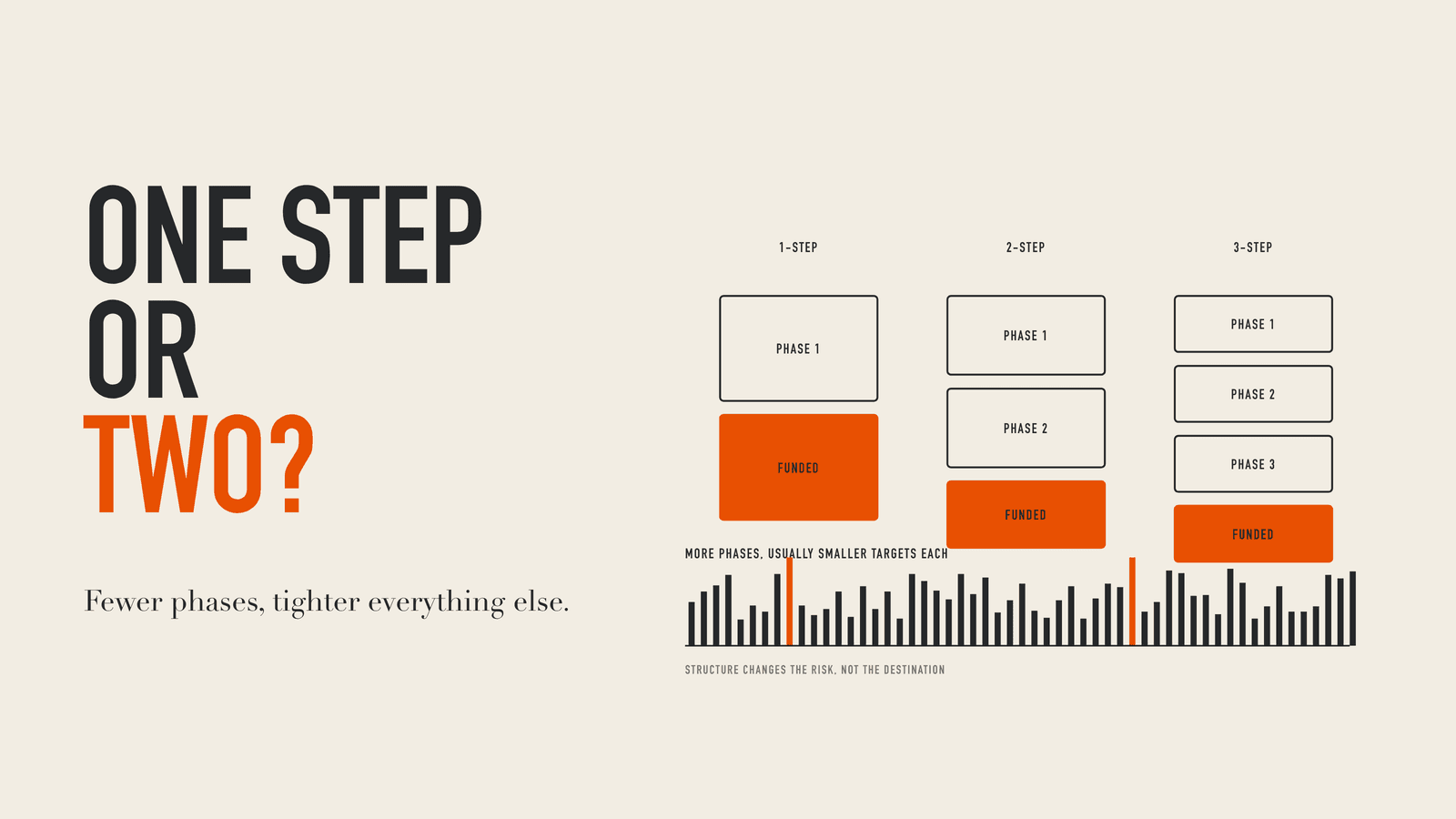
A 1-step evaluation asks for one profit target in a single phase; a 2-step evaluation splits the requirement across two phases, usually a larger target first and a smaller one second. Neither structure is simply easier: a 1-step often carries a stricter daily loss or drawdown limit to compensate for skipping a phase, and rules like consistency and minimum trading days apply regardless of how many phases the target is split across. This is a structural tradeoff between speed to funding and day-to-day breathing room, not a simple better-or-worse choice between two competing products.
Traders often assume fewer phases means less total work, or that a 2-step must be "safer" because it gives two chances to prove yourself. Both assumptions oversimplify what is really happening: a firm has to underwrite risk somewhere, and the number of phases is only one of the levers it can adjust.
What actually differs between a 1-step and a 2-step evaluation?
The core difference is how the total profit requirement is distributed. A 1-step account needs to reach its target once and is then eligible for funding. A 2-step account needs to clear Phase 1's target, then clear a second, usually smaller, target in Phase 2, before funding. Both structures still apply the same category of rules along the way, daily loss, max drawdown, minimum trading days, and consistency where the program has one; only the profit-target checkpoint changes shape.
| Program | Structure | Profit target by phase |
|---|---|---|
| FTMO Challenge: 1-Step | 1-step | 10% |
| Maven Trading 1-Step Challenge | 1-step | 8% |
| FTMO Challenge: 2-Step | 2-step | 10% then 5% |
| FundingPips 2 Step Standard | 2-step | 10% then 5% |
| FundedNext Stellar 2-Step | 2-step | 8%, single phase target in Phase 1 |
| Maven Trading 3-Step Challenge | 3-step | 3% in each of three phases; max loss 3% |
How does clearing the phases actually work?
Open the account
Rules, targets, and the phase count are fixed at purchase and do not change mid-evaluation.
Clear Phase 1
Reach the stated profit target while staying inside the daily loss and max drawdown limits.
Clear Phase 2, if the program has one
Usually a smaller target than Phase 1, under the same or adjusted limits.
Move to funded status
Consistency and minimum trading day rules are commonly still checked here, even though the profit-target phase is done.
Request a payout
Subject to whatever payout-gating rules the program applies, separate from the evaluation phases.
Does fewer phases mean less total profit required?
Not necessarily. Adding the phase targets together gives a rough sense of the total ground a trader has to cover, and it does not obviously favor either structure. FTMO's 1-Step asks for 10% once. FTMO's 2-Step asks for 10% then 5%, which is 15% total across two phases. FundingPips's 2 Step Standard is the same 10%-then-5% shape. Maven's 3-Step spreads 3% across each of three phases, for 9% total, the smallest cumulative figure of the group precisely because it is split three ways.
Examples only. Sums are the phase targets added together; each program still enforces them one phase at a time, not as a single combined number.
Read that chart carefully: it adds phase targets together for comparison, but no program actually asks a trader to hit the combined number in one sitting. A 2-step trader clears 10%, the account resets to Phase 2, and only then works toward the next 5%. The cumulative figure tells you total ground covered over the whole evaluation, not the size of any single checkpoint.
Do 1-step programs carry stricter daily loss or drawdown limits to compensate?
Structurally, yes, this is common, though the exact figures vary by program and are not something to generalize from firm to firm. A 2-step structure gives the firm two checkpoints to observe behavior before funding an account, so it can sometimes afford a slightly looser day-to-day limit. A 1-step structure gives up that second observation point, and firms commonly offset that by tightening the daily loss limit, the max drawdown, or both. Confirm the actual percentages on your specific program rather than assuming a pattern applies uniformly; our guide to when the daily loss limit resets covers how that particular limit is measured once you know its figure.
Does the consistency rule differ by phase structure?
Not in a way that tracks 1-step versus 2-step directly. Consistency caps, where a program has one, are usually a funded-stage or payout-stage rule, applied after the profit-target phases are already behind the trader. The examples below are real, named programs and show the range that exists across firms, regardless of how many phases each one used to get funded.
| Program | Consistency cap |
|---|---|
| Elite Trader Funding Fast Track, futures | 40% |
| Top One Futures Elite Access, funded | 40% |
| Bulenox Option 1 Momentum, funded | 35% |
| FundedNext Futures Bolt / Flex / Legacy | 40% |
| FundingPips Zero, funded | 15% |
| Maven Trading Buy Now Pay Later, funded | 20% |
Notice these are all funded programs, not evaluation phases, and the caps range from 15% to 40% independent of whether the trader arrived there through one step or two. An unlisted program's absence from this table means the figure was not verified for this piece, not that the program has no consistency rule.
Do minimum trading days change with the number of phases?
Generally, yes, in the sense that a 2-step evaluation gives a program two separate opportunities to require a minimum number of trading days, once per phase, while a 1-step program only has the one phase to attach that requirement to. The exact day counts differ widely across firms and are not being generalized here. The illustration below shows the shape of that spread across programs broadly, not measured figures for any named firm.
Minimum trading days
A trader comparing a 1-step and a 2-step program purely on "days required" is often comparing one number against a total that is really two numbers added together. Ask for the minimum trading days per phase, not a single combined figure, when you are sizing up a specific pair of programs.
Does futures vs forex change the 1-step vs 2-step comparison?
Not in the structure itself. Both markets run 1-step, 2-step, and 3-step evaluations, and the phase-clearing logic, reach a target, satisfy the day and consistency rules, move on, works the same regardless of instrument. What differs is the usual unit each market expresses its targets and limits in: futures programs commonly state targets and loss limits as fixed dollar amounts per account size, while forex and CFD programs commonly state them as percentages of balance or equity. That unit difference sits underneath the phase count, not because of it.
How should a trader actually choose between them?
Start from trading style rather than from the labels "1-step" or "2-step" themselves. A trader who trades in short, controlled bursts and closes out most days flat tends to find a tighter daily loss limit manageable, which makes a 1-step's usual compensating trade-off less costly for them specifically. A trader who needs room to let a position develop over a session, or who has occasional larger drawdown days as part of a wider strategy, often finds the looser day-to-day limits more common on a 2-step worth the extra phase and the extra time that phase adds.
It is also worth separating the question of speed from the question of difficulty. A 1-step account can get a trader to funded status faster in wall-clock time, since there is only one checkpoint to clear, but faster is not the same as easier if the daily loss or drawdown limit behind that single checkpoint is meaningfully tighter. A 2-step or 3-step account takes longer to clear by definition, since it adds at least one more full phase, minimum trading days included, but each individual phase can be less demanding on a day-to-day basis. Weigh total time to funding against daily risk tolerance together, not one in isolation from the other.
How Proplysis helps
Proplysis tracks each phase's profit target against your live balance and warns you as you approach it, using the same detector that flags when a phase clears. Consistency and minimum trading days for the phase you are in show as live standing on the Rules page instead: you can see where you stand on both without an alert, since neither triggers a breach notification the way the profit target and loss limits do.
Progress toward current phase profit target
Illustrative example of the live progress view. Not a specific account.
Frequently asked questions
Is a 1-step or 2-step prop firm challenge better?
Neither is universally better. A 1-step reaches funding in one phase but commonly carries a tighter daily loss or drawdown limit. A 2-step spreads the target across two phases, often with a looser day-to-day limit. The right one depends on your own trading style and risk tolerance, not a fixed ranking.
Do 1-step challenges have stricter rules than 2-step challenges?
Often the daily loss or max drawdown limit is tighter on a 1-step program, since the firm has one fewer checkpoint to observe behavior before funding the account. This is a common pattern, not a universal rule, so check the specific program's figures directly.
Does the consistency rule apply differently to 1-step vs 2-step accounts?
The consistency cap, where a program has one, is typically a funded or payout-stage rule that applies after the evaluation phases are complete, regardless of whether those phases numbered one, two, or three. It is not tied to the phase count itself.
Do minimum trading days add up across phases in a 2-step evaluation?
Often each phase carries its own minimum trading day requirement, so a 2-step total can be higher than a 1-step total even if the per-phase numbers look similar. Ask for the figure per phase rather than assuming a single combined number.
Is a 3-step evaluation always harder than a 2-step one?
Not automatically. Splitting the profit target across three phases can mean a smaller percentage required in each individual phase, as with Maven Trading's 3-Step Challenge at 3% per phase. More phases can mean more total time and more checkpoints, not necessarily a larger total profit requirement.
Does the 1-step vs 2-step choice work the same for futures and forex accounts?
The phase structure itself works the same in both markets. What differs is the unit the targets and limits are expressed in: fixed dollar amounts are more common in futures, percentages of balance or equity are more common in forex and CFDs.
Prop firms on Proplysis
Buy your evaluation through our link
These are the firms we list, in alphabetical order. Buying through our link is what keeps Proplysis free to use - it costs you nothing extra.















Some links are affiliate links. Purchasing through them is how Proplysis stays free.