July 18, 2026
Prop Firm IP Address Rule: Consistency, Account Sharing, and Travel
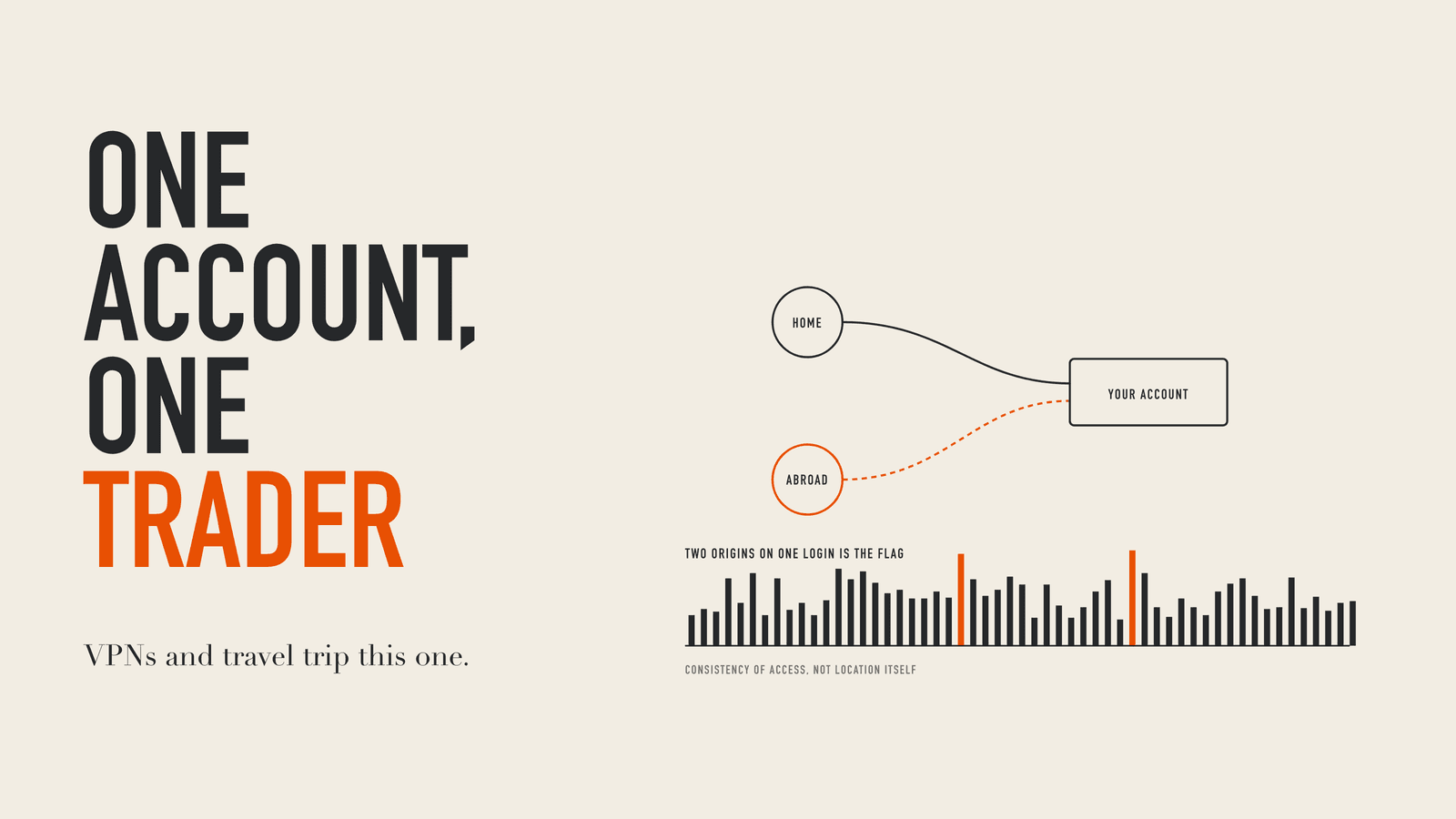
The prop firm IP address rule is generally about consistency, not geography: it checks that the same account is being logged into and traded from a stable, recognizable pattern rather than from many unrelated locations. It is not, on the programs that state it, a rule that bans travel outright or requires you to trade from one fixed city. It exists mainly to catch account sharing, where two people trade one account from two different places at once.
Whether your program even has this rule varies. Some state an IP consistency requirement directly, others don't mention it at all, and the two things it is usually policing, account sharing and unexplained location jumps, sit right next to each other in most rulebooks even though they aren't identical concerns.
Is IP consistency actually a rule at most prop firms?
It's stated on some programs and not on others, and there's no way to know which applies to you except reading your own rulebook. Below is a set of examples showing both sides of that split.
| Program | IP consistency required |
|---|---|
| FTMO Challenge: 2-Step | Not required |
| FTMO Challenge: 1-Step | Not required |
| FundedNext Stellar 2-Step | Required |
| FundingPips 2 Step Standard | Required |
| Maven Trading 2-Step | Required |
| Alpha Futures Standard Account | Required |
Four of the six programs above state the requirement, two don't. A program not stating it doesn't necessarily mean location is a free pass; it means the firm hasn't written a specific IP rule into that program's terms, which is a narrower claim.
Why check IP addresses instead of just trusting traders?
A firm can't see who is physically sitting at the keyboard, only the technical trail a login leaves behind: an IP address, a device fingerprint, a login timestamp. IP consistency is one of the few signals a firm actually has access to that can hint at whether one person is trading an account or several people are, which is why it shows up as a rule at all rather than the firm simply asking traders to self-report.
It's an imperfect signal on its own. A single IP address doesn't prove one trader any more than a changing one proves sharing, since ordinary things like switching from home broadband to a mobile connection, or changing internet providers, can also shift the address a login comes from. That's part of why a genuine review, rather than an automatic and irreversible action, is the more common response to an inconsistent pattern on the programs that state this rule.
What is the rule actually trying to catch?
Account sharing is the main target: a friend, a signal group, or a paid "manager" logging into your account from a different city or country while you also trade it, which the firm reads as multiple people running one account rather than the individual who was evaluated. A consistent IP pattern is one of the signals a firm can check to make sure the account behaves like it's being traded by one person in one general location.
What counts as account sharing under this rule?
The core violation is simple to state and easy to fall into without meaning to: letting anyone else log into and place trades on your account, even someone you trust, even for a single session. It applies whether the other person is a friend covering for you while you sleep, a paid signal service given your login, or a "copy my account" arrangement where a second person executes on your behalf rather than a platform-level copy feature.
A friend logging in for you
Still counts as sharing, even briefly
A paid signal service with your login
Treated the same as any other shared login
Someone trading on your behalf
Not the same as a platform copy-trading feature
That last distinction matters. Copy trading, where a platform mirrors trades from a source account into yours automatically, is a separate rule from account sharing, where a second human being holds and uses your login. A program that restricts one does not automatically restrict the other, so check each one on its own terms rather than assuming they're the same clause.
Does using a VPN break the rule?
It can, because a VPN is one of the more common ways an IP pattern looks inconsistent even when only one person is trading. Routing through a VPN server in a different country changes the location your login appears to come from, and if that happens irregularly it can look, to an automated check, like the account is being accessed from unrelated places. This isn't a statement that any specific program bans VPN use outright; it's that a VPN is a common trigger for the same underlying check that flags shared logins.
What happens if you travel while holding a funded account?
A single location change, a genuine trip, is a different situation from ongoing shared access, and the two aren't meant to be read as the same violation. The practical risk is that a jump in login location can still get flagged for review even when it's entirely legitimate, simply because an automated check can't tell the difference between "the trader flew somewhere" and "someone else is now logging in" from the same pattern alone.
A new IP location appears
The account logs in from a location that doesn't match its usual pattern.
The change is flagged for review
On programs with an IP consistency rule, this can trigger a manual or automated review rather than an immediate action.
The trader may be asked to confirm
Some firms contact the trader directly to confirm the change is legitimate travel rather than shared access.
The account is cleared or restricted
Depending on the program and the review outcome, the account continues normally or is restricted pending further checks.
If you know travel is coming, the safest approach on a program that states an IP consistency requirement is to check with the firm's support directly beforehand rather than assuming a single trip will be read correctly by an automated system with no context.
A short heads-up message costs almost nothing and can save a review from turning into a longer back-and-forth once you're already mid-trip and harder to reach. Firms that state an IP consistency requirement generally have a support channel built for exactly this kind of heads-up, and using it before the trip rather than explaining after the fact tends to be the faster path back to normal trading.
Does this rule differ between futures and forex prop firms?
Not clearly, based on the programs available for comparison. FundingPips and Maven Trading, both forex-side programs, state the requirement, and so does Alpha Futures's Standard Account, a futures program. FTMO's Challenge programs, also forex-side, don't state it. The split here looks like a per-firm decision rather than something tied to futures versus forex the way the daily loss limit's units and clock are.
That lines up with the rule's underlying purpose rather than contradicting it. Account sharing is a risk regardless of whether the account trades futures or forex, since it's about who is controlling the login, not what instrument is being traded. There's no obvious reason a futures firm would care less about that than a forex firm would, so a split by asset class was never especially likely to begin with.
Examples only, the six programs covered in this article. Not a firm-wide statistic.
Speaking of clocks: if you're travelling across time zones, it's worth separately checking how your program's daily loss limit resets, since that's measured against a specific clock regardless of where you're logging in from. See our guide on when the daily loss limit resets for how that timing works.
How Proplysis helps
Proplysis doesn't monitor your login locations or flag IP changes; that check happens on the firm's side, not ours. What Proplysis does is show whether your specific program states an IP consistency requirement at all, per program, so you know before you travel whether it's something to plan around instead of finding out from a support ticket after the fact.
| Program | IP consistency |
|---|---|
| Your program | Shown per program, as stated in the rulebook |
Frequently asked questions
Do all prop firms require IP consistency?
No. Among the programs covered here, FundedNext Stellar 2-Step, FundingPips 2 Step Standard, Maven Trading 2-Step, and Alpha Futures Standard Account state the requirement, while the FTMO Challenge (2-Step and 1-Step) does not. Check your own program's rulebook directly rather than assuming either way.
Will a VPN get my prop firm account flagged?
It can, particularly if the VPN location changes frequently, since that produces the same irregular login pattern the rule is designed to catch. It isn't that VPN use itself is necessarily the violation; it's that inconsistent VPN locations can look like the shared access the rule targets.
Can I trade my funded account while on holiday in another country?
Generally yes, but on a program that states an IP consistency requirement, a sudden location change can trigger a review even when it's completely legitimate. If you know travel is coming, contacting the firm's support beforehand is the safer route than hoping an automated check reads the change correctly.
Is letting a friend log into my account the same as account sharing?
Yes. The rule generally doesn't carve out an exception for trust or for how briefly the other person used the login. Any second person accessing and trading your account is treated as sharing, separate from whether an IP consistency rule also applies.
Is account sharing the same rule as copy trading?
No. Copy trading is a platform feature that mirrors trades from a source account into yours automatically, and it's governed by its own rule that some programs allow and some don't. Account sharing means a second person is actually holding and using your login, which is a separate restriction.
Does the IP consistency rule differ for futures accounts versus forex accounts?
Not in a way the available examples show clearly. Alpha Futures Standard Account, a futures program, states the requirement, the same as several forex-side programs, while FTMO's Challenge programs, also forex-side, don't state it. It looks like a per-firm choice rather than one split along asset class.
Prop firms on Proplysis
Buy your evaluation through our link
These are the firms we list, in alphabetical order. Buying through our link is what keeps Proplysis free to use - it costs you nothing extra.















Some links are affiliate links. Purchasing through them is how Proplysis stays free.