July 18, 2026
Which Prop Firms Allow News Trading?
Most prop firm programs allow news trading, but attach a buffer window around high-impact releases during which you cannot open or close a position. Some programs restrict news trading outright once you reach a funded account, even if the evaluation stage allowed it. The rule is set per program, not per firm, so the only reliable answer is the one written against your specific program.
That per-program detail is where most confusion starts. Traders read one forum post about "the firm" allowing news trades and apply it to a program with a completely different rule. This guide walks through what a news-trading buffer actually restricts, how the rule can differ between evaluation and funded stage, and where futures and forex traders should look for different guardrails around the same economic release.
Can you trade the news on a prop firm account?
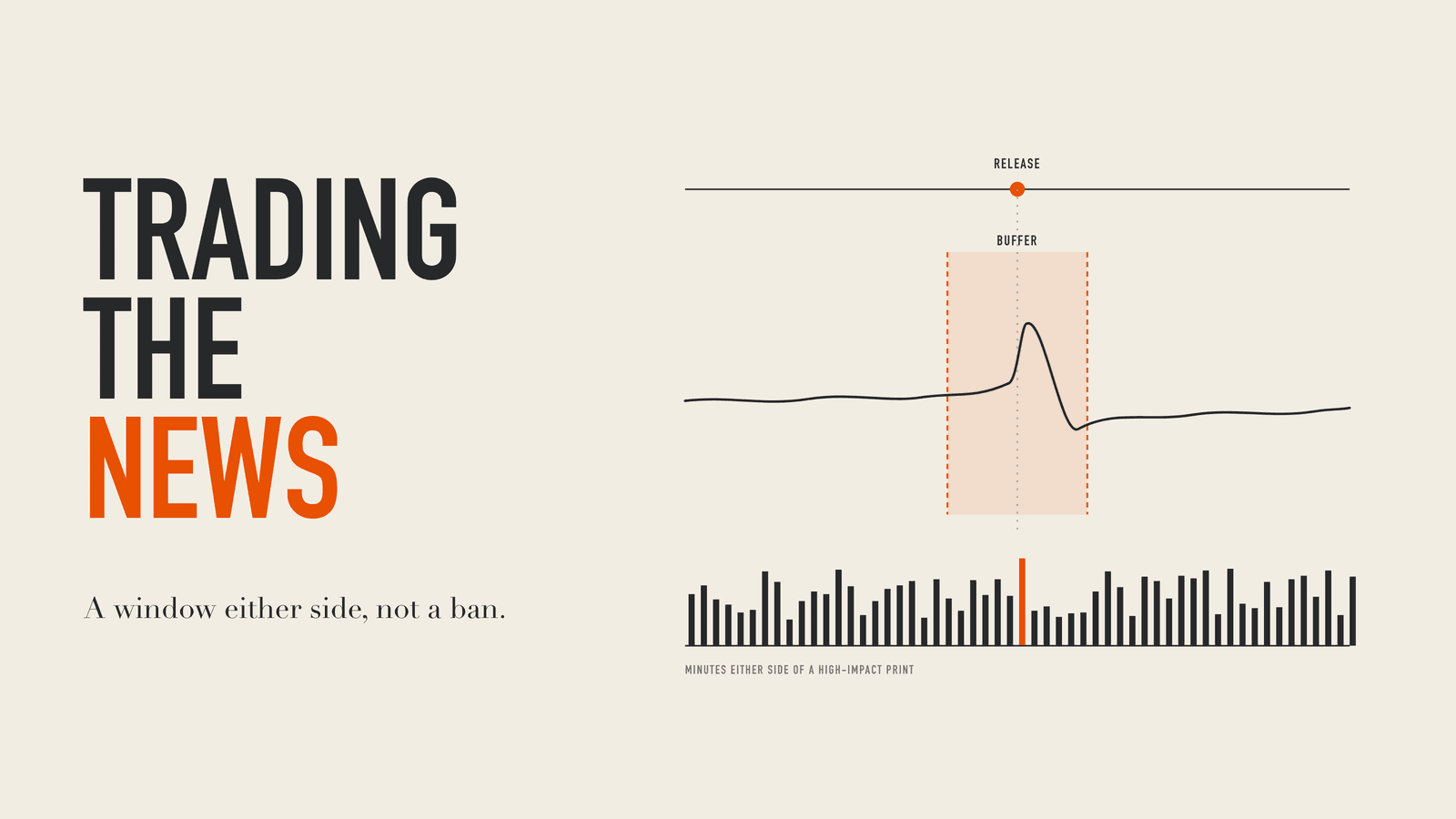
Generally yes, in the sense that most evaluation and funded programs do not ban trading during high-impact economic releases outright. What they usually add instead is a buffer: a short window immediately before and after the scheduled release during which opening or closing a position is restricted. Outside that window, trading around the news is treated the same as any other trading.
A minority of programs go further and disallow news trading entirely, most often at the funded stage rather than the evaluation stage. The distinction matters because it means the rule you cleared your evaluation under is not guaranteed to be the rule your funded account lives under.
| Firm | Program | News trading |
|---|---|---|
| Blue Guardian | 1 Step | Yes |
| Blue Guardian Futures | Express | Yes |
| Bulenox | Option 1 Fast Track | Yes |
| E8 Crypto | E8 One 10% drawdown | Yes |
| E8 Futures | E8 Signature | Yes |
| E8 Markets | E8 One 10% drawdown | Yes |
| Earn2Trade | The Gauntlet Mini™ | Yes |
| FTMO | FTMO Challenge: 1-Step | Yes |
| Funded Futures Network | Standard MAX | Yes |
| FundedNext | Stellar 1-Step | Yes |
| FundedNext Futures | Flex | Yes |
| FundingPips | 1 Step | Yes |
| FundingTraders | 1-Step Pro | Yes |
| Ment Funding Equities | Static | Yes |
| Ment Funding Forex | Forex 1-Step | Yes |
| Ment Funding Futures | Futures 1-Step | Yes |
| Top One Futures | Elite Access | Yes |
| Top One Trader | Nova Challenge | Yes |
| TradeDay | Fast Pass End of Day | No |
| Upcomers | Ash | Yes |
| Upcomers Futures | Thunderbolt Classic | Yes |
All 21 firms. Live from the Proplysis firm database.
That table is generated from the Proplysis firm database when the page loads, so it reflects what we hold today rather than a snapshot taken when this was written. It also answers only half the question: it shows the evaluation stage. The funded stage is a separate rule, and for some of these programs it is the opposite answer, which is covered further down.
What is a news-trading buffer, and how does it work?
A buffer is a fixed number of minutes on either side of a scheduled high-impact release during which the program restricts opening or closing positions. It exists because spreads widen and prices can gap in the seconds around a release, and firms use the buffer to keep a trader's result tied to skill rather than to a lucky or unlucky tick during a thin market.
Buffer length is not standard across firms. The example programs above range from 2 to 10 minutes, and the number alone does not tell you which side of the release it covers or whether it differs between majors, indices, and metals. Treat the minute figure as a starting point and confirm the exact mechanics in your own program's rulebook.
Examples only, from live programs. Minutes describe the buffer window, not a trading limit.
What actually happens during a news release, mechanically?
Step back from any one firm's numbers and the sequence is the same shape everywhere. A scheduled release approaches, a window opens around it, and the account is treated differently for the duration of that window before returning to normal.
A high-impact release is scheduled
Firms typically define this by economic calendar impact rating, not by asset class alone.
The buffer window opens
A set number of minutes before the scheduled time, during which new positions or exits may be restricted.
The release happens
Spreads commonly widen and price can gap during this stretch, which is the reason the buffer exists.
The buffer window closes
Normal trading conditions resume once the stated number of minutes has passed.
Positions opened before the window are reviewed
Programs vary on whether a position opened earlier that is still live during the window is treated as a violation. Confirm this specifically for your program rather than assuming.
Does the rule change between evaluation and funded stage?
Yes, and often. FTMO's Challenge programs allow news trading with a 2-minute buffer at the evaluation stage, and then do not allow it on the funded account that same evaluation earns you. Maven Trading's 2-Step Challenge permits it at both stages. Same question, same firm-level brand, different answers, which is why a single "does this firm allow news trading" answer is close to meaningless.
Compare the funded-stage table below against the evaluation table near the top of this page. Both are generated from the same live data at page load, so the difference between them is a real difference in the rules, not two snapshots taken on different days.
| Firm | Program | News trading |
|---|---|---|
| Blue Guardian | 1 Step | No |
| Blue Guardian Futures | Direct | Yes |
| Bulenox | Option 1 Fast Track | Yes |
| E8 Crypto | E8 One 10% drawdown | No |
| E8 Futures | E8 Signature | Yes |
| E8 Markets | E8 One 10% drawdown | No |
| Earn2Trade | The Gauntlet Mini™ | Yes |
| FTMO | FTMO Challenge: 1-Step | No |
| Funded Futures Network | Standard MAX | No |
| FundedNext | Stellar 1-Step | Yes |
| FundedNext Futures | Flex | Yes |
| FundingPips | 1 Step | No |
| FundingTraders | 1-Step Pro | Yes |
| Ment Funding Equities | Static | Yes |
| Ment Funding Forex | Forex 1-Step | Yes |
| Ment Funding Futures | Futures 1-Step | Yes |
| Top One Futures | Elite Access | Yes |
| Top One Trader | Instant Funding | Yes |
| TradeDay | Fast Pass End of Day | No |
| Upcomers | Ash | Yes |
| Upcomers Futures | Thunderbolt Classic | Yes |
All 21 firms. Live from the Proplysis firm database.
2 min
FTMO Challenge 2-Step, evaluation: news allowed
5 min
FundingPips 2 Step Standard, evaluation: news allowed
10 min
FundingPips Zero, funded: news not allowed
FundingPips is worth reading carefully here, because it is a single firm running two rules at once, not one rule that loosens or tightens with time. Its 2 Step Standard evaluation program permits news trading with a 5-minute buffer. Its Zero program, a funded account structure, does not permit news trading at all, and still carries a 10-minute buffer window around releases regardless. These are two different programs with two different rules, not two stages of the same program.
Is news trading treated differently for futures versus forex?
Not as a clean structural split, and it is honest to say so rather than invent one. The buffer-minute mechanic in the examples above comes from forex and CFD programs, which is where the concept is most commonly quoted in rulebooks and marketing pages. The futures example available here, FundedNext Futures's Bolt, Flex, and Legacy programs, states that news trading is allowed without naming a specific buffer figure.
That does not mean futures accounts face no guardrails around news. Exchange-driven volatility halts, wider margin requirements around major releases, and the general structure of exchange trading hours all interact with a big number like a jobs report or a rate decision, just through different mechanisms than a stated buffer window. If your futures program does state an explicit buffer, treat that written figure as the rule and the general market structure as background context, not the other way around.
What happens if you break a news-trading restriction?
This is where the caution has to be plainest. What actually happens on a violation, whether it is a warning, a forced close, a rule strike, or an account failure, is not something this guide can state for any specific program, because that operational detail was not in the verified facts behind this article. Assume it can be serious and confirm it directly in your program's rulebook before you test the boundary. A loss taken during a news event still counts toward your account's daily loss limit the same as any other loss, and our guide to when the daily loss limit resets covers how that figure is calculated day to day.
What should you actually do around a scheduled release?
Practically, the safest habit is to treat the buffer window as closed rather than restricted. Decide your position before the window opens, not during it, because a program that disallows opening or closing a trade inside the window will not care that your intention formed a few seconds too late. If you plan to hold a position through a release on a program that allows it, size it before the window starts, since spreads widening inside the window can also change your effective risk on an existing position even without a new order.
It also helps to separate the economic calendar from your program's own rulebook in your head. The calendar tells you when a release happens and how big the market generally expects it to be. Your program's rulebook tells you whether that release matters to your account at all, and if so, for how many minutes on either side. Traders who only check the calendar and skip the rulebook are the ones who find out about a buffer window the hard way.
How Proplysis helps you track news-trading rules
News-trading permission and buffer length are not something the compliance engine monitors or alerts on. Proplysis does not watch the clock around a release for you. What it does is put the rule in front of you per program, so the buffer window and the allowed/not-allowed status are sitting on your dashboard next to the account they apply to, instead of buried in a PDF you have to reopen mid-session.
| Program | News trading | Buffer |
|---|---|---|
| Account A | Allowed | 2 minutes |
| Account B | Not allowed | 10 minutes |
Frequently asked questions
Do all prop firms restrict news trading?
No. Among the example programs in this article, news trading is allowed at FTMO's 2-Step and 1-Step Challenges, FundedNext's Stellar programs, FundingPips's 2 Step Standard evaluation, Maven Trading's 2-Step Challenge, and the FundedNext Futures programs. FundingPips's Zero funded program is the one example here that does not allow it. Restriction is common enough to check for, not universal.
What is a typical buffer window for news trading?
Among the programs named in this article the range runs from 2 to 10 minutes. There is no single industry-standard figure, and the number alone does not tell you whether it covers the minutes before the release, after it, or both. Confirm the exact window in your own program's rulebook.
Can a funded account have a different news rule than the evaluation that unlocked it?
It can, and FundingPips is a direct example of two different programs at one firm running opposite rules: 2 Step Standard permits news trading during evaluation, while Zero, a funded program, does not. Never assume the rule that got you through an evaluation still applies once you are funded, especially if the funded structure is a different named program.
Are futures news-trading rules the same as forex news-trading rules?
Not necessarily. The buffer-minute figure is most commonly quoted by forex and CFD programs. Futures programs can state that news trading is simply allowed, without a stated buffer, and instead rely on exchange-level mechanisms such as volatility halts and margin changes around major releases. Read your specific program's rulebook rather than assuming either market's convention applies to the other.
Does a loss during a news event count differently against my daily loss limit?
No, a loss taken during a news release counts the same as any other loss toward your account's daily loss limit. The limit itself resets on its own schedule, which is covered in our guide to when the daily loss limit resets, and that schedule is unrelated to the news calendar.
Where do I find my own program's exact news-trading rule?
In the rulebook attached to your specific program, not the firm's general marketing page, since the two can differ even within one firm. If the buffer window is stated without detail on which assets it covers or whether it applies both sides of the release, treat that as unconfirmed and ask support directly before you trade around a scheduled number.
Prop firms on Proplysis
Buy your evaluation through our link
These are the firms we list, in alphabetical order. Buying through our link is what keeps Proplysis free to use - it costs you nothing extra.














Some links are affiliate links. Purchasing through them is how Proplysis stays free.