August 21, 2026
Bulenox Consistency Rule: The Best-Day Cap on Every Payout
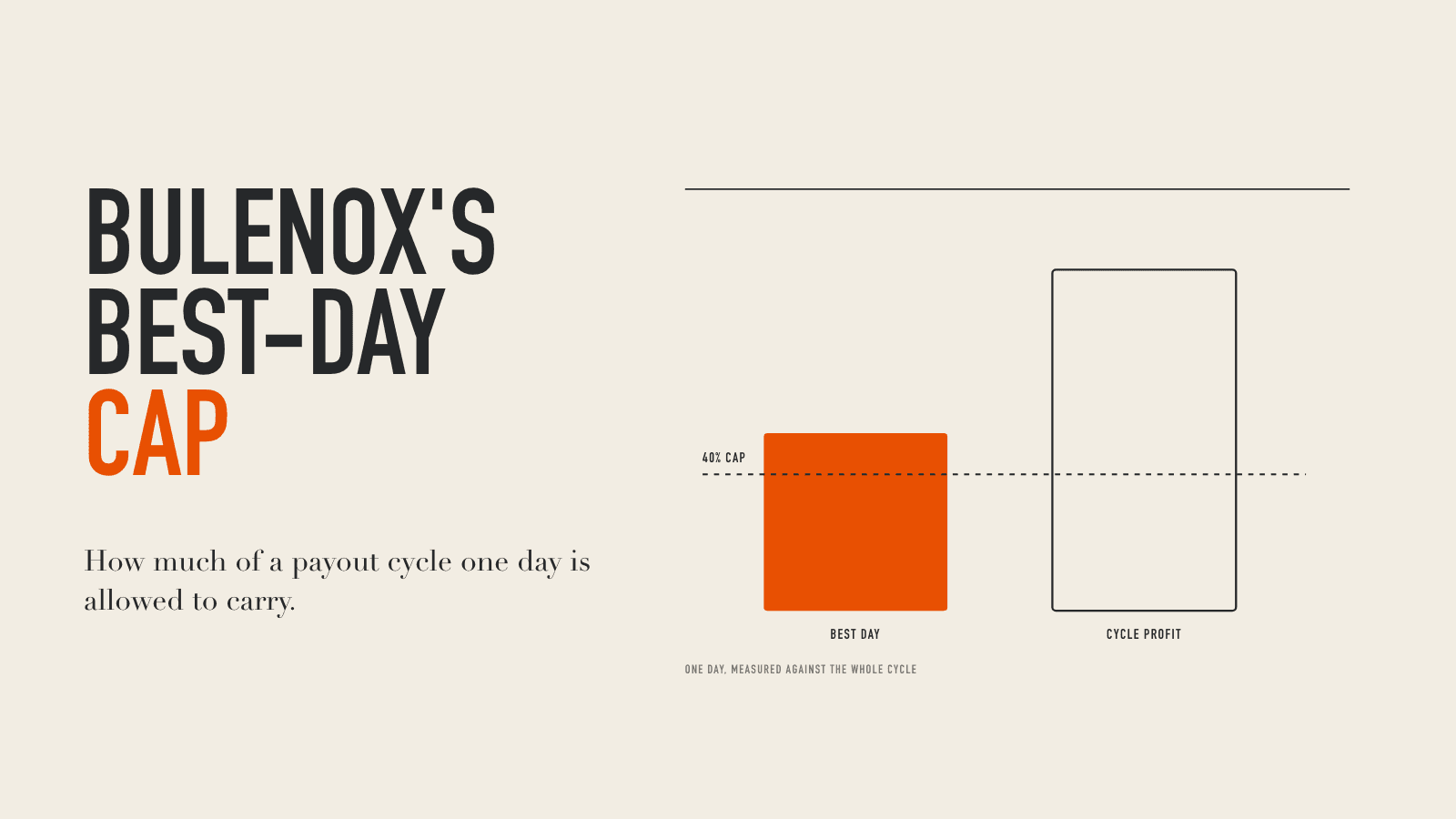
The Bulenox consistency rule caps how much of a payout cycle's profit is allowed to come from your single best trading day. On the Option 1 Qualification and Option 2 Qualification programs the cap is 40%. On Option 1 Momentum and Option 2 Momentum it is 35%. On Option 1 Fast Track and Option 2 Fast Track it starts at 20% for your first payout, moves to 25% for the second, and settles at 30% from the third onwards. Miss the cap and your payout is held until the number comes back into line. It does not fail your account.
That last sentence is the part most traders get wrong, and it is the difference between a bad week and a lost account.
| Program | Best-day cap | Drawdown model |
|---|---|---|
| Option 1 Qualification | 40% of cycle profit | Intraday trailing |
| Option 1 Fast Track | 20% / 25% / 30% by payout number | Intraday trailing |
| Option 1 Momentum | 35% of cycle profit | Intraday trailing |
| Option 2 Qualification | 40% of cycle profit | End-of-day trailing |
| Option 2 Fast Track | 20% / 25% / 30% by payout number | End-of-day trailing |
| Option 2 Momentum | 35% of cycle profit | End-of-day trailing |
How is the Bulenox consistency percentage calculated?
One division. Take the profit and loss of your single most profitable day in the payout cycle, divide it by the total profit and loss for that same cycle, and multiply by 100. Bulenox states the Option 1 Qualification and Option 2 Qualification calculation directly: consistency percentage = best day P&L / total P&L x 100, and the result must be 40% or less.
Two things follow from the shape of that fraction, and both catch people out.
The first is that the denominator is the cycle, not the account. Profit you withdrew in an earlier cycle is gone from the sum. A cycle that starts fresh after a payout starts your ratio fresh too, which is why one enormous day early in a new cycle is far more dangerous than the same day would have been at the end of the last one.
The second is that you can only ever fix the fraction from the bottom. Your best day is a fact once it has closed. Nothing you do afterwards makes it smaller. The only lever left is the total, and the only way to grow the total is more profitable days.

What happens if you are over the cap on payout day?
Nothing happens to the account. Bulenox records the consequence as blocked until compliant: the payout request is refused, and you keep trading the same account under the same rules until the percentage falls inside the cap. Bulenox's own wording on the Momentum and Fast Track programs is that missing it is not a breach, and that you keep trading until the account comes into line.
This is worth saying plainly because a lot of firms in this niche do treat a consistency miss as a hard failure, and traders arrive at Bulenox carrying that assumption. Here, the rule gates money, not survival. Your drawdown threshold is what can end an account. The consistency percentage only decides whether today is the day you get paid.
The cap also resets after each successful payout on all six programs, so the ratio you fought to fix in one cycle does not follow you into the next.
Option 1 Fast Track and Option 2 Fast Track. Verified figures, not illustrative.
Why is Fast Track stricter on your first two payouts?
The Option 1 Fast Track and Option 2 Fast Track programs escalate the cap by payout number rather than holding one figure. It is 20% for the first payout, 25% for the second, and 30% from the third onwards. Bulenox records this as a rule in its own right: the cap tightens and then loosens by payout number.
The practical effect is front-loaded. A 20% cap means your best day may be no more than a fifth of the cycle's total profit, which forces at least five days of comparable size before the first payout clears. By your third payout the same account is running at 30%, which is still tighter than the 35% on Momentum, but is meaningfully easier than where it started.
If you plan to take a first payout quickly on Fast Track, plan the size of your days before you take them. The 20% cap is the tightest consistency figure Bulenox applies anywhere.
Does the rule work the same on Option 1 and Option 2?

Yes, for consistency. The cap on Option 1 Qualification matches Option 2 Qualification at 40%, Option 1 Momentum matches Option 2 Momentum at 35%, and Option 1 Fast Track matches Option 2 Fast Track on the same 20/25/30 escalation.
What differs between the two families is the risk model behind them, not the payout arithmetic. Option 1 programs run an intraday trailing drawdown, which follows your account's peak as it happens. Option 2 programs run an end-of-day trailing drawdown, which only moves on closed daily balances. That choice changes how you size a position; it does not change how your best day is measured against your cycle.
There is one gap worth naming honestly. Bulenox publishes these percentages against payout cycles on the funded stage. Our rule database holds no consistency percentage for the Qualification stage itself, and Bulenox does not state one as a proven absence either. That means unstated, not absent. If you are mid-Qualification and the answer matters to your plan, ask Bulenox directly rather than assuming either way.
How much more do you need to trade to get compliant?
Work it backwards from the cap. Divide your best day by the cap expressed as a decimal, and the answer is the cycle total you need.
Say a cycle sits at $4,000 of net profit and the best day inside it made $1,800. That is 45%, over the 40% cap that Option 1 Qualification and Option 2 Qualification carry. Divide $1,800 by 0.40 and you need a $4,500 cycle total, so another $500 of profit clears it, as long as no day inside that $500 becomes a new best day.
Run the same account on the first Fast Track payout at 20% and the arithmetic turns brutal: $1,800 divided by 0.20 is a $9,000 cycle total, more than double where you are. Same trading, same day, four and a half times the profit needed to unlock it. That gap is the whole argument for keeping day sizes even from the start of a cycle rather than repairing the ratio afterwards.
Find your best day
The single highest net-profit day inside the current payout cycle. It is fixed once that day has closed.
Divide it by the cap
Best day divided by 0.40 on Qualification, by 0.35 on Momentum, by 0.20 on a first Fast Track payout.
That is the cycle total you need
Subtract your current cycle profit to see how much more the cycle still has to make.
Add profit without a new best day
Any day larger than the current best day pushes the required total up again.
Request the payout
The percentage is checked at request time, and it resets after a successful payout.
How does Bulenox's cap compare with other futures firms?
Consistency percentages vary widely across futures firms, and they are set per program rather than per firm, so a single number for any firm is usually the wrong question. The table below reads live from our rule database on every page load, so it does not go stale the way a hand-typed comparison does.
Read it as one row per firm, its best-disclosed program. A cell showing a value is a stated percentage, "None" with a check mark means the firm has proven there is no such rule, and "Not stated" means exactly that: unknown for that firm, not absent.
| Firm | Program | Stage | Consistency |
|---|---|---|---|
| Blue Guardian Futures | Direct | Funded | Yes |
| Bulenox | Option 1 Fast Track | Evaluation | Yes |
| E8 Futures | E8 Signature | Evaluation | Yes |
| Earn2Trade | The Gauntlet Mini™ | Evaluation | 30% |
| Funded Futures Network | Standard MAX | Evaluation | 40% |
| FundedNext Futures | Flex | Evaluation | 40% |
| Ment Funding Futures | Futures 1-Step | Evaluation | 33% |
| Top One Futures | Elite Access | Evaluation | Yes |
| TradeDay | Fast Pass End of Day | Evaluation | 45% |
| Upcomers Futures | Thunderbolt Classic | Evaluation | Yes |
All 10 firms. Live from the Proplysis firm database.
For Bulenox's full rule set alongside the drawdown model, contract limits and payout mechanics, see the Bulenox rules page and the Bulenox payout policy. The general mechanics of how these caps work across the industry are covered in the prop firm consistency rule guide, and the payout side in how prop firm payouts work.
Tracking your consistency percentage across accounts
Bulenox lets one trader hold up to five active Master-level accounts at once, in any combination of Master, Fast Track and Momentum. That is five separate payout cycles, on two different caps or more, each with its own best day and its own running total.
Proplysis shows your live standing on the consistency percentage for each account and program, computed from your synced trades, so you are reading one number per account instead of exporting statements and dividing by hand. It is a live standing figure and nothing more: a consistency miss does not end an account, so Proplysis puts the number in front of you rather than watching it for you. The dashboard is free. If you are buying a Bulenox account anyway, buying it through Proplysis is what pays for it.
Best day as a share of cycle profit
Illustrative example, not a specific account's figures.
FAQ
Does the Bulenox consistency rule fail my account?
No. Bulenox records a consistency miss as blocked until compliant, meaning the payout is held rather than the account closed. Its own wording on the Momentum and Fast Track programs is that missing the percentage is not a breach and that you keep trading until the account comes into line. What ends a Bulenox account is the drawdown threshold, which is a separate rule.
What is the consistency percentage on Bulenox Fast Track?
The Option 1 Fast Track and Option 2 Fast Track programs use 20% for the first payout, 25% for the second, and 30% from the third onwards. It is the only Bulenox consistency figure that changes with payout number. Qualification stays at 40% and Momentum stays at 35%.
Does the consistency rule reset after a payout?
Yes. On all six Bulenox programs the consistency calculation resets after a successful payout. The next cycle starts with a fresh total and a fresh best day, which is why a large day is riskier at the start of a cycle than at the end of one.
Is the cap different on Option 1 and Option 2?
No. Each tier carries the same percentage in both families: 40% on both Qualification programs, 35% on both Momentum programs, and the same 20/25/30 escalation on both Fast Track programs. The difference between Option 1 and Option 2 is the drawdown model, intraday trailing against end-of-day trailing.
Do losing days lower my consistency percentage?
A losing day reduces the cycle total, which is the denominator, so it pushes the percentage up rather than down. Only additional profitable days that are smaller than your current best day bring the ratio toward the cap.
Is the best day measured per trade or per day?
Per day. The figure is the net profit and loss of a full trading day, and it is that day's total that gets divided by the cycle's total. A single large trade only matters through the day it lands in.
Prop firms on Proplysis
Buy your evaluation through our link
These are the firms we list, in alphabetical order. Buying through our link is what keeps Proplysis free to use - it costs you nothing extra.















Some links are affiliate links. Purchasing through them is how Proplysis stays free.