July 18, 2026
Prop Firm Consistency Rule: Which Firms Have One, and How Much
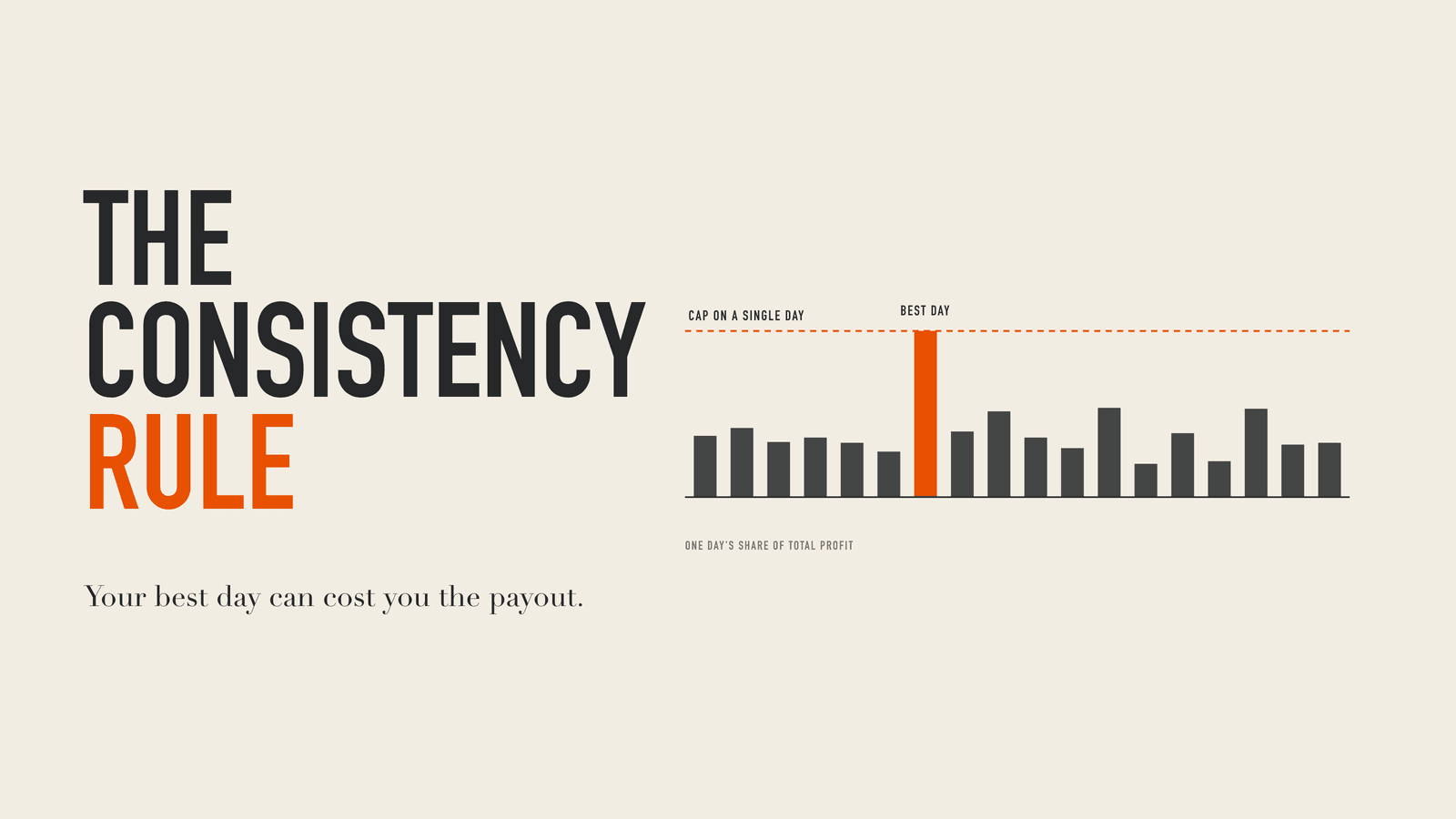
The consistency rule caps the share of your total profit that one single day is allowed to contribute. If a program sets it at 40%, no single day's profit can be more than 40% of everything you have made so far, or that day's excess gets excluded when the firm checks your payout. It is usually a payout gate, not an instant account breach, which is exactly the part that trips people up.
That distinction matters because a trader who reads "consistency rule" and pictures a wall that stops them mid-session is picturing the wrong mechanism. This guide covers what the percentage is measured against, where it gets checked, and why one enormous winning day can quietly cost you a payout weeks later.
Which prop firms have a consistency rule, and how much?
The table below is built from the Proplysis firm database each time this page loads, so it shows what we hold today rather than a list frozen on the day the article was written. Each row is one firm, its most clearly disclosed program, because the cap is set per program: the same brand can run very different numbers across its products, and quoting a single figure for a firm is how people end up planning against a rule that does not apply to the account they bought - check the firm's own page for the full per-program breakdown.
| Firm | Program | Stage | Consistency |
|---|---|---|---|
| Blue Guardian | 1 Step | Evaluation | None ✓ |
| Blue Guardian Futures | Direct | Funded | Yes |
| Bulenox | Option 1 Fast Track | Evaluation | Yes |
| E8 Crypto | E8 One 10% drawdown | Evaluation | Yes |
| E8 Futures | E8 Signature | Evaluation | Yes |
| E8 Markets | E8 One 10% drawdown | Evaluation | Yes |
| Earn2Trade | The Gauntlet Mini™ | Evaluation | 30% |
| FTMO | FTMO Challenge: 1-Step | Evaluation | 50% |
| Funded Futures Network | Standard MAX | Evaluation | 40% |
| FundedNext | Stellar 1-Step | Evaluation | Not stated |
| FundedNext Futures | Flex | Evaluation | 40% |
| FundingPips | 1 Step | Evaluation | Yes |
| FundingTraders | 1-Step Pro | Evaluation | Yes |
| Ment Funding Equities | Static | Evaluation | 33% |
| Ment Funding Forex | Forex 1-Step | Evaluation | Yes |
| Ment Funding Futures | Futures 1-Step | Evaluation | 33% |
| Top One Futures | Elite Access | Evaluation | Yes |
| Top One Trader | Instant Funding | Funded | 15% |
| TradeDay | Fast Pass End of Day | Evaluation | 45% |
| Upcomers | Ash | Evaluation | Yes |
| Upcomers Futures | Thunderbolt Classic | Evaluation | Yes |
All 21 firms. Live from the Proplysis firm database.
Two patterns are worth reading off it. First, the tightest caps sit on instant-funded products rather than evaluations: paying to skip the challenge often buys a stricter rule, not a looser one. Second, FTMO labels its version the "Best Day Rule" and treats it as a soft cap on a withdrawal rather than an instant breach of the account, which matches how most consistency rules behave once you look past the marketing name.
What "Not stated" means, and why we will not guess
A cell reads "Not stated" when we do not hold a verified figure for that program. It does not mean the program has no consistency rule. We print "None" only where a firm's own documentation explicitly rules the requirement out and we have that source on file, which is a deliberately high bar. "Which prop firm has no consistency rule" is one of the most-asked questions in this market, and the honest answer for a good number of programs today is that nobody has published it clearly enough to state either way. A comparison table that quietly turns missing data into "no rule" is worse than one that admits the gap, because you would size an account around it.
What problem is the consistency rule solving for the firm?
A firm paying out real money wants evidence of a repeatable process, not a single lucky trade dressed up as a track record. A trader who makes $9,000 on one news spike and $200 on every other day has technically hit a profit target, but the firm has no evidence that trader can do it again. The consistency rule exists to filter for the second kind of trader over the first.
Soft cap
Usually blocks or reduces a payout, not an instant breach
Per program
The percentage and enforcement point vary by program
Checked at payout
Most programs evaluate it when you request funds
How is the consistency percentage actually calculated?
The common version divides your single best day's profit by your total profit across the evaluation or funded period. A 40% consistency rule means your best day cannot exceed 40% of the total. If it does, the program typically does one of two things at payout time: it either holds the payout until the ratio is fixed by further trading, or it pays out everything except the portion of that one day's profit that pushed you over the cap.
Some programs define it slightly differently, comparing the best day against the profit target rather than the running total, or checking it daily instead of only at payout. The mechanism always answers the same question though: does one day account for too much of the story?
What does an over-the-cap day actually look like?
Picture a five-day stretch where four days are small and steady and one day is a large outsized win. The chart below is an illustrative example only, not any specific firm's data, but the shape is the one that trips the rule.
Illustrative example. Day 3 alone supplies more than the 40% cap allows.
Total profit across the five days is $3,200. Day 3 alone is $2,100, which is roughly two thirds of the total, far past a 40% cap. Every other day being solid and repeatable does not offset one day that large. The fix is not to have avoided the good trade; it is to keep trading afterward until the ratio comes back down, or to size that single day differently in the first place.
Across a wider sample of accounts, the share of total profit coming from a single best day tends to cluster: most traders land well under any common cap, and a smaller group lands far over it. The illustration below shows that shape, not a measured statistic from any dataset.
Best day / total profit
What happens at the moment a payout is requested?
The consistency check is usually one step in a larger payout process, run after the profit target and minimum trading days are already satisfied.
Profit target confirmed
The account has reached the required overall profit for the phase.
Minimum trading days confirmed
The account has traded on enough separate days.
Best-day ratio calculated
The single largest day's profit is divided by total profit.
Ratio compared to the cap
If it exceeds the program's consistency percentage, the payout is held, reduced, or delayed until fixed.
Payout released
Once every check clears, the request is approved.
Notice that the consistency check comes after the profit target, not before it. That ordering is why traders sometimes reach a target and still cannot withdraw: the number on the account is right, but the shape of how it got there is not.
Some programs also move the cap as you go rather than holding it flat. The Bulenox payout rules are a worked example: on its instant-funded route the ceiling is tightest for the very first withdrawal and only loosens from the third, which is the opposite of what most traders expect.
Does the consistency rule differ between futures and forex?
Not structurally. The underlying question, whether one day's profit dominates the total, is the same in both markets, and the percentage-of-total-profit mechanic does not change based on what you trade. What differs is the size of the moves that typically produce an outsized day. A single futures contract move around a data release or a forex position held through a surprise announcement can both create the same lopsided ratio; the instrument changes, the math behind the rule does not.
Where futures and forex genuinely diverge is in the daily loss and drawdown conventions around the same account, covered in our guide to when the daily loss limit actually resets. The consistency rule sits alongside those, not inside them.
Illustrative example, not a specific account or firm.
Why do so many traders get caught by this rule without noticing?
Part of the problem is timing. A trader who has a single huge day early in an evaluation feels like the hard part is over: the profit target is nearly met, the account looks strong, and the temptation is to trade smaller or stop entirely rather than "risk" the gain. That instinct is exactly what creates a consistency breach, because the rest of the account's trading history stays thin while that one day keeps sitting at the top of the ledger. The fix is almost the opposite of what feels safe: keep trading at a normal size afterward so more days get added to the denominator, which is the only thing that brings the ratio back down.
The other part of the problem is that most platforms do not surface the ratio anywhere in the trading interface itself. A trader can watch balance, equity, and open profit in real time and still have no visibility into how lopsided their own track record has become, because the consistency calculation happens on the firm's back end, usually only at the moment a payout is requested. That gap between "the number looks fine" and "the shape of the number is fine" is where most consistency surprises come from, and it is also the part a dashboard can close simply by calculating the ratio continuously instead of waiting for a payout request to reveal it.
How Proplysis helps
Proplysis calculates your best day's share of total profit and shows it as a live gauge on your account's Rules page, alongside your program's consistency cap where one is on file. There is no breach alert for this rule: it shows your live standing so you can see the ratio moving before you ever get to a payout request, rather than warning you the way it does for a hard limit like daily loss or max drawdown.
Best day as a share of total profit
Illustrative example of the live standing view. Not a specific account.
Frequently asked questions
What is the prop firm consistency rule in simple terms?
It is a cap on how much of your total profit one single day can supply. If your best day is more than the allowed percentage of everything you have made, the program typically holds or reduces your payout until the ratio comes back within the cap.
Does breaking the consistency rule fail my account?
Usually not by itself. Most programs treat it as a soft cap checked at payout time, meaning it delays or reduces what you can withdraw rather than ending the account outright. Confirm this against your own program's rules, since enforcement details differ.
Is the consistency rule the same for futures and forex accounts?
The underlying mechanic, one day's profit divided by total profit, does not change by market. What differs is simply how large a single move typically is in each market, which affects how easily one day dominates the total.
How do I avoid breaching the consistency rule after one huge day?
Keep trading afterward at a normal size so subsequent days bring the ratio back down, rather than stopping once you feel "done" for the phase. A single outsized day early on is not fatal; letting it stand as your only significant day is what triggers the cap.
Does the consistency percentage apply to losing days too?
Most versions of the rule look at your best profitable day against your total profit, not at losses. A large losing day affects your account balance and other rules, like daily loss or drawdown, but it is a separate calculation from the consistency check.
If a program shows "Not stated", does that mean it has no consistency rule?
No. "Not stated" means we hold no verified figure for that program, and absence of data is not absence of a rule. A program genuinely without the requirement reads "None", and we only print that where the firm's own documentation rules it out and we have the source on file.
Prop firms on Proplysis
Buy your evaluation through our link
These are the firms we list, in alphabetical order. Buying through our link is what keeps Proplysis free to use - it costs you nothing extra.















Some links are affiliate links. Purchasing through them is how Proplysis stays free.