August 13, 2026
Instant Funding vs Evaluation: Which Prop Firm Rules Actually Change
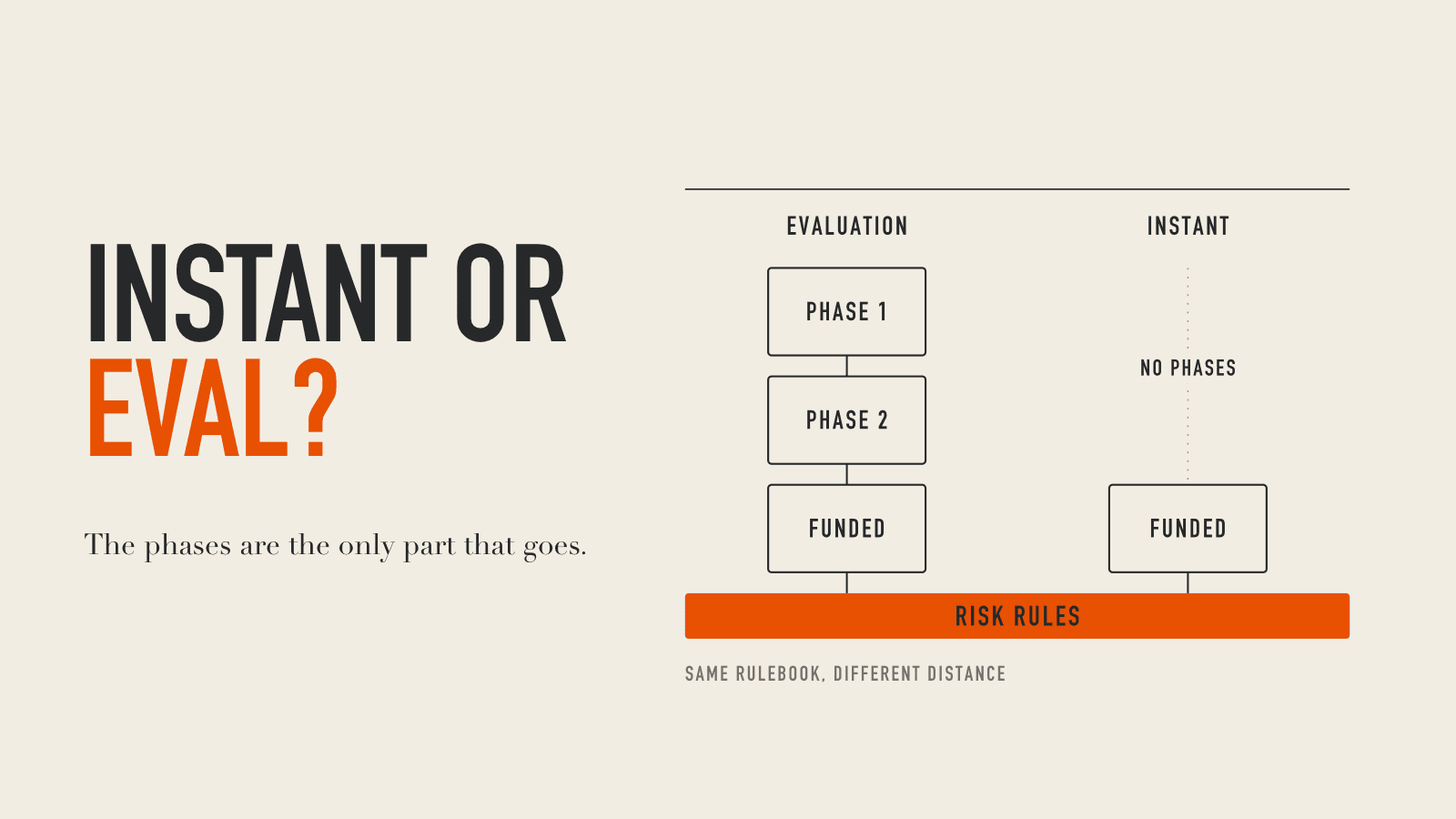
Instant funding removes the evaluation, not the rulebook. Buying a funded account skips the profit target and the phase structure, and everything else moves forward in time rather than disappearing: the daily loss limit, the drawdown floor, the behaviour rules and the payout conditions all apply from your first trade instead of from the day you pass. If you are searching for an instant funding prop firm without a consistency rule, that timing is the whole answer. Removing the evaluation removes the evaluation-stage consistency check, because there is no evaluation left to check. It leaves the payout-stage one exactly where it was.
What does instant funding actually remove?
An evaluation program sells you a test. An instant funding program sells you the account. Every rule that disappears is attached to the test, and every rule that survives is attached to one of two other things: protecting the firm's capital while you trade it, or governing money that leaves the firm. Neither of those concerns cares how you got the account.

Firms price that difference. An instant account commonly costs more upfront than a challenge of the same size, or arrives with a smaller starting balance, or begins on a lower profit split that improves after the first few payouts. The evaluation was doing filtering work for the firm, and when a firm removes it, it recovers the cost elsewhere in the terms. Reading the comparison as "same account, less waiting" is where most of the disappointment starts.
| Rule | Evaluation program | Instant funding program |
|---|---|---|
| Profit target | Gate to the next phase | No phase to clear |
| Phase structure | One to three steps | None |
| Consistency requirement | Often applied to the evaluation | Commonly applied to the payout instead |
| Daily loss limit | Applies throughout | Applies from the first trade |
| Drawdown floor | Applies throughout | Applies from the first trade |
| News, EAs, copy trading | Set per program | Set per program |
| Minimum trading days | May apply per phase | Usually applies to the payout |
| Payout conditions | Apply once funded | Apply from the start |
Read the middle column as what the test was for and the right column as what the capital is for. Only the first two rows genuinely disappear. Everything below them moves earlier.
Is there an instant funding program without a consistency rule?
It is a per-program question, never a per-firm one. Rules are stored one to many, so a single brand can run a two-step challenge with a consistency requirement and an instant account that handles it completely differently. "Does this firm have a consistency rule" cannot be answered. "Does this firm's instant funded program have one" can be.

The reason is that a consistency rule does two different jobs and people conflate them. In an evaluation it is a filter: without it, a trader can reach a profit target with one oversized position on one day and pass on luck rather than process. After funding, the firm is no longer deciding whether to hand you an account, it is deciding whether to wire you money, and it asks the same question in a different frame. Was this period's profit the product of a method, or of one trade the firm now has to pay for?
An instant funding program has nothing to filter, so the first job disappears and the second one usually stays. That is why "no consistency rule" claims about instant programs are so often half true. They are describing the missing evaluation check and saying nothing at all about the payout check, which is the one that decides whether your money arrives.
We publish the live per-program answer, including which programs genuinely have none and which simply have not published a figure, in our guide to the prop firm consistency rule. One thing worth carrying over from it before you buy anything: a blank field means the firm has not stated the rule, which is not the same as the firm not having one. Absence of data is not absence of a rule, and any comparison table that quietly turns one into the other will cost you a payout eventually.
Which rules apply from your very first trade?
All of the risk ones, with no ramp and no grace period. This is the part traders underestimate, because on a challenge the first phase quietly doubles as practice on the rulebook. You learn where the floor sits and when the day rolls while the only thing at stake is the fee. On an instant account there is no practice round. Your first misread of the terms happens on live terms.
Drawdown type is the single most important thing to check, and the most commonly assumed. Static or trailing, trailing on closed balance or on intraday equity, trailing forever or locking once it reaches the starting balance: these are four materially different accounts, and they are set per program. An answer you found in a review of the same firm's two-step challenge does not transfer to their instant product. The table below is generated from our firm database each time this page loads, one row per firm - whichever of its programs states drawdown type most clearly - so it reflects what we hold today rather than a list frozen on the day this was written.
| Firm | Program | Stage | Drawdown type |
|---|---|---|---|
| Blue Guardian | 1 Step | Evaluation | Trailing intraday |
| Blue Guardian Futures | Direct | Funded | Trailing EOD |
| Bulenox | Option 1 Fast Track | Evaluation | Trailing intraday |
| E8 Crypto | E8 One 10% drawdown | Evaluation | Trailing intraday |
| E8 Futures | E8 Signature | Evaluation | Trailing EOD |
| E8 Markets | E8 One 10% drawdown | Evaluation | Trailing intraday |
| Earn2Trade | The Gauntlet Mini™ | Evaluation | Trailing EOD |
| FTMO | FTMO Challenge: 1-Step | Evaluation | Trailing EOD |
| Funded Futures Network | Standard MAX | Evaluation | Trailing EOD |
| FundedNext | Stellar 1-Step | Evaluation | Static |
| FundedNext Futures | Flex | Evaluation | Trailing EOD |
| FundingPips | 1 Step | Evaluation | Static |
| FundingTraders | 1-Step Pro | Evaluation | Trailing intraday |
| Ment Funding Equities | Static | Evaluation | Static |
| Ment Funding Forex | Forex 1-Step | Evaluation | Static |
| Ment Funding Futures | Futures 1-Step | Evaluation | Static |
| Top One Futures | Elite Access | Evaluation | Trailing EOD |
| Top One Trader | Instant Funding | Funded | Trailing EOD |
| TradeDay | Fast Pass End of Day | Evaluation | Trailing EOD |
| Upcomers | Ash | Evaluation | Trailing intraday |
| Upcomers Futures | Thunderbolt Classic | Evaluation | Trailing intraday |
All 21 firms. Live from the Proplysis firm database.
A trailing floor is the one that surprises people on an instant account, because it starts moving with your first profitable trade rather than after a phase you have already survived. It follows your equity or your closed balance upward, and depending on the program it may never come back down. A trader who is up and then gives some back has not just lost profit, they have lost the distance between where they are now and a floor that moved while they were winning.
Illustrative example, not a specific firm's figures.
Seven sessions in, the account is up on where it started and has roughly a fifth of its original buffer zone left, purely because the floor followed the good days up and stayed there through the bad ones. Nothing in that sequence is reckless trading. It is the ordinary shape of a profitable week measured against a rule that only moves one way.
Does the futures and forex split change any of this?
It changes how the limits are written, not whether they apply. Across the programs we track, forex and CFD daily loss limits are expressed as a percentage of balance or equity, and futures ones as a fixed dollar amount per account size, with effectively no crossover between the two conventions. That difference has nothing to do with how you were funded and everything to do with the market.
The day roll splits the same way. A futures day rolls at an exchange session close, 5:00pm New York for CME products, while a forex day rolls at broker server midnight, commonly GMT+2 or GMT+3. Those two land within a couple of hours of each other, which is exactly why traders who move between markets tend to find the difference the hard way rather than in the terms. Our guide to when the daily loss limit resets covers that in full.
The consistency rule does not split along this line the way the loss limits do. It appears in both markets, and it is written differently by nearly every firm, which is the honest reason there is no rule of thumb for it.
Is instant funding easier than an evaluation?
Faster, not easier. You skip the profit target and the phase structure, which is where most evaluations are lost, and you keep every risk rule from your first trade with none of the low-stakes rehearsal a first phase provides. You also usually pay more for the privilege. If you are weighing the routes rather than the rules, our comparisons of 1-step vs 2-step evaluations and of evaluation vs funded accounts cover the ground either side of this one.
What to check before you buy an instant funded account
Five questions, in this order, answered from the program's own terms rather than from a review or a forum post.
- Is there a consistency condition on the payout, and what does it cap?
- What is the drawdown type, and does it trail on intraday equity or on closed balance?
- When does the trading day roll, in your own timezone?
- How many trading days are required before a first payout?
- What happens when a payout condition is not met: is the payout trimmed, deferred, or is the account failed?
That last one varies more than the rule itself and is almost never in the marketing copy. You can compare the first four side by side across every firm and program we track on the firms page, and current offers sit on the deals page. If you are buying an instant account or a challenge anyway, buying through one of those offers costs you exactly the same and is how the dashboard stays free.
How Proplysis helps
Worth being straight about which half of this Proplysis actually watches. There is no consistency alert. What the dashboard does for that rule is compute your best day's share of total profit live across every account you connect and show it as a standing gauge next to your program's cap where we hold one, so the ratio is a number you can look at mid-period rather than one you discover when a withdrawal comes back trimmed.
The risk half is a different tier. Proplysis warns you before you breach the daily loss limit or the drawdown floor, on every connected account, using the intraday low rather than the value at sync time so a dip that recovers is still caught. On an instant account, where those rules are live from your first session, that is the half that matters on day one.
Illustrative example of the standing computed per account, not a specific account.
Two accounts, ten sessions, one of them quietly spending its buffer zone while the other barely moves. Watching that on one account is easy. Watching it on four, across two firms with two different floor conventions and two different day-roll times, is the part nobody does reliably by hand, and it is the reason the warning has to come from something that reads every account the same way.
The rules the dashboard displays but does not compute, news trading windows, expert advisors, copy trading, leverage and payout splits, are shown per program. That is a smaller claim, and it is the honest one: it puts the rulebook in front of you instead of in a PDF you last opened the day you bought the account.
Frequently asked questions
Do instant funding prop firms have a consistency rule?
Some programs do and some do not, and it is set per program rather than per firm. What is close to universal is that where the rule exists on an instant program, it is attached to the payout rather than to an evaluation, because there is no evaluation for it to sit in. Read the payout section of the terms, not the challenge rules.
Does instant funding mean fewer rules overall?
Fewer gates, not fewer rules. You lose the profit target and the phases. You keep the daily loss limit, the drawdown floor, the behaviour restrictions and every payout condition, and they all start applying immediately rather than after you have cleared a phase.
Why do instant funded accounts sometimes have stricter rules than challenges?
Because the evaluation was doing filtering work that the firm now has to do some other way. When a program stops screening traders before it hands out capital, the screening tends to move into the risk parameters and the payout conditions on the account itself.
Does the drawdown work the same way on an instant account?
The mechanic is the same, but the setting is per program, and a firm's instant product is a different program from its challenge. Check the type on the exact program you are buying rather than assuming it matches the challenge you read about, and pay particular attention to whether the floor trails on intraday equity or only on closed balance.
Can I get an instant funded account and withdraw straight away?
Almost never. Minimum trading days and a payout cycle are among the conditions that survive the removal of the evaluation, and any consistency condition is checked at that same moment. Skipping the challenge shortens the path to trading real capital, not the path to a first withdrawal.
Prop firms on Proplysis
Buy your evaluation through our link
These are the firms we list, in alphabetical order. Buying through our link is what keeps Proplysis free to use - it costs you nothing extra.















Some links are affiliate links. Purchasing through them is how Proplysis stays free.