Futures vs Forex Prop Firms: Which to Choose
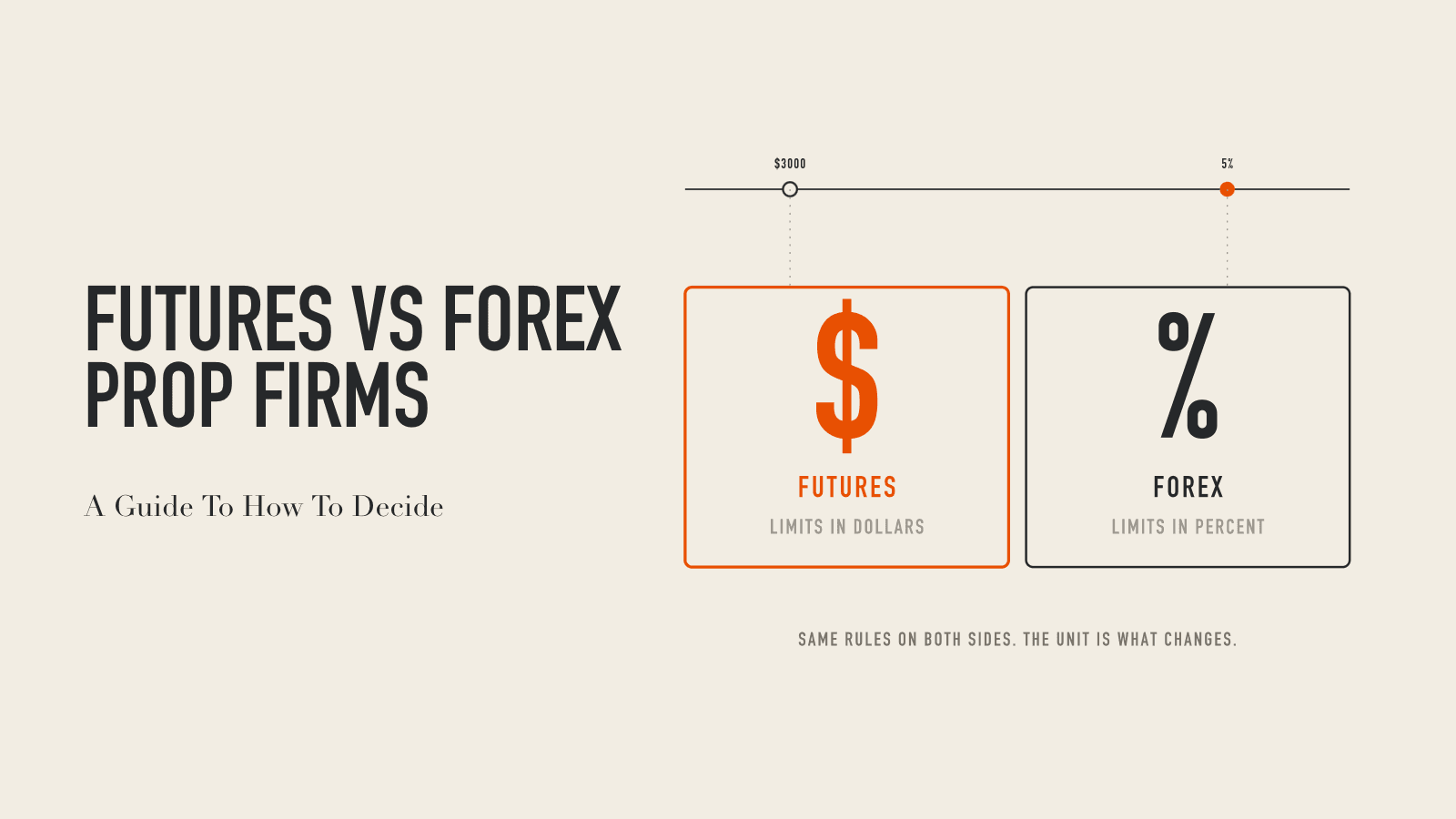
Choosing between a futures prop firm and a forex prop firm is mostly a choice between two different rulebook conventions, not two different difficulty levels. Futures programs state the profit target, the max loss and the daily loss limit as fixed dollar amounts tied to an account size, usually run a drawdown floor that trails your account upward, and roll the trading day at the 5:00pm New York futures close. Forex programs state the same three rules as percentages of balance or equity, more often keep the floor fixed at a static level, and roll the day at a broker server midnight. Pick the market you actually want to trade first, then read the specific program's numbers in the units that market uses.
Almost every "which is easier" argument you will read online is really an argument about which convention the writer is used to reading. A $2,000 max loss on a 50K futures account and a 6% max loss on a $50,000 forex account are not the same rule wearing different clothes: they are measured against different reference points, they move at different times, and they fail for different reasons.
What actually differs between futures and forex prop firms?
Four things differ in a way that changes how you trade day to day: the unit each limit is stated in, the reference point the limit is measured against, when the trading day rolls over, and how position size is capped. Everything else, the phase structure, the consistency rules, the minimum trading days, exists on both sides of the split and varies more between programs than between markets.
| Futures programs | Forex and CFD programs | |
|---|---|---|
| Limits stated as | Fixed dollars per account size | Percentage of balance or equity |
| Profit target stated as | Fixed dollars per account size | Percentage of the starting balance |
| Drawdown floor | Commonly trails the account upward | Commonly fixed at a static level |
| Day rolls at | The 5:00pm New York futures close | A broker server midnight, or the 5:00pm New York close |
| Size capped by | A maximum contract count | Lot size and account leverage |
The unit split is not a stylistic preference, it is how the underlying instruments are sized. A futures contract is a fixed-size instrument with a fixed tick value, so a firm can express risk in dollars and know exactly how many contracts that permits. A forex position is sized continuously in lots against leverage, so a percentage of balance is the natural way to state the same constraint. Across the active firms in our database, that split is close to absolute.
57 of 62
Forex rule rows stating daily loss as a percentage
0 of 163
Forex account sizes carrying a dollar daily loss limit
60 of 78
Futures account sizes carrying a max contract count
That matters when you compare programs. A futures program whose percentage fields are empty is not a program without a max loss rule, it is a program that states its max loss in dollars. The empty percentage is a modelling convention, nothing more. Converting one into the other to force a comparison produces a number the firm will never measure you against.
Why does the drawdown floor behave differently in futures?
The single biggest practical difference between the two markets is the drawdown floor. A static floor sits at a fixed level below your starting balance and does not move, so profits build a real cushion above it. A trailing floor moves up as your account grows, which means a profitable run raises the level at which you fail, and giving back part of that run can breach you at a balance that is still above where you started. Trailing floors come in two flavours: one that follows your end-of-day balance, and one that follows your intraday equity peak, which is the stricter of the two because an unrealised gain you never banked can still raise your floor.
Counts of program rule rows in the Proplysis database, active firms, 2026-08-02. A count is not a ranking, and a low count in a cell says nothing about any individual firm.
Read that as a tendency, not a law. Static futures programs exist, trailing forex programs exist, and several firms sell both shapes side by side under different program names. What the counts tell you is which shape you should expect to meet by default in each market, so you know what to look for on the program page rather than assuming.
What does a futures program's rulebook look like in dollars?
Concretely: on a 50K futures evaluation you are usually given a dollar profit target, a dollar max loss, sometimes a dollar daily loss limit, and a hard cap on how many contracts you can hold at once. The examples below are real, named programs at the 50K size, listed to show the shape of the rulebook. They are examples only, never a ranking, and each row is one specific program, not the firm as a whole.
| Program, 50K size | Profit target | Max loss | Daily loss limit | Max contracts |
|---|---|---|---|---|
| Elite Trader Funding 1 Step | $3,000 | $2,000 | 8 | |
| Elite Trader Funding End of Day | $3,000 | $2,000 | $1,100 | 8 |
| Bulenox Option 2 Qualification | $3,000 | $2,500 | $1,100 | 7 |
| Alpha Funded Futures Flex | $3,000 | $1,500 | 5 | |
| Top One Futures Elite Access | $3,000 | $2,000 | $1,000 | 3 |
| FundedNext Futures Flex | $2,500 | $1,500 |
Notice how little the profit target varies and how much the max loss does. Most of these ask for $3,000 on a 50K account, but the loss the firm will absorb before failing you ranges across the group, and the contract cap ranges further still. If you trade five contracts at a time, a cap of three is not a detail, it is a different strategy. The dollar convention makes this easy to check: the numbers on the program page are the numbers your platform will show you.
One cost difference that only exists on the futures side is the recurring fee. Of the 78 futures account sizes in our data, 41 carry a monthly fee, while none of the 163 forex sizes do. A futures evaluation is often sold as a subscription rather than a one-time purchase, so the real cost of a slow evaluation is higher than the sticker price suggests.
What does a forex program's rulebook look like in percent?
On the forex side the same three rules arrive as percentages, and the detail that matters most is what the percentage is measured against. Some programs measure the daily loss against the balance you started the day with, some against live equity, and some against whichever of the two is higher, which is the strictest reading of the three because an open profit cannot be used to widen the day's room. Those are typed, per-program facts, so check yours rather than assuming a house style.
Examples only, real named forex programs, evaluation stage. Each bar is one program, not a firm-level figure, and the bars are not ranked.
The pattern inside a single firm is more informative than the spread across firms. FTMO's 1-Step Challenge carries a 3% daily loss limit measured against equity, while its 2-Step Challenge carries 5%. The 1-Step reaches funding in one phase and asks for a tighter day in exchange. That trade-off between speed and daily breathing room is the same one you meet in futures, and our guide to 1-step versus 2-step evaluations covers it in detail. Top One Trader's Nova Challenge measures its 3% against the higher of balance or equity, which is a materially different rule from 3% of the starting balance even though both read as "3%".
When does the trading day reset in each market?
Futures is the simpler side. Every active futures program in our data that records a daily reset resets at 5:00pm US time, matching the CME session close, split between the New York and Chicago zones, which are the same instant. Your loss limit refills at that close, not at your local midnight, so a late-afternoon session and the evening that follows it are two different trading days for rule purposes.
Forex is more varied. Among active forex programs in our data, some reset at midnight in a server timezone (UTC, GMT+3 and Berlin all appear), and others reset at the same 5:00pm New York boundary the futures programs use. Note how close a GMT+3 midnight and a 5:00pm New York close land to each other for most of the year, which is exactly why traders assume the two markets agree here. Some programs record no reset time at all in our data, which means unknown and should be confirmed with the firm. Our guide on when the daily loss limit resets walks through what that boundary does to an open position.
Does the payout side differ?
The profit split tends to sit higher on futures programs and cluster tightly, while forex splits spread across a wider range. Across active firms in our data, futures account sizes record a 90%, 100% or 80% split, with 90% by far the most common. Forex sizes range from 60% to 95%, with 80% the most common by a wide margin. A higher headline split is not automatically a better deal: payout frequency, minimum trading days before a withdrawal, consistency caps at the payout stage and any activation fee all sit between you and the money.
Counts of account sizes in the Proplysis database, active futures firms, 2026-08-02. Not a ranking and not a recommendation.
Read the payout terms as one package rather than one number. A 90% split with a consistency cap at the payout stage can hand back less than an 80% split without one, depending entirely on how lumpy your profits are. The consistency rule guide explains how that cap is calculated and why a single outsized day is the usual reason a payout gets trimmed.
So which one should you choose?
Start with the instrument, not the rulebook. If you already trade ES, NQ or CL and think in ticks and contracts, a futures program will feel native and a forex program will make you translate every rule. If you trade currency pairs, gold or indices as CFDs and think in lots and pips, the reverse is true. Nobody has ever passed an evaluation because the drawdown convention suited them while the market itself did not.
Pick the market you actually trade
Instrument familiarity beats every rulebook detail below it. A convention you have to translate costs you attention in the middle of a session.
Check the session hours against your life
Futures products have concentrated liquidity around the US session. Forex runs a continuous week across sessions. Whichever you pick has to fit the hours you can genuinely be at the screen.
Read the drawdown floor before the profit target
Static or trailing, and if trailing, whether it follows end-of-day balance or intraday equity. This decides what a good run does to your risk of failing.
Find the daily reset time and write it down
It is the 5:00pm New York close on the futures side, and either a server midnight or that same close on the forex side. It decides which day a trade belongs to.
Price the whole evaluation, not the sticker
Include any monthly fee, any activation fee on funding, and the cost of a reset if you fail. Futures programs are more often sold as a subscription.
Check the payout terms last, and as a package
Split, payout frequency, minimum trading days before withdrawal, and any consistency cap. The headline split is the least informative number in that list.
Two smaller factors decide more cases than most traders expect. The first is position sizing: futures caps you at a contract count, which is a hard ceiling that does not scale with your balance, while forex caps you through lot size and leverage, which flexes with the account. The second is capital efficiency at the low end. Futures evaluations tend to start cheaper and smaller, so the cost of one failed attempt is lower, but the recurring fee means a slow pass is not free. Neither of those makes a market better, they just make one of them cheaper to be wrong in.
How Proplysis helps
Proplysis reads both kinds of account into one dashboard and keeps each program's rules in that program's own units, so a dollar limit stays a dollar limit and a percentage stays a percentage. The daily loss limit, the max drawdown floor and the profit target are monitored live, and Proplysis warns you before you breach any of them. Consistency and minimum trading days are computed and shown as live standing on the Rules page instead, with no alert attached, so you can see where you stand without being told when to stop. Rules such as news trading windows, inactivity limits and copy-trading permissions are shown per program as reference, exactly as the firm states them, so you can read your program's rule without opening a PDF mid-session.
Illustrative example of the live standing view, not a specific account or program.
If you are buying a challenge anyway, buying it through our link costs you nothing extra and funds the free dashboard. The firm directory lists every firm we track on both sides of the futures and forex split, with the per-program rules laid out in the units each firm uses, so you can compare programs rather than marketing pages.
Frequently asked questions
Are futures prop firms easier to pass than forex prop firms?
There is no evidence either market is systematically easier, and the difficulty of an evaluation is set by the specific program rather than by the asset class. Futures programs more often use a trailing drawdown floor, which punishes giving back a good run, while forex programs more often use a static floor with a tighter percentage daily loss. Compare the program you are considering against your own trading, not the market against the market.
Why do futures prop firms use dollars instead of percentages?
Because a futures contract is a fixed-size instrument with a fixed tick value, so risk in dollars maps directly onto a number of contracts. Forex positions are sized continuously in lots against leverage, where a percentage of balance is the natural unit. When a futures program shows no percentage figure for its max loss, that is the convention at work, not a missing rule.
Can I trade both a futures and a forex prop account at the same time?
Nothing about the two markets prevents it, and plenty of traders run accounts with more than one firm. What makes it hard is that each program has its own limits, its own drawdown shape and its own daily reset time, so the mental overhead grows faster than the account count. Rules such as account sharing, copy trading and holding correlated positions across firms are set per program, so check each one before you assume it is allowed.
Which market has better profit splits, futures or forex?
Across active firms in our data, futures account sizes cluster at a 90% split while forex sizes most often sit at 80%, though forex ranges from 60% to 95%. The split alone is not the payout, though. Payout frequency, the minimum trading days you must clear first, any activation fee, and any consistency cap applied at the payout stage all change what actually reaches your bank.
Does the 5:00pm New York reset apply to forex prop accounts too?
Sometimes. Some forex programs do use that boundary, and others reset at midnight in a broker server timezone such as UTC or GMT+3. Every futures program in our data that records a reset uses the 5:00pm US futures close. Because a GMT+3 midnight and a 5:00pm New York close land at nearly the same instant for much of the year, the difference is easy to miss until it costs you a day.
Should a beginner start with futures or forex prop firms?
Start with whichever market you have actually traded, on your own money or in simulation, for long enough to know how it moves. An evaluation tests risk management under a rulebook, and learning the instrument and the rulebook at the same time is the most expensive way to do both. If you have traded neither, the lower entry cost of small futures evaluations makes a failed attempt cheaper, but the recurring monthly fee on many of them means a slow attempt is not.
Prop firms on Proplysis
Buy your evaluation through our link
These are the firms we list, in alphabetical order. Buying through our link is what keeps Proplysis free to use - it costs you nothing extra.















Some links are affiliate links. Purchasing through them is how Proplysis stays free.