August 21, 2026
FundedNext Payout Rules: Stellar, Rapid, Flex & Legacy - Splits, Cycles, Caps
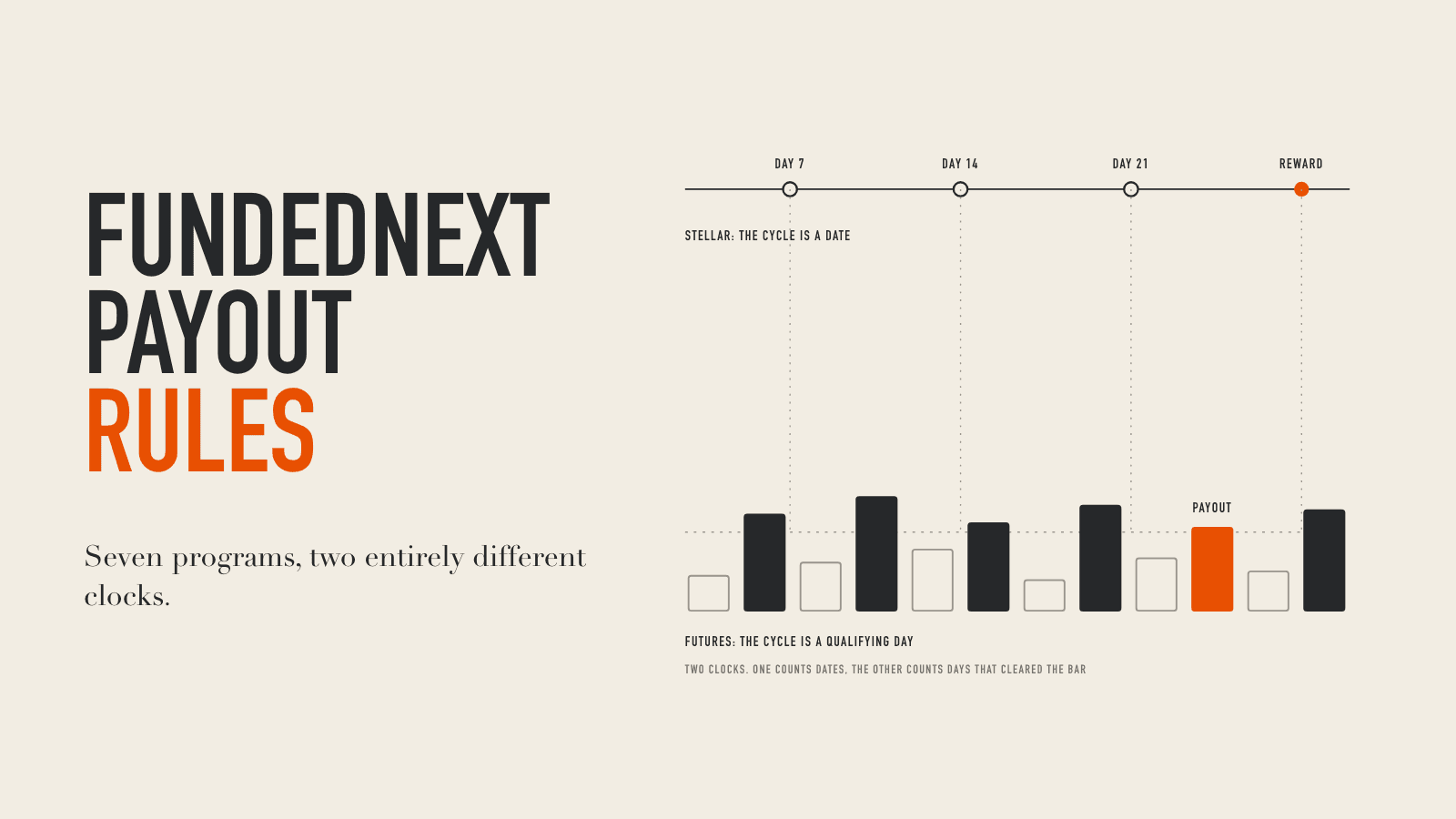
FundedNext's payout rules are not one policy. They are seven, and which one applies depends on the program you bought. The forex side (Stellar) pays on a fixed cycle and reaches 95% on the Stellar 1-Step and Stellar 2-Step programs. The futures side pays on benchmark days at an 80% split, caps what you can take per request, and resets your max loss limit the first time you withdraw.
That last part is the one that surprises people. On FundedNext Futures, a withdrawal is not a neutral event. It moves the floor your account is measured against, and on some programs it also moves you one step closer to the account being closed on purpose.
Clear the clock
A Stellar reward cycle measured in calendar days, or a set number of benchmark days on FundedNext Futures.
Clear the minimum
A minimum profit inside the current cycle, plus a minimum withdrawal amount on the futures programs.
Stay inside the request cap
Futures requests are capped by program and account size, and asking for 100% of profit is a breach on Legacy and Rapid.
Survive the conduct rules
News-window, sub-30-second and margin rules adjust profit after the fact rather than blocking the trade at the time.
What do FundedNext's payout rules actually require?
Every FundedNext program gates a payout on three separate things, and passing two of them is worth nothing.
The first is time. Stellar programs run reward cycles measured in calendar days. Futures programs count benchmark days, which are days that cleared a minimum profit, not days you happened to trade.
The second is money. There is a minimum profit inside the current cycle, and on the futures side there is also a minimum withdrawal amount. A $180 profit on a FundedNext Futures Flex account is not a payout, it is a balance.
The third is conduct. FundedNext runs several behavioural rules that adjust profit after the fact rather than blocking the trade at the time. Profit made in a news window can be counted at 40% of its value on funded Stellar accounts. Sub-30-second trades are flagged. High margin usage is flagged. None of that stops you trading; all of it can change what is left to withdraw.
If you want the general shape of the process first, the plain-English guide to how prop firm payouts work covers the mechanics that are common to every firm. This article is about where FundedNext specifically differs.

How much of the profit do you actually keep?
The headline number depends on the program, and two of the seven can move up if you qualify for an upgrade.
| Program | Asset class | Split | First payout | Then |
|---|---|---|---|---|
| Stellar 1-Step | Forex | 95% | 7 days | Every 7 days |
| Stellar 2-Step | Forex | 95% | 21 days | Every 14 days |
| Stellar Lite | Forex | 80% (90% via Scale-Up) | 21 days | Every 14 days |
| Stellar Instant | Forex | 70%, 80% from tier 3 | On demand at 5%+ cycle growth | 14 days from cycle start at 1-5% growth |
| Flex | Futures | 80% (90% paid add-on) | 5 benchmark days | Concluded after 5 withdrawals |
| Rapid | Futures | 80% | 3 days after meeting the 40% rule | Uncapped after 5 withdrawals |
| Legacy | Futures | 80% | 5 benchmark days | Up to 100% after 30 benchmark days |
A few notes the table cannot carry. On Stellar Lite the 80% base becomes 90% only through the Scale-Up Plan, which requires at least 10% growth over four consecutive months, at least two performance rewards, and a final cycle that ends in profit. On Stellar Instant the split starts at 70% for tiers 1 and 2 and becomes 80% from tier 3, and you advance a tier by making 10% cumulative growth in the current tier plus at least one withdrawal. On FundedNext Futures Flex the 90% split is a paid add-on, priced $14.99, $24.99 or $34.99 depending on account size, not something you earn.
On the Stellar 1-Step and Stellar 2-Step programs the challenge fee is refunded as part of your first withdrawal from the funded account, so the first payout is usually larger than the split alone suggests.
When can you request your first payout?
On the Stellar programs the answer is a number of days.
FundedNext figures per program, captured 2026-06-10. Stellar Instant also pays on demand at 5%+ cycle growth; the 14 days shown is the wait when cycle growth is between 1% and 5%.
Stellar 1-Step runs the shortest cycle of the four: 7 calendar days, recorded as 5 business days. Stellar 2-Step and Stellar Lite both run a 21-day first cycle and then move to 14-day cycles. On Stellar 2-Step, the 14-day cycle is only activated after a profitable cycle in which you actually requested a withdrawal, so skipping a request does not shorten the next one.
Stellar Instant is the exception. It pays on demand once the cycle is up 5% or more, verified end of day. Between 1% and 5% growth you wait until 14 days after the cycle started, and below 1% growth there is no reward that cycle at all. There is also a floor on the withdrawal itself: you cannot take a reward that would drop the account to breakeven or below.
On FundedNext Futures the answer is not days, it is benchmark days.

A benchmark day is a trading day that ended with at least a set profit, and the threshold moves with account size. On Flex it is $200 on the 50K and 100K accounts and $250 on the 150K. On Legacy it is $100 on the 25K and $200 on the 50K and 100K. Five of them unlock the first withdrawal on both programs. A day where you made $40 counts for nothing, and a losing day is not a setback so much as a day that simply does not exist for payout purposes.
Rapid works differently again: it is on demand, and eligibility opens 3 days after you satisfy its 40% daily consistency rule, meaning no single day's profit is more than 40% of your total profit. That is the fastest first payout in the FundedNext Futures range, and it is also the only one of the three with a consistency requirement attached to it. If consistency rules are new to you, which firms run one and at what percentage is worth reading before you size your best day.
How much can you take out at once?
Every FundedNext Futures program caps the single request, and the cap is set by account size.
FundedNext Futures figures per program, captured 2026-06-10. Flex and Legacy also cap each request at 50% of accumulated profit.
Flex and Legacy also cap the request at 50% of accumulated profit, so the dollar figures above are ceilings, not entitlements. Legacy lifts the 50% restriction to 100% once you have completed 30 benchmark days. Rapid lifts its dollar cap entirely after 5 performance rewards, after which withdrawals are uncapped. Flex goes the other way: the funded account is concluded after 5 performance reward withdrawals, so on Flex the fifth payout is the last one.
Minimum withdrawal is $250 across Flex, Legacy and Rapid, except on the Rapid 100K account where it is $500.
This one is worth reading twice, because it inverts the usual instinct. On FundedNext Futures Legacy and Rapid, requesting all of your profit in a single withdrawal is treated as a hard breach of the account, not as an ambitious request that gets trimmed. Leave something behind.
What your first withdrawal does to your drawdown
On FundedNext Futures the max loss limit trails your highest end-of-day balance, updating once a day rather than intraday. Your first withdrawal resets that limit back to your initial balance, plus a $100 buffer on Flex.
Illustrative example on a hypothetical 50K account, not a specific FundedNext account's figures. The mechanic, an end-of-day trailing max loss limit reset by the first withdrawal, is FundedNext Futures policy.
Read that reset carefully, because it cuts both ways. If your trailing floor had climbed above your starting balance, the reset pushes it back down and gives you room. If your balance is barely above the starting figure, the reset can leave you with very little distance between your equity and a floor that no longer moves. Either way, the account you trade the day after your first payout is not the account you traded the day before it. The difference between a floor that trails and one that sits still is covered in static vs trailing drawdown.
On the Stellar side the drawdown is static on 1-Step, 2-Step and Lite: 6%, 10% and 8% of the initial balance respectively, with the daily loss limit at 3%, 5% and 4% of initial balance, resetting at 00:00 GMT+3. Stellar Instant is the odd one out with a 6% trailing max loss measured on equity intraday, no daily loss limit at all, and a 1% equity buffer that FundedNext adds up to three times per account so a news-window profit adjustment cannot breach you by accident. If reset timing is the part you are unsure about, when the daily loss limit resets explains why the server clock matters more than yours.
The rules that quietly shrink the payout
These are the FundedNext rules that do not stop a trade and do not fail an account, but do change the number at the end of the cycle.
- News-window 40% profit rule. On funded Stellar accounts, a trade opened or closed within five minutes either side of a high-impact news event counts only 40% of its profit toward the balance. Losses count in full. Trading the release is allowed; being paid for it in full is not. Our guide to prop firm news trading rules shows how unusual that structure is.
- Quick Strike restriction. Trades closed inside 30 seconds are flagged. A warning lands when 20% of profit comes from them, and a violation when 30% or more does.
- Margin and gambling rule. Cumulative margin usage at or above 70%, or risk above 3% on a single trade, is flagged as gambling behaviour.
- Disciplined Trader Program. Traders flagged as high risk are moved into a corrective program: maximum 1% risk per trade, maximum 30% margin, no news trading, and new accounts capped at $50,000. You graduate at $30,000 cumulative profit plus five reward cycles after enrollment.
None of these are hidden, but all four live in the help centre rather than the sales page, which is where most rules of this kind end up. We wrote a whole piece on the clauses that quietly end accounts for the same reason.
How FundedNext's caps compare with other futures firms
Per-request caps are the number traders compare least and get bitten by most.
| Firm | Program | Payout cap |
|---|---|---|
| Blue Guardian Futures | Direct | Not stated |
| Bulenox | Option 1 Fast Track | Not stated |
| E8 Futures | E8 Signature | Not stated |
| Earn2Trade | The Gauntlet Mini™ | Not stated |
| Funded Futures Network | Standard MAX | Not stated |
| FundedNext Futures | Flex | $1,500 |
| Ment Funding Futures | Futures 1-Step | Not stated |
| Top One Futures | Elite Access | Not stated |
| TradeDay | Quick Pay End of Day | None ✓ |
| Upcomers Futures | Thunderbolt Classic | Not stated |
All 10 firms. Live from the Proplysis firm database.
That block reads the live database rather than a snapshot, so it is right on the day you read it. The FundedNext programs in it are the ones described above; the rest of the rows are there for context.
Keeping track when you hold more than one
The realistic FundedNext situation is not one account. It is a Stellar 2-Step on a 14-day cycle, a Flex account counting benchmark days, and a Rapid account waiting on a consistency percentage, each with a different clock and a different floor.
Proplysis reads all of them into one dashboard. Drawdown and daily loss are monitored, and it warns you before you breach either one. Payout splits, per-request caps and benchmark-day counts are not alerting rules, so what Proplysis does with those is show you the rule per program next to the account it belongs to, which is otherwise a help-centre tab you never have open at the right moment. The full rule picture per firm sits on the FundedNext profile and the FundedNext Futures profile.
The dashboard is free. If you are buying a FundedNext challenge anyway, buying it through Proplysis is what pays for the dashboard, and it costs you nothing extra.
FAQ
How long does a FundedNext payout take to arrive?
FundedNext publishes eligibility rules rather than a guaranteed transfer time, and processing time depends on the payment method and the firm's review of the request. What you can plan around is eligibility: a Stellar 1-Step cycle is 7 days, Stellar 2-Step and Stellar Lite start at 21 days and then run 14, and the futures programs open on benchmark days rather than dates. Treat the cycle as the number you can schedule around and the transfer as the part you cannot.
What is the profit split on FundedNext?
It depends on the program. Stellar 1-Step and Stellar 2-Step pay 95%. Stellar Lite pays 80%, rising to 90% through the Scale-Up Plan. Stellar Instant pays 70% at tiers 1 and 2 and 80% from tier 3. FundedNext Futures Flex, Rapid and Legacy all pay 80%, and Flex offers a paid add-on that raises it to 90%.
What is a benchmark day on FundedNext Futures?
A trading day that ends with at least a minimum profit for your account size. On Flex it is $200 on the 50K and 100K accounts and $250 on the 150K. On Legacy it is $100 on the 25K and $200 on the 50K and 100K. Five benchmark days unlock the first withdrawal on both programs, and Legacy needs 30 of them before the 50% cap on each request is lifted to 100%.
Can you lose a FundedNext account by withdrawing?
On FundedNext Futures Legacy and Rapid, requesting 100% of your profit in a single withdrawal is a hard breach of the account. On Flex, withdrawing does not breach anything, but the funded account is concluded after the fifth performance reward withdrawal by design. And on every futures program the first withdrawal resets the max loss limit, which changes how much room you have the next day.
Does FundedNext have a consistency rule on funded accounts?
FundedNext Futures Rapid does: no single day's profit may be more than 40% of your total profit, and payout eligibility opens 3 days after you meet it. FundedNext's own Legacy documentation states there is no consistency rule on the funded Legacy account. For the other programs, read the rule page for the specific program you hold rather than assuming the Rapid rule carries across.
Prop firms on Proplysis
Buy your evaluation through our link
These are the firms we list, in alphabetical order. Buying through our link is what keeps Proplysis free to use - it costs you nothing extra.















Some links are affiliate links. Purchasing through them is how Proplysis stays free.