August 21, 2026
FundedNext Consistency Rule: Which Programs Have One and When It Bites
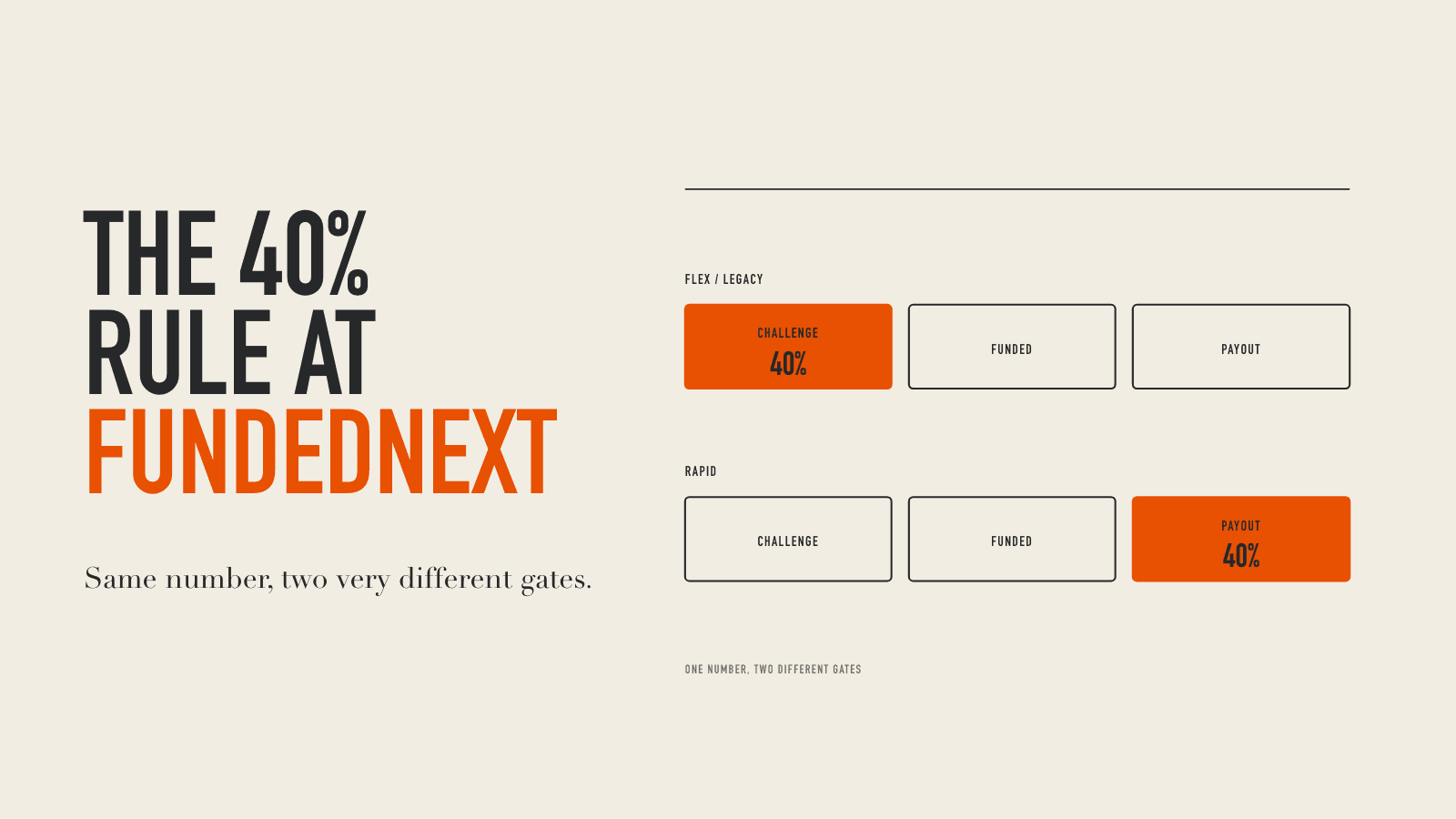
The FundedNext consistency rule is a 40% cap on how much of your total profit any single day is allowed to contribute. It lives on the FundedNext Futures side of the business, and where it bites depends on the program: on Flex and Legacy it is a challenge-phase requirement that stops applying once you are funded, while on Rapid it sits on the funded account as a payout-eligibility gate. For the FundedNext forex programs, our database holds no verified consistency figure, which is not the same thing as there being no rule.
That last distinction is worth reading twice. Most of what gets posted about this rule collapses two brands, four programs and two completely different enforcement points into one sentence, and traders then plan against a rule that does not apply to the account they actually bought.
What the 40% consistency rule actually measures
The calculation is a share, not a dollar cap. Take your total profit on the account, then take your single best profitable day. If that one day is more than 40% of the total, you are outside the rule. This is the same mechanism used across the market, and it is worth reading how consistency rules work in general if you hold accounts at more than one firm, because the number and the enforcement point both move from firm to firm.
Nothing about this depends on how big the day was in absolute terms. A $400 day on a small account can breach the share while a $4,000 day on a large one sits comfortably inside it. What matters is the ratio, and the ratio moves every time you add profit on any day.
There is a second consequence people miss: losing days do not help you. They reduce total profit, which pushes your best day's share up, not down. The only thing that brings a hot day back inside the cap is more profit spread across other days.

Which FundedNext programs have a consistency rule?
The table below is resolved against the Proplysis firm database every time this page loads, so it reflects what we hold today rather than a snapshot frozen on the day this was written. It shows one row per FundedNext brand - the forex programs under FundedNext and the futures programs under FundedNext Futures - each row showing whichever of that brand's own programs states the rule most clearly, because quoting a single figure for the whole brand is exactly how people end up planning wrong.
| Firm | Program | Stage | Consistency |
|---|---|---|---|
| FundedNext | Stellar 1-Step | Evaluation | Not stated |
| FundedNext Futures | Flex | Evaluation | 40% |
All 2 firms. Live from the Proplysis firm database.
Two things to read off it. The 40% figure on the FundedNext Futures row is the cap stated on its evaluation programs, which is unusual: most firms vary the cap by product. And the FundedNext forex row shows "Not stated" - none of the Stellar programs (1-Step, 2-Step, Lite, Instant) carry a confirmed consistency figure in our records, which is covered next.
Why "Not stated" is not "no rule"
A cell reads "Not stated" when we do not hold a verified figure for that program. It is a statement about our records, not about the firm's rulebook. We print "None" only where a firm's own documentation explicitly rules the requirement out and we have that source on file, which is a deliberately high bar and the reason the table has three states instead of two.
So if you are on a Stellar program and you want a definitive answer, ask FundedNext support in writing before you size up a single session. "Nobody on Reddit has mentioned one" is not evidence of absence, and a payout request is a bad place to find out.
Challenge gate or payout gate? It changes the whole plan
The same 40% number does two different jobs depending on the program.
| Program | Cap | Where it applies | What it gates |
|---|---|---|---|
| Flex | 40% | Challenge phase only | Passing the challenge; no consistency rule on the funded account |
| Legacy | 40% | Challenge phase only | Passing the challenge; no consistency rule on the funded account |
| Rapid | 40% | Funded account | Payout eligibility; reward requestable 3 days after the rule is met |
On Flex and Legacy, the rule applies during the challenge phase only. Our records for both programs state that no consistency rule applies to the funded account. Practically, that means the rule shapes how you pass, not how you get paid: you need your challenge profit spread across enough days that no single one carries more than 40% of it, and once you are through, that particular constraint is behind you.
On Rapid, it works the other way around. The 40% cap sits on the funded account as a condition of payout eligibility, and a Performance Reward can be requested as early as three days after you meet it. The rule is not something you clear once, it is something your account has to be standing inside on the day you ask for money.
The trap is that the plans these two shapes reward are opposites. A challenge-phase rule punishes a fast, lumpy pass. A payout-phase rule punishes a fast, lumpy funded run. Read which one you bought. Other firms place the same idea somewhere else again: FTMO calls its version the Best Day Rule and measures the share against profitable days rather than total profit, so the arithmetic is not transferable between the two.
The math on getting back inside the cap
Say a funded account has made $2,400 in total profit, and $1,200 of that came from one session. That day is 50% of the total, over the 40% line.
Illustrative example, not a specific trader's figures.
To fix the ratio you need total profit to reach your best day divided by 0.4. Here that is $1,200 / 0.4 = $3,000, so you need another $600 of profit from other days. Not a smaller best day. More total.
Best day as a share of total profit
Illustrative example. The 40% mark is the FundedNext Futures cap.
The arithmetic has an edge to it: beating your own record moves the goalposts. Close a $1,500 day on top of that $2,400 total and your best day is now $1,500 against $3,900. The new requirement is $3,750, which you have already cleared, so a big enough day can also fix the problem outright. Whether a strong day helps or hurts depends entirely on where it lands relative to your existing best.
Benchmark days, and why they are not just trading days
On the FundedNext Futures payout side you will also run into the term "benchmark day", and it is easy to read it as a synonym for "day you traded". It is not.

A benchmark day has a minimum profit attached to it. On Flex, our records show a benchmark day requires at least $200 of profit on the 50K and 100K accounts and at least $250 on the 150K, with a payout available every five benchmark days. On Legacy, it is at least $100 on the 25K and at least $200 on the 50K and 100K, with five benchmark days required before your first withdrawal.
A day where you finished green by $40 is a profitable day. It is not a benchmark day. It still counts toward your total profit for consistency purposes, and it does not move you closer to the benchmark-day count. Those are two separate counters running on the same calendar, which is why people miscount how far they are from a payout. It is also a different thing again from a minimum trading days requirement, which asks only that you traded, not that you profited.
The other 40% rule people confuse this with
FundedNext's forex side runs a rule that also uses the number 40, and it has nothing to do with consistency. On funded accounts, a trade opened or closed within five minutes either side of a high-impact news event has only 40% of its profit credited to the balance, while losses apply in full.
Same number, different mechanism, different side of the business. If you searched for "FundedNext 40% rule" and landed on an explanation involving news windows, you were reading about that one. Where each firm draws that window, and whether it exists at all, varies enough that it is worth checking news-trading rules program by program before you hold through a release.
How a payout actually gets requested on Rapid
Because Rapid is the program where consistency and payout logic are welded together, the sequence is worth laying out end to end. The shape will look familiar if you have read how prop firm payouts work more generally, but the consistency step is the part specific to this program.
Trade the funded account
The 40% consistency cap applies here, not in a prior challenge phase.
Bring your best day inside 40% of total profit
Daily profit cannot exceed 40% of total account profits.
Wait 3 days
A Performance Reward can be requested as early as 3 days after the consistency rule is met.
Request within the cap
The first 5 withdrawals are capped by account size ($800 / $1,500 / $2,500). After 5 rewards the cap is lifted.
Never request 100% of profit
Withdrawing all profit in a single request causes a hard breach on the FundedNext Futures programs.
Two clauses in that sequence deserve their own line. First, on the FundedNext Futures programs, withdrawing 100% of your profit in a single request causes a hard breach of the account. Second, on Rapid the first five withdrawals are capped by account size, and after the fifth Performance Reward the cap is lifted. The consistency rule decides whether you can ask; those clauses decide what you can ask for.
Trading around the rule without capping your winners
The wrong response to a consistency rule is to close good trades early. That trades a real edge for a scheduling problem, and it is how people talk themselves out of the trading that got them funded in the first place.
The right response is to know your current share before you open the position, not after you close it. If your best day is already sitting near 40% of total profit, the next big day pushes the requirement further out. If it is nowhere near, the constraint is not binding and you should trade normally.
Proplysis tracks your accounts across firms and shows your live standing on rules like this one, alongside the per-program figure we hold for each account, so the number is on screen before the session rather than reconstructed afterwards. If you are buying a FundedNext Futures challenge anyway, buying through our FundedNext Futures link is what pays for the dashboard being free.
Frequently asked questions
Does the FundedNext consistency rule fail your account?
On the FundedNext Futures programs that carry it, the 40% cap is a gate rather than an instant account breach: on Flex and Legacy it is a challenge-phase requirement, and on Rapid it is a condition of payout eligibility. Separately, withdrawing 100% of your profit in one request does cause a hard breach on the FundedNext Futures programs, which is a different clause with a much harsher outcome.
Do FundedNext's Stellar programs have a consistency rule?
We do not hold a verified consistency figure for Stellar 1-Step, Stellar 2-Step, Stellar Lite or Stellar Instant, so they show as "Not stated" in the table above. Treat that as unknown and confirm with FundedNext directly rather than assuming the rule does not exist.
Does the consistency rule still apply after you pass the challenge?
It depends on the program. Our records state that Flex and Legacy apply the 40% rule during the challenge phase only, with no consistency rule on the funded account. On Rapid the 40% cap applies to funded payout eligibility.
Do losing days help my consistency ratio?
No. Losing days reduce your total profit, which raises your best day's share of it. Only additional profit on other days brings the ratio down.
How do I calculate how much more profit I need?
Divide your best day's profit by 0.4 to get the total profit you need, then subtract the total you already have. On a $1,200 best day, you need $3,000 total, so with $2,400 banked you are $600 short.
Prop firms on Proplysis
Buy your evaluation through our link
These are the firms we list, in alphabetical order. Buying through our link is what keeps Proplysis free to use - it costs you nothing extra.















Some links are affiliate links. Purchasing through them is how Proplysis stays free.