August 28, 2026
Which Prop Firms Use Trailing Drawdown (And Which Don't)
No prop firm has zero drawdown. When traders search for a prop firm with no trailing drawdown, what they actually want is a static drawdown: a maximum loss floor fixed below your starting balance that does not climb when you make money. Those programs exist, but they are not spread evenly. Static floors are common among forex firms and close to nonexistent among futures firms, and the two live tables below show which programs currently use which.
Which prop firm has no trailing drawdown?
The honest answer is that "firm" is the wrong unit. Drawdown type is set per program, not per company. The same firm can sell a two-step challenge with a fixed floor and an instant-funded account with a floor that follows your equity up, on the same pricing page, an hour apart. Both tables below are one row per firm - its most clearly documented program for this field - so read any single row as one data point about one product, never a verdict on the whole brand. A firm's OTHER programs can and do land in a different drawdown type, which is exactly why the unit question above matters.
So the question worth asking is not which firm has no trailing drawdown. It is which program you are about to put in your cart, and what its floor does after your first good week.

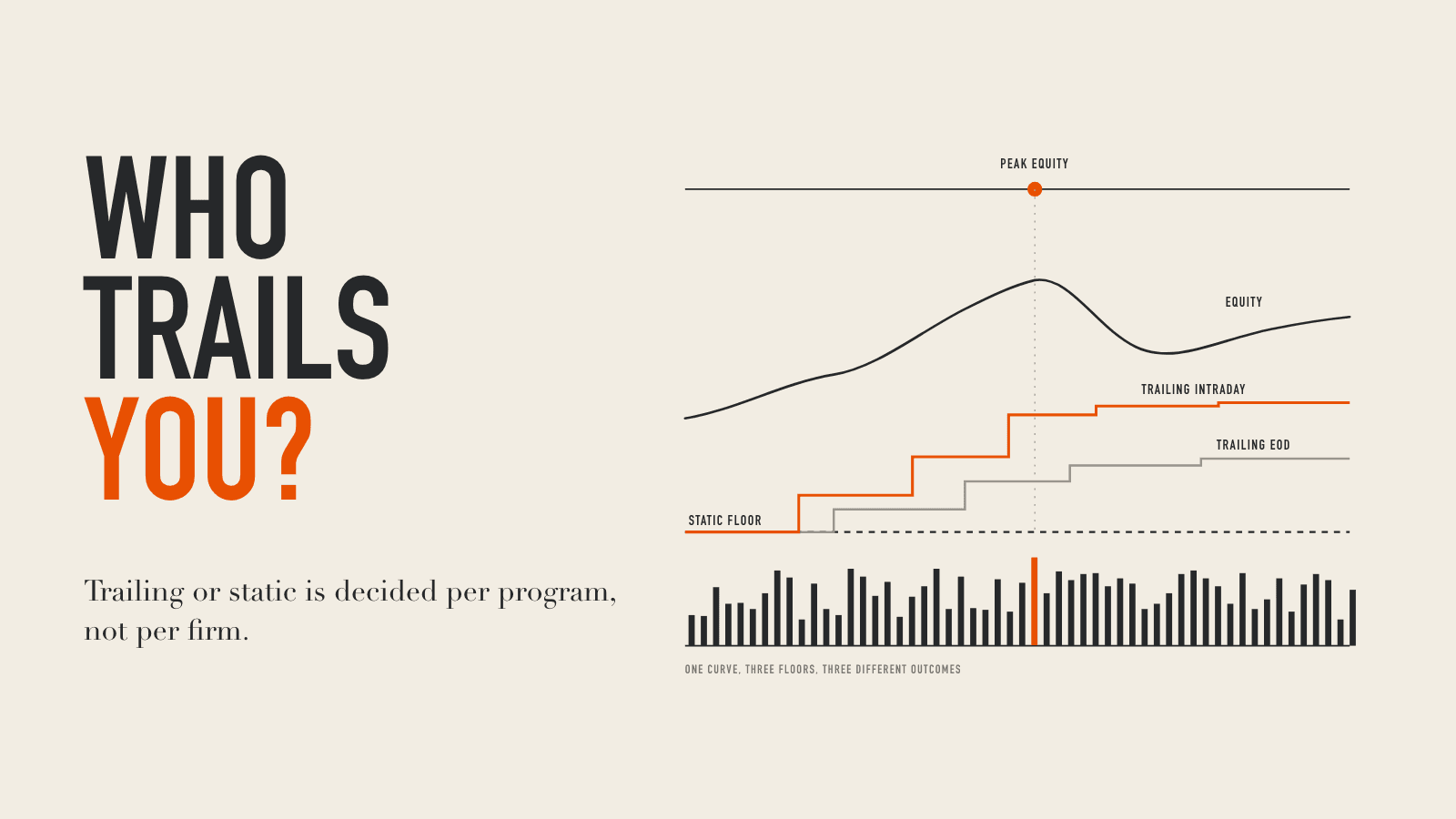
There are three floors in circulation, and this article assumes you already know the difference. If you don't, how a static floor differs from a trailing one covers the mechanics with worked examples; this page is its firm-by-firm counterpart.
Which futures prop firms use trailing drawdown?
Almost all of them. In futures, a trailing floor is close to the default, and the handful of exceptions tend to be sold as a named alternative rather than as the house rule.
| Firm | Program | Stage | Drawdown type |
|---|---|---|---|
| Blue Guardian Futures | Direct | Funded | Trailing EOD |
| Bulenox | Option 1 Fast Track | Evaluation | Trailing intraday |
| E8 Futures | E8 Signature | Evaluation | Trailing EOD |
| Earn2Trade | The Gauntlet Mini™ | Evaluation | Trailing EOD |
| Funded Futures Network | Standard MAX | Evaluation | Trailing EOD |
| FundedNext Futures | Flex | Evaluation | Trailing EOD |
| Ment Funding Futures | Futures 1-Step | Evaluation | Static |
| Top One Futures | Elite Access | Evaluation | Trailing EOD |
| TradeDay | Fast Pass End of Day | Evaluation | Trailing EOD |
| Upcomers Futures | Thunderbolt Classic | Evaluation | Trailing intraday |
All 10 firms. Live from the Proplysis firm database.
That table is a live query, not a snapshot. It resolves against our rule database every time the page renders, so it reflects the programs we currently track rather than the state of the market on the day this was written. Two things to read carefully. The Stage column tells you whether you are looking at the evaluation rule or the funded rule, because instant-funded programs have no evaluation to show. And a cell reading Not stated means we have no recorded value for that program, not that the program has no rule.
What does a trailing floor actually cost you?
The gap between the three types only becomes concrete once you have made money and given some back. Take an illustrative $50,000 account with a $2,000 maximum loss. You run it to $52,000 intraday, then close the day at $50,500.
Under a static rule the floor never moved: it is still $48,000, and you are $2,500 clear. Under an end-of-day trailing rule the floor resets from your closing balance to $48,500, so $500 of your cushion is gone. Under an intraday trailing rule the floor was set by the $52,000 spike you never banked, landing at $50,000 and leaving you $500 from a breach on a day you finished up.
Illustrative example on a $50,000 account with a $2,000 maximum loss. Not a specific firm's figures.
That is the whole argument for hunting a static program, and it is also why the same account size can feel completely different at two firms charging similar prices.
Which forex prop firms use static drawdown?
Here the picture inverts. Static floors are ordinary in forex, and the trailing ones cluster in instant-funded and single-phase products rather than in the standard multi-step challenges.
| Firm | Program | Stage | Drawdown type |
|---|---|---|---|
| E8 Markets | E8 One 10% drawdown | Evaluation | Trailing intraday |
| FTMO | FTMO Challenge: 1-Step | Evaluation | Trailing EOD |
| FundedNext | Stellar 1-Step | Evaluation | Static |
| FundingPips | 1 Step | Evaluation | Static |
| FundingTraders | 1-Step Pro | Evaluation | Trailing intraday |
| Ment Funding Forex | Forex 1-Step | Evaluation | Static |
| Top One Trader | Instant Funding | Funded | Trailing EOD |
| Upcomers | Ash | Evaluation | Trailing intraday |
All 8 firms. Live from the Proplysis firm database.
This table is scoped to firms we classify as forex. Firms trading CFDs or crypto sit outside it and are listed in the full firm database, where you can filter by asset class and read the same rule on each firm's own page.
Why do futures firms trail and forex firms usually don't?
It comes down to what the account is. Futures programs are generally risk-managed off a high-water mark: the firm's exposure is measured against the best your simulated account has ever been, so the floor is defined to follow it. Forex and CFD firms more often express maximum loss as a percentage of the starting balance, which by construction gives you a fixed number that cannot move.
Neither model is generosity or malice. They are two ways of capping the same liability, and they produce very different trading experiences after a profitable run. If you are weighing the asset classes more broadly, futures versus forex prop firms covers the rest of the differences.
Does a static drawdown stay static after you pass?
Not necessarily, and this is the trap that costs people accounts. The drawdown rule attached to an evaluation and the one attached to the funded account are two separate records, and they are allowed to disagree. A program can be perfectly static while you are proving yourself and switch to a trailing floor the moment real payouts are on the table.

The Stage column in both tables above exists for this. If a program's row says Evaluation, that value is the rule for the challenge, and the funded rule is a separate question worth asking before you buy. Instant-funded products skip the distinction entirely, which is covered in instant funding versus evaluation rules.
What does "no drawdown" mean when a firm advertises it?
Usually something narrower than it sounds. Marketing copy compresses several distinct rules into one phrase, and the compression always favours the seller.
| What the page says | What you still have to check |
|---|---|
| No trailing drawdown | Whether the fixed floor applies to the funded account too, or only to the evaluation |
| End-of-day drawdown | That the floor still trails, just from your closing balance instead of your intraday high |
| Balance-based drawdown | Whether unrealized profit moves the floor, and whether open losses count against it |
| No daily drawdown | That this is the daily loss limit, a separate rule from the maximum loss floor |
| Drawdown freezes once you are in profit | The exact level it freezes at, and whether the freeze applies before funding |
The one that catches the most people is the fourth row. "No daily drawdown" is a claim about the daily loss limit, which is a separate rule from the maximum loss floor. A program can genuinely have no daily limit and still trail your maximum loss up every evening.
How do you check a program's drawdown type before you buy?
Identify the program, not the firm
Drawdown type is set per program. A firm's best-known rule may not be the one attached to the plan in your cart.
Read the funded rule separately
Ask for the rule that applies after you pass, in writing, and do not infer it from the evaluation.
Ask what the floor is measured from
A fixed starting figure, your closing balance, or your highest intraday equity are three different rules.
Ask when it stops moving
Get the freeze level as a number, or confirm that there isn't one.
One more question is worth adding to that list: is the floor measured against your balance or your equity? A trailing floor that reads your open, unrealized profit behaves very differently from one that only reads closed trades, and balance-based versus equity-based drawdown is where that gets decided. Rules that are technically published but easy to miss are collected in the prop firm rules nobody reads until it is too late.
Once you are funded, the floor stops being a research problem and becomes a monitoring one. Proplysis is free and connects to the accounts you already trade. It watches the drawdown floor and the daily loss limit on every account you connect, and warns you before you breach either one. If you are running more than one account, tracking prop firm rules across accounts explains how that works.
FAQ
Is static drawdown better than trailing drawdown?
For most traders, yes, in the specific sense that a static floor cannot punish you for a profitable run you gave back. It is not free, though. Firms that offer static floors often pair them with a smaller maximum loss, a higher profit target, or a tighter daily limit, so compare the whole rule set rather than one line of it.
Do any prop firms have no maximum drawdown at all?
No. Every active program we track records a maximum loss rule of some kind. A firm advertising "no drawdown" is almost always talking about the daily loss limit, or about a floor that stops trailing once you reach a stated profit level. Treat the phrase as a prompt to read the rule, not as the rule.
Does a trailing drawdown ever stop moving?
Many trailing programs freeze the floor once it reaches your starting balance, or a stated amount above it, so that a funded account cannot be failed at a level higher than where it began. The freeze point varies by program and some do not have one, so it belongs in the list of things you confirm in writing before you pay.
Is end-of-day drawdown the same as static drawdown?
No. An end-of-day floor still trails, it just only recalculates from your closing balance instead of from your highest intraday equity. It is friendlier than an intraday floor because unrealized spikes do not count against you, but it will still climb behind a profitable week. A static floor never moves at all.
Bottom line
If a fixed floor is what you need, look at forex programs first and read the funded rule as carefully as the evaluation rule. If you are set on futures, expect a trailing floor and budget your cushion accordingly, because the static exceptions are a short list. Either way, buy the program, not the brand: the two tables on this page exist because the same logo can sit above both answers.
Prop firms on Proplysis
Buy your evaluation through our link
These are the firms we list, in alphabetical order. Buying through our link is what keeps Proplysis free to use - it costs you nothing extra.















Some links are affiliate links. Purchasing through them is how Proplysis stays free.